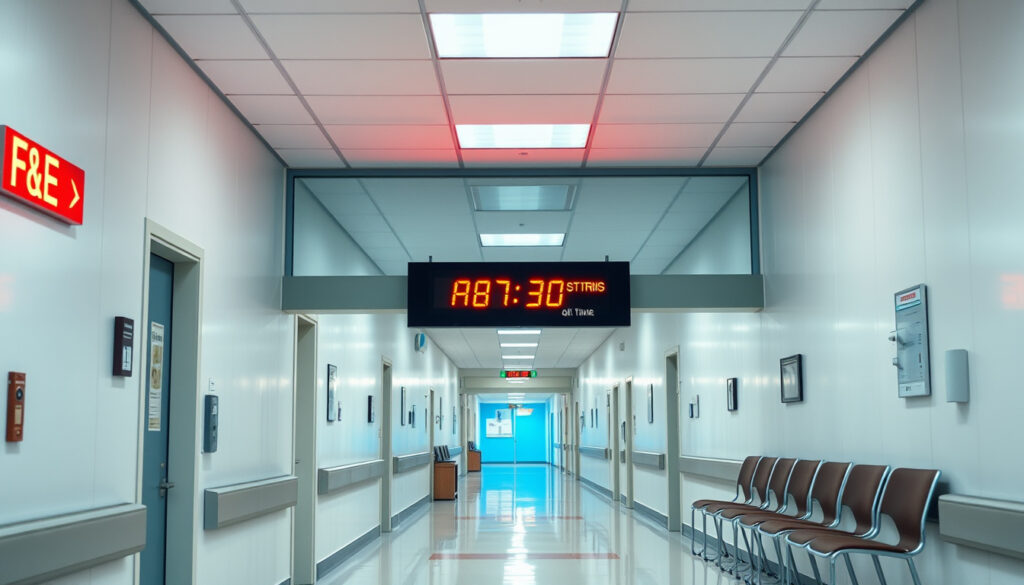
Nearest A&E: Costs, Wait Times & How to Get Seen Faster
Few moments in daily life feel as urgent as needing to find the nearest emergency department — fast, whether it’s a sudden chest pain, a deep cut, or a child who’s taken a nasty fall. From the €100 charge in Ireland to the 2222 code for cardiac arrest, this guide walks through costs, waiting times, and practical tips to help you decide when to head to A&E — and how to get seen sooner.
A&E charge without referral (Ireland): €100 ·
A&E charge with GP referral or medical card: Free ·
Emergency code 2222 (hospital cardiac arrest): Immediate call ·
NHS 111 line: alternative to A&E for non-life-threatening issues: Available 24/7
Quick snapshot
- Use the HSE online finder or the NHS site to locate your nearest emergency department (HSE (Ireland’s health service))
- Search by town or postcode for hospital contact details and opening hours (nidirect (Northern Ireland government))
- Most A&E departments are open 24/7; check before travelling (NI Department of Health)
- Live waiting times are published for Northern Ireland EDs to help you decide (Northern Trust waiting times)
- €100 charge for A&E attendance in Ireland without a medical card or GP referral letter (Children in Hospital Ireland (patient guidance))
- No charge if you have a full medical card or a GP/injury unit referral (Children in Hospital Ireland (patient guidance))
- Children under 18 with a medical card are also exempt from the fee (Children in Hospital Ireland (patient guidance))
- HSE daily trolley counts show 335 patients on trolleys, with 65 waiting over 24 hours (HSE (Ireland’s health service))
- Go to A&E or call 999 for chest pain, severe bleeding, difficulty breathing, unconsciousness, or severe allergic reactions (NHS (UK government health service))
- These symptoms are medical emergencies and should not be ignored (NHS (UK government health service))
- For minor issues, consider a minor injury unit, GP out-of-hours, or NHS 111 first (NHS (UK government health service))
- If you are unsure, call 111 or check online triage tools before travelling (NHS (UK government health service))
- Call NHS 111 first for non-life-threatening conditions; they can book you an appointment at an ED or urgent care centre (NHS (UK government health service))
- Use the NHS 111 online triage tool to get a same-day assessment (NHS (UK government health service))
- Check live waiting times online for Northern Ireland EDs before you go (nidirect (Northern Ireland government))
- ED waiting times are based on clinical priority; urgent cases are seen sooner (HSE (Ireland’s health service))
Five key facts about A&E costs and timing, one pattern: the difference between a directed visit and a self-referral can save you time and money.
| Label | Value |
|---|---|
| A&E charge without referral (Ireland) | €100 |
| A&E charge with GP referral or medical card | Free |
| Emergency code 2222 (hospital cardiac arrest) | Immediate call |
| NHS 111 line | Available 24/7 for non-life-threatening issues |
| Target A&E wait time (UK NHS) | 95% seen within 4 hours |
Can I go to A&E without a referral?
Yes, you can attend an A&E department without a GP referral, but only for serious, life-threatening conditions. However, if you walk in without a referral letter, a medical card, or a GP/injury unit referral, you will face a €100 charge in Ireland (Children in Hospital Ireland (patient guidance)).
What if I have a medical card?
If you hold a full medical card or have a GP referral letter, the A&E charge is waived entirely (Children in Hospital Ireland (patient guidance)). That applies to both adults and children under 18.
What is the €100 charge?
The €100 charge is a standard fee for attending an emergency department in Ireland without a referral. It applies to all public A&E departments. The fee is waived automatically if you present a GP referral, a medical card, or a minor injury unit referral (Children in Hospital Ireland (patient guidance)).
For anyone without a medical card, the €100 fee is a strong nudge to call your GP first. But in a true emergency, don’t let the price stop you — go straight in.
The catch: While self-referral is allowed, it costs more and can lead to longer waits if your condition is not triaged as urgent. A GP referral effectively pre-triages you, often leapfrogging non-referred patients.
How to get seen quicker in A&E?
One of the most effective ways to reduce A&E waiting time is to call NHS 111 before you go. The service is available 24/7 for non-life-threatening conditions and can direct you to the right care — often booking you into an emergency department appointment (NHS (UK government health service)).
Should I call NHS 111 first?
Yes — if your condition is not a life-threatening emergency, calling NHS 111 first can save you a long wait. A 2024 FAQ from the Royal College of Emergency Medicine states that NHS 111 First helps triage patients and direct them to the appropriate service (RCEM (Royal College of Emergency Medicine)).
What is NHS 111 First?
NHS 111 First is a service that lets you get an appointment at an emergency department or urgent treatment centre. You call 111 or use the online triage tool, and the clinician may book a specific time slot for you, reducing your waiting time (NHS (UK government health service)).
“Calling 111 first means you get a clinical assessment over the phone, and if you need to go to A&E, they can often book a timed arrival. That beats sitting in a waiting room for hours without knowing when you’ll be seen.”
— Healthwatch Sutton (patient advocacy group)
For patients with non-urgent conditions, NHS 111 First can cut the average A&E wait from several hours down to the time of your appointment. For the NHS, it reduces overcrowding.
The pattern: Patients who use 111 first are seen faster because they’ve already been triaged. Those who walk in cold are sorted by clinical priority, which may mean a long wait for less urgent cases.
Should I go to A&E with chest pain?
Yes — chest pain is a medical emergency. You should go to A&E immediately or call 999. The NHS advises that chest pain, especially if it’s sudden, crushing, or spreading to the arm or jaw, requires emergency assessment (NHS (UK government health service)).
What are other symptoms requiring emergency care?
- Severe bleeding that doesn’t stop (NHS (UK government health service))
- Difficulty breathing or sudden shortness of breath (NHS (UK government health service))
- Unconsciousness fits or seizures (NHS (UK government health service))
- Severe allergic reactions with swelling or breathing difficulty (NHS (UK government health service))
When should I call 999 instead?
Call 999 if the person is unconscious, not breathing, has severe chest pain, or is bleeding uncontrollably. For less severe symptoms, consider NHS 111 first (NHS (UK government health service)).
Time is muscle in a heart attack. If you have chest pain and drive yourself to A&E, you lose the on-scene care that an ambulance provides. Calling 999 can be the faster, safer choice.
The implication: Chest pain is never a wait-and-see symptom. Even if it turns out to be indigestion, it’s far better to be told that in an ED than to risk a heart attack at home.
How much does an A&E visit cost in Ireland?
A standard A&E attendance in Ireland costs €100 if you arrive without a GP referral, a medical card, or an injury unit referral. The fee is waived for anyone with a full medical card or a GP referral letter (Children in Hospital Ireland (patient guidance)).
Are there charges for children?
Children under 18 with a medical card are exempt from the €100 charge. Children without a medical card may still be charged, though many hospitals waive it automatically for paediatric attendances (Children in Hospital Ireland (patient guidance)).
What about private A&E costs?
Private A&E departments in Ireland, such as those at Blackrock Health or the Hermitage Clinic, charge separately. Costs are not standardised; contact the private hospital directly for fee details. In Northern Ireland, NHS A&E is free at the point of use for all residents (NI Department of Health).
Here is how public and private A&E compare.
| Factor | Public A&E (HSE) | Private A&E |
|---|---|---|
| Referral needed | No, but €100 fee without GP or medical card | No, but expect higher charges |
| Typical charge | €100 (waivable) | €200–€400+ depending on hospital |
| Waiting time | Hours to half-day (based on triage) | Often shorter (fewer patients) |
| Medical card accepted | Yes – fee waived | Usually not; pay upfront |
What this means for you: If you have a medical card or GP referral, public A&E is the cheapest and easiest route. Without either, a private A&E might get you seen faster but at a higher cost. In Northern Ireland, NHS A&E is free, so there’s no charge barrier.
The takeaway: Knowing the cost structure before you go can save both money and time.
How long is it normal to wait in A&E?
Waiting times vary widely by hospital, time of day, and how urgent your condition is. In the UK, the NHS target is for 95% of patients to be seen within 4 hours, though many EDs currently fall short of this (NI Department of Health (government health authority)). In Northern Ireland, as of 7 May 2026, median waiting times ranged from 77 minutes at Causeway Area Hospital to 254 minutes at Royal Victoria Hospital (nidirect (Northern Ireland government)).
What factors affect waiting times?
- Clinical priority: urgent cases (e.g., heart attack, stroke) are seen immediately; less urgent patients wait longer (HSE (Ireland’s health service))
- Time of day: evenings and weekends are busiest
- Hospital capacity: number of beds, staff, and delayed transfers of care (539 in Ireland on a recent day) (HSE (Ireland’s health service))
Can I check live waiting times?
Yes. Northern Ireland’s nidirect website publishes live median waiting times for all EDs. The HSE also provides daily trolley counts and waiting lists for outpatient specialties, updated monthly (HSE (Ireland’s health service)).
Having real-time waiting data empowers patients to choose a less busy ED, but it also risks overwhelming smaller hospitals as patients flock to shorter wait times. The system works best when everyone knows their local options.
The pattern: In Northern Ireland, median waits under 2 hours are possible at smaller hospitals like Causeway, but the main Belfast hospitals often see 3-4 hour waits. In Ireland, 335 patients on trolleys on a given day shows that overcrowding is chronic.
Comparison: A&E vs Minor Injury Unit vs GP Out-of-Hours
Three options exist for urgent but non-life-threatening care. Here is how they stack up.
| Factor | A&E (Emergency Department) | Minor Injury Unit (MIU) | GP Out-of-Hours |
|---|---|---|---|
| What they treat | Life-threatening emergencies, chest pain, serious injuries | Sprains, minor fractures, cuts, burns, bites | Infections, rashes, stomach bugs, prescriptions |
| Charge (Ireland) | €100 without referral (free with GP/medical card) | Free (HSE centres) or small fee | Typically free with medical card; €60-100 without |
| Typical wait | Hours | 30-90 minutes | 1-3 hours (call-back system) |
| Appointment needed? | No | No | Usually call ahead |
| Best for | True emergencies | Minor injuries like ankle sprains | Non-injury illnesses |
The trade-off: Using an MIU or GP out-of-hours for minor issues frees up A&E for emergencies and gets you seen faster. For chest pain or severe bleeding, skip the MIU and go straight to A&E or call 999.
Pros and Cons of Different A&E Access Strategies
Upsides
- Calling NHS 111 first can book you a timed A&E appointment, reducing wait
- Having a GP referral letter waives the €100 fee in Ireland
- Checking live waiting times allows you to choose a less crowded ED
- Minor injury units treat many conditions faster and for free
Downsides
- Self-referral to A&E costs €100 in Ireland with no guarantee of quick care
- Waiting times in EDs can exceed 4 hours even for non-critical cases
- Private A&E fees are unpredictable and often not covered by basic insurance
- Misjudging your condition may send you to the wrong facility, wasting time
The implication: Each strategy has trade-offs; the best approach depends on your condition, location, and insurance status.
How to Find the Nearest A&E: Step-by-Step
- Assess your symptoms: Life-threatening (chest pain, severe bleeding) → call 999 immediately. Non-urgent (sprain, mild fever) → consider GP or NHS 111 first.
- Call NHS 111 (UK) or HSE (Ireland) if unsure: 111 will triage and may direct you to an A&E with a booked time (NHS (UK government health service)).
- Use online finders: HSE website (HSE (Ireland’s health service)) or nidirect (nidirect (Northern Ireland government)) list all EDs with addresses.
- Check live waiting times: For NI, see nidirect page for median waits; for Ireland, use HSE trolley count data to gauge busyness.
- Bring necessary documents: If you have a medical card or private insurance card, bring it. Also ID and any medication list.
- If driving, use GPS to the nearest ED: Ensure you have the postcode or Eircode. In Northern Ireland, EDs are clearly signposted.
The method: Following these steps can reduce confusion and speed up care.
For route planning, see our guide on Travel Directions by Car: Best Route Planners 2026. And for finding other local services, check Royal Mail Near Me: Drop Offs, Lockers & Post Offices.
Confirmed Facts vs What’s Unclear
Confirmed Facts
- €100 charge for A&E in Ireland without referral (Children in Hospital Ireland (patient guidance))
- Medical card holders and those with GP referral are exempt (Children in Hospital Ireland (patient guidance))
- Chest pain is a medical emergency requiring A&E (NHS (UK government health service))
- Code 2222 is used for cardiac arrest in hospitals
- NHS 111 can redirect to appropriate urgent care (NHS (UK government health service))
What’s Unclear
- Exact waiting times vary by hospital and time of day
- Private A&E costs are not standardised across hospitals
- Future changes to A&E charges after 2026 are not yet confirmed
The distinction: Understanding what is certain versus variable helps set realistic expectations.
What They Say: Expert Perspectives
“Calling 111 first means you get a clinical assessment over the phone, and if you need to go to A&E, they can often book a timed arrival. That beats sitting in a waiting room for hours without knowing when you’ll be seen.”
— Healthwatch Sutton (patient advocacy group)
“If you have chest pain, do not wait. Call 999 or go to your nearest emergency department immediately. Time is muscle.”
— NHS (UK government health service) guidance
“The €100 A&E charge is in place to discourage non-urgent use, but anyone with a genuine emergency should never let cost deter them from attending.”
— HSE (Health Service Executive, Ireland)
The consensus: Experts agree that timely assessment and appropriate access are critical, and that costs should never delay emergency care.
The Bottom Line: What to Take Away
Knowing where your nearest A&E is, how much it costs, and whether you need a referral can save you time, money, and stress. The single most impactful action is to call NHS 111 (in the UK) or your GP (in Ireland) before you go, unless it’s a clear emergency. For the resident of Dublin without a medical card, the choice is clear: call a GP or injury unit first to avoid the €100 fee, or head straight to A&E if the symptoms are severe. For the family in Belfast, live waiting times are available — use them to pick the least crowded ED.
For a detailed breakdown of costs and wait times, check out this guide on nearest A&E departments and wait times.
Frequently Asked Questions
What is the difference between A&E and a minor injury unit?
A&E (Emergency Department) treats life-threatening conditions like chest pain, severe bleeding, and unconsciousness. Minor Injury Units (MIUs) handle sprains, minor fractures, cuts, and burns. MIUs are often faster and cheaper for non-serious injuries.
Can I go to a private A&E without insurance?
Yes, but you will be expected to pay upfront. Private A&E charges vary widely (€200–€400+). Contact the private hospital directly for a quote before attending.
Do I need to bring identification to A&E?
It is recommended to bring photo ID and your medical card or private insurance card if you have one. It helps registration and billing.
Can I go to A&E if I am not registered with a GP?
Yes. You can attend any A&E in the UK or Ireland without being registered with a GP. You will still receive emergency care. In Ireland, you may be charged €100 if you don’t have a GP referral.
What should I do if I am unsure whether to go to A&E?
Call NHS 111 (UK) or your local GP out-of-hours service (Ireland). They can assess your symptoms and direct you to the most appropriate care, whether that’s A&E, a minor injury unit, or a pharmacy.
Are children treated differently at A&E?
Children are assessed and treated in paediatric areas within many EDs. They are prioritised for paediatric emergencies. Children with medical cards are exempt from the €100 charge in Ireland.
How can I check live A&E waiting times?
In Northern Ireland, visit the nidirect website for live median waiting times per hospital. The HSE website publishes daily trolley counts. Some third-party apps also aggregate data.
Final note: Use these answers as a starting point; always confirm with local health services for the most current information.
More related posts
 Tina Malone: Brookside, Shameless, and Life Now
 Trent Alexander-Arnold: Real Madrid’s No. 12 & LaLiga Rules
 Hemsworth Brothers: Number, Ages & Forgotten Brother
 DNA Test Cost and Accuracy in Ireland: A Guide
 Bob Ross: Final Words, Cause of Death, Painting Prices & Legacy
 Blake Shelton: Age, Wife, Children, and Latest News
 British Gas Business Login: Official Guide & Access
 Ruben Loftus-Cheek: AC Milan Midfielder Stats, Career
