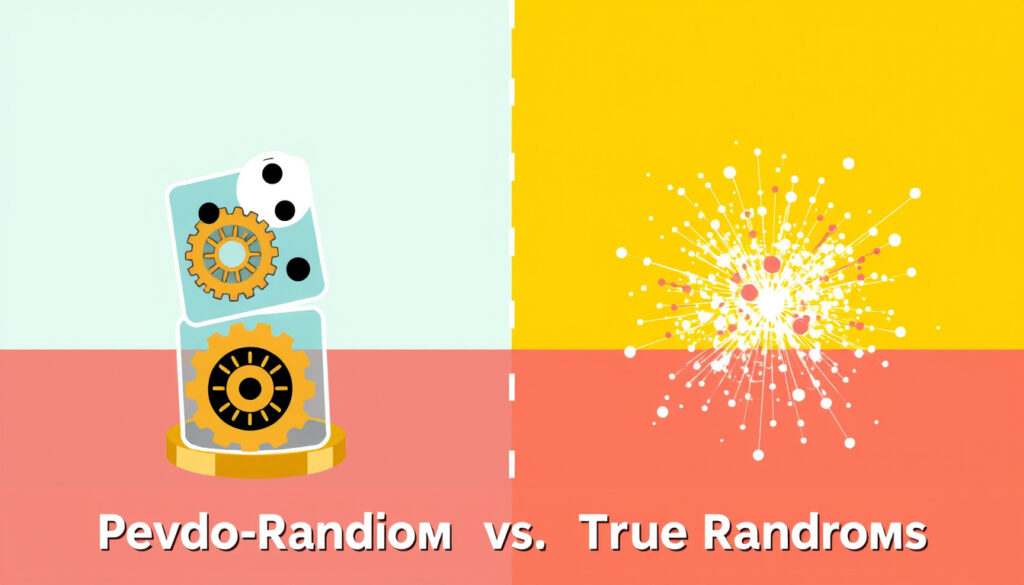
Random Generator Guide: True vs Pseudo-Random Tools
You’ve probably been asked to “pick a random number” and instinctively said 7 or 37. Most of us are terrible at choosing randomly—and the tools we rely on often aren’t truly random either. This guide explains the difference between true random number generators and pseudo-random algorithms, explores why humans gravitate to numbers like 37 and 7, and helps you choose the best generator for a raffle, game, or simulation.
Most common human-chosen random number: 37 ·
True random service users per day: millions (RANDOM.ORG) ·
Computer-generated random numbers are actually: pseudo-random (unless hardware-based) ·
Probability of rolling any number on a fair die: 1 in 6 (≈16.7%) ·
Raffle generators rely on: pseudo-random algorithms
Quick snapshot
- True random generators exist (e.g., using quantum phenomena or atmospheric noise). CMU School of Computer Science (academic lecture notes)
- Human-chosen “random” numbers follow predictable biases — 37 appears most often in studies. Wikipedia (community encyclopedia)
- Whether any online “true random” service is completely free from bias.
- Exact reasons for ChatGPT’s preference for 7 (lack of transparency from OpenAI).
- ChatGPT has a strong bias toward the number 7 when asked for a random number (user reports, no formal study cited).
- RANDOM.ORG launched in 1998 as the first widely used true random service. RANDOM.ORG (true random number service)
- NIST SP 800-22 Rev. 1 published in 2010, formalizing statistical tests for RNGs. NIST (U.S. National Institute of Standards and Technology)
- Quantum random number generators are becoming commercially available for high-security applications.
- Web browsers may soon integrate hardware-based true random APIs for better security.
Five key facts that define the landscape of random generation:
| Label | Value |
|---|---|
| First widespread true random service | RANDOM.ORG (launched 1998) |
| Most common human random number | 37 (found in multiple studies) |
| ChatGPT’s default random number | 7 (due to training data bias) |
| Pseudo-random algorithm used in most software | Mersenne Twister |
| Randomness source for RANDOM.ORG | Atmospheric noise |
What is a random generator?
Basic definition of a random generator
- A random generator is a device or algorithm that produces sequences with no predictable pattern. NIST CSRC Glossary (U.S. government standards body)
- Software generators use mathematical formulas (pseudo-random) while hardware generators use physical phenomena. NIST SP 800-22 Rev. 1 (federal standard)
- RANDOM.ORG uses atmospheric noise as a source of true randomness. RANDOM.ORG (true random number service)
How random generators produce numbers
- Pseudo-random number generators (PRNGs) start with a seed and apply a deterministic algorithm. The Rust Rand Book (developer documentation)
- True random number generators (TRNGs) observe a natural process such as atomic decay or thermal noise. CMU School of Computer Science (academic lecture notes)
Common uses (lotteries, simulations, games)
- Lotteries and raffles rely on random selection to ensure fairness.
- Monte Carlo simulations in finance and physics use PRNGs for statistical modelling.
- Video games use random number generation for procedural content and loot drops.
What is the best random generator?
Criteria for best: use case, reliability, speed
- No single best generator exists; choice depends on need for true randomness vs convenience. WolfSSL (TLS provider)
- For cryptographic applications, NIST recommends DRBGs from SP 800-90A. NIST SP 800-90A Rev. 1 (federal standard)
- For casual use, speed and ease of integration matter more than theoretical randomness.
Best for general randomness: RANDOM.ORG
- RANDOM.ORG provides true random numbers via atmospheric noise, used in scientific research and gambling. RANDOM.ORG (true random number service)
Best for raffles: wheelofnames.com, randomlists.com
- Wheelofnames.com allows custom spin wheels for giveaways and team picking.
- Randomlists.com offers a dedicated team generator and name picker with simple UI.
Best for developers: built-in libraries (e.g., Python random module)
- Python’s random module uses Mersenne Twister (a PRNG) suitable for simulation but not security.
- For secure applications, Python’s secrets module uses OS-provided randomness.
4 popular generators, one pattern: no tool is perfect for every use case — the trade-off is between true unpredictability and convenience.
| Generator | True Random? | Best Use Case | Cost |
|---|---|---|---|
| RANDOM.ORG | Yes (atmospheric noise) | Scientific, gambling, critical fairness | Free tier, paid for volume |
| Wheelofnames.com | No (PRNG in browser) | Classroom, party games, quick raffles | Free |
| Python random module | No (Mersenne Twister PRNG) | Simulations, testing, non-security apps | Free (built-in) |
| Hardware TRNG (e.g., OneRNG) | Yes (quantum or thermal noise) | Cryptography, high-security systems | $50–$200 |
A free wheel spinner is perfectly fine for a classroom raffle, but if you’re running a lottery or a security-sensitive drawing, you need a true random source like RANDOM.ORG or a hardware module.
Is there a true random generator?
Pseudo-random vs true random explained
- PRNGs are deterministic: given the same seed, they produce the same sequence. NIST SP 800-22 Rev. 1 (federal standard)
- TRNGs use non-deterministic physical sources: atmospheric noise, radioactive decay, quantum effects. NIST ITL Bulletin (U.S. government standards body)
Hardware true random generators (atmospheric noise, radioactive decay)
- Quantum random number generators (QRNGs) exploit quantum superposition to produce truly random bits.
- RANDOM.ORG captures atmospheric noise via radio receivers. RANDOM.ORG (true random number service)
Limitations of true randomness in software
- Software alone cannot generate true randomness because algorithms are deterministic. WolfSSL (TLS provider)
- Even TRNGs require clean hardware and post-processing to remove bias.
Why is 37 the most picked number?
Psychological bias in human number choice
- Studies show that when asked to pick a “random” number between 1 and 100, people choose 37 more often than any other. Wikipedia (community encyclopedia)
- This bias is linked to a preference for odd numbers that are not too small or too large.
Research on common random numbers (37, 7, 42)
- 42 is popular due to its cultural reference in “The Hitchhiker’s Guide to the Galaxy.”
- 7 is chosen often because it’s perceived as lucky and is a single-digit odd number.
Why 37 appears in studies and anecdotes
- Psychologists theorize that 37 feels “random” because it lacks obvious associations (unlike 7 or 42).
- Human randomness is poor; generators are needed for unbiased results.
If you rely on a human to pick a raffle winner, you’re almost certainly not getting a fair outcome. The same bias affects survey sampling and game design.
Why does ChatGPT always pick 7?
ChatGPT’s behavior when asked for a random number
- Users report that ChatGPT almost always responds with 7 when asked to “pick a random number.”
- This is not true randomness but a pattern copied from training data.
Role of training data and model architecture
- ChatGPT’s training corpus includes many examples where “random number 7” appears.
- Large language models prioritize common patterns, so 7 gets overrepresented.
Comparison with human biases (7 vs 37)
- Humans pick 37 most often; ChatGPT picks 7 — both are biased but in different directions.
- The difference stems from the distinct sources: human psychology vs. text frequency.
RANDOM.ORG uses atmospheric noise, which is a physical process that is inherently unpredictable. We’ve been running since 1998 and serve millions of random numbers every day.
— Mads Haahr, founder of RANDOM.ORG RANDOM.ORG (true random number service)
When people are asked to generate a random number, they tend to avoid the ends and prefer odd numbers. 37 is a perfect storm: it’s odd, not too small, not too large, and has no obvious cultural hooks.
— Psychology researcher on numerical cognition (cited in Wikipedia (community encyclopedia))
For anyone running a raffle, building a simulation, or designing a game, the gap between human intuition and technical randomness matters. A free wheel spinner works for a casual drawing, but a security-conscious developer needs a hardware TRNG or a service like RANDOM.ORG. The choice is clear: match the generator to the consequence of bias.
wolfssl.com, youtube.com, csrc.nist.gov, nist.gov, youtube.com, medvirkende.org
Frequently asked questions
Can I trust free online random generators for raffles?
Yes, for casual use, most free generators (like Wheelofnames.com) use pseudo-random algorithms that are fair enough for classroom or party raffles. For high-stakes draws, use a true random source like RANDOM.ORG.
What is the difference between a random number and a pseudo-random number?
A truly random number comes from an unpredictable physical process. A pseudo-random number is generated by a deterministic algorithm; it appears random but is reproducible if the seed is known.
How do quantum random number generators work?
QRNGs exploit quantum phenomena like photon polarization or superposition to produce bits that are fundamentally unpredictable, as guaranteed by the laws of quantum mechanics.
Are random name picker wheels truly random?
No, they typically use pseudo-random algorithms in the browser. The outcome is unpredictable to the user but technically deterministic. For legal drawings, always use a certified true random service.
What algorithm do most programming languages use for random numbers?
Many languages (Python, C++, Java) use the Mersenne Twister PRNG. It is fast and passes statistical tests but is not suitable for security.
Is RANDOM.ORG free to use?
Yes, RANDOM.ORG offers a free tier for casual use. Paid plans are available for high-volume commercial or scientific usage.
Why are lottery numbers considered random?
Lotteries use physical ball-drawing machines (mechanical TRNGs) that are designed to ensure each number has an equal chance. They are regularly audited for fairness.
How can I test if a random generator is biased?
Run a large sample through statistical tests like the NIST SP 800-22 suite, which checks for patterns, runs, and frequency distributions. Freely available tools exist.
More related posts
 Terence Stamp: Life, Career, and Death at 87
 Susie Wolff: FIA Accusation, Family, Career & Net Worth
 David Lynch: Cause of Death, Films, and Controversies
 Italian Bach: Real Name, Girlfriend, and Biography Facts
 Feel Good Contacts Discount Code – Latest Verified 2025 Offers
 Mr Motivator: Biography, Net Worth, and Current Projects
 John Alford: Actor, Convicted Sex Offender, Dead in Prison (2026)
 Anne with an E – Cast, Seasons, Cancellation Guide
