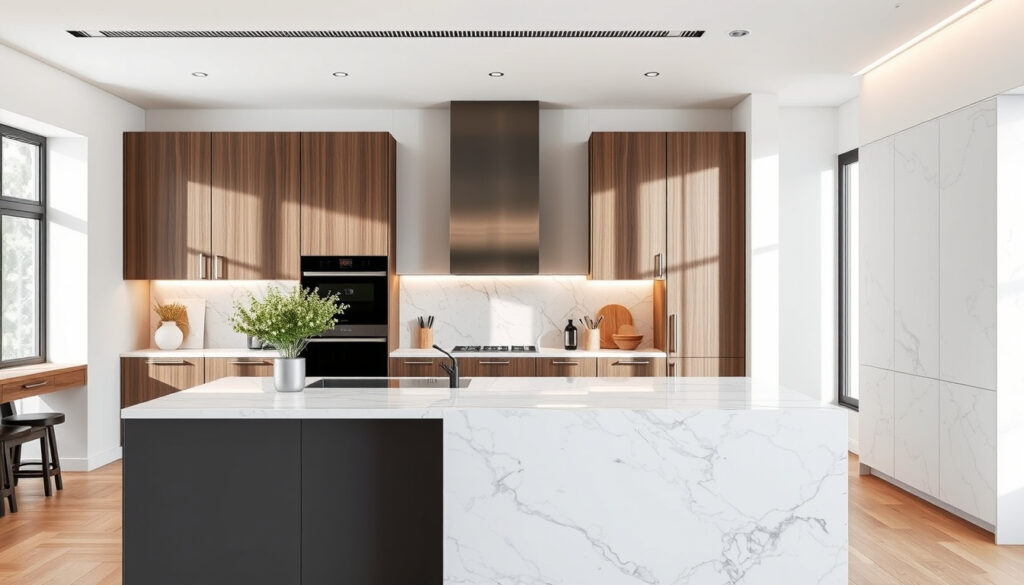
Kitchen Worktop Guide 2026: Costs, Trends & Best Materials
Choosing a kitchen worktop is one of those decisions that feels permanent – and in many ways it is, with prices ranging from €50 per linear metre for laminate to over €600 for natural stone. When trends shift and new materials like sintered stone enter the picture, this guide cuts through the noise for Irish homeowners, comparing costs, durability, and style options so you can make a confident decision for your 2026 kitchen project.
Average worktop replacement cost (Ireland): €1,200–€3,500 · Most affordable worktop material: Laminate at €50–€150 per linear metre · 2026 trend: fastest growing material: Sintered stone / porcelain slabs · IKEA worktop warranty period: 25 years · DIY installation feasibility: Possible for laminate, not recommended for stone or quartz
Quick snapshot
- Laminate is the cheapest worktop material at €50–€150 per linear metre (A Loco Kitchens (Dublin kitchen specialist))
- Quartz is non-porous and does not require sealing (A Loco Kitchens (Dublin kitchen specialist))
- Granite needs sealing every 12–18 months (Worktops Ireland (Irish worktop supplier))
- IKEA offers a 25-year warranty on all kitchen work surfaces (IKEA Ireland (official warranty page))
- Exact price elasticity of worktop demand in Ireland for 2026 remains untracked in published data
- Whether DIY installation rates will rise with inflation is uncertain; no reliable survey exists yet
- 2024: Sintered stone and Dekton begin to displace quartz in high-end specifications
- 2025: Matte and textured finishes become the dominant design preference over gloss
- 2026: Thin-profile worktops (12–15mm) expected to lead trend cycles; warm earth tones replace cool greys
- Porcelain slab worktops continue to gain popularity, starting at about €400 per linear metre (A Loco Kitchens (Dublin kitchen specialist))
- 2026 renovation budgets in Ireland are expected to rise, with premium kitchens reaching €45,000+ (RenovationCosts.ie (Irish renovation cost tracker))
The table below summarises the key differences between common worktop materials.
| Material | Lifespan | Sealing requirement | DIY possible? | Price per linear metre |
|---|---|---|---|---|
| Laminate | 10–15 years | None | Yes | €50–€150 |
| Quartz | 25+ years | None | No | €300–€500 |
| Granite | 25+ years | Every 12–18 months | No | €350–€600 |
| Sintered stone | Lifetime | None | No | €400–€700 |
| Solid wood | 20–30 years (refinishable) | Oil/sealant every 1–2 years | Yes, with skill | €150–€300 |
What is the best worktop to have in a kitchen?
No single material wins across every measure, but quartz comes closest: it combines high durability with low maintenance and a wide aesthetic range. For budget-conscious homes, laminate remains the sensible choice. The table above lays out the trade-offs.
Durability and maintenance comparison
- Quartz is non-porous and resists stains without sealing (A Loco Kitchens)
- Granite requires annual sealing – a routine many owners neglect, leading to staining (Worktops Ireland)
- Solid wood can be sanded and refinished but is vulnerable to water damage if not oiled regularly (A Loco Kitchens)
Heat and scratch resistance by material
- Laminate: low heat resistance – hot pans cause permanent damage
- Quartz: heat resistant up to 150°C but can crack under extreme direct heat
- Granite: excellent heat resistance – withstands hot pans directly (Self-Build Hub (Irish planning & renovation guide))
- Sintered stone: extremely heat resistant, even to 300°C (Worktops Ireland)
Cost versus longevity trade-offs
Laminate costs €50–€150 per linear metre and lasts 10–15 years – a short-term saving. Quartz costs €300–€500 per linear metre but lasts 25+ years, making its cost-per-year lower in the long run. Granite sits between €350–€600 per linear metre with similar longevity. The pattern: spending more upfront on engineered stone often pays back over decades.
Laminate may save €1,500 upfront in a typical 3m kitchen, but a single water-damaged seam can cost €500 to repair – potential savings vanish if your sink area isn’t perfectly sealed.
The implication: for most homeowners, quartz offers the best compromise between upfront cost and long-term value.
What are the countertop trends for 2026?
Sintered stone and porcelain rise in popularity
Porcelain slab worktops are currently popular and start at about €400 per linear metre (A Loco Kitchens). Sintered stone (Dekton being the main brand) is predicted to be the 2026 trend leader, displacing quartz in high-end specifications. Unlike quartz, it is UV stable and does not yellow outdoors – though for indoor kitchens the advantage is primarily aesthetic.
Thin-profile worktops gain traction
Ultra-thin slabs (12–15mm) are a design trend for 2026, offering a minimalist look that suits contemporary and industrial kitchens. These thin profiles require very flat base cabinets and professional installation – not a DIY candidate.
Matte finishes and neutral earth tones dominate
“Warm beige, taupe, and charcoal replace stark white,” notes an interior design trend analysis. Matte finishes hide fingerprints better than gloss and pair well with brass or matte black hardware. Homeowners tiling backsplashes in 2026 should expect worktops with tactile rather than reflective surfaces.
If you’re planning a kitchen replacement in 2026, specifying a thin sintered stone slab in a warm earth tone will put you ahead of the trend curve – but budget accordingly: these start at €3,500 fitted for a standard kitchen (Worktops Ireland).
The pattern: the shift to natural, tactile materials means investing in a thin sintered stone slab in a warm neutral will keep your kitchen looking current for the next decade.
How much does it cost to replace kitchen worktops in the UK and Ireland?
The total cost for a worktop replacement in Ireland ranges from €1,000 for a basic laminate fit to over €10,000 for a bespoke stone installation. Breaking it down by material and labour shows where the money goes.
Material-specific cost breakdown
- Laminate: €50–€150 per linear metre – material only (A Loco Kitchens)
- Solid wood: €150–€300 per linear metre (A Loco Kitchens)
- Quartz: €300–€500 per linear metre (A Loco Kitchens)
- Natural granite (Irish quarries): €350–€600 per linear metre (A Loco Kitchens)
- Porcelain / sintered stone: from €400 per linear metre (A Loco Kitchens)
Installation labour costs
Professional installation for laminate worktops typically adds €300–€600 in Ireland. For quartz or granite, fabrication and fitting can double the material cost – expect €1,500–€3,000 for a standard 3m kitchen. Removing the old worktop adds roughly €200–€400.
Supplier price comparison (Ireland)
- IKEA Ireland: Saljan laminate worktop ~€65 per 2.46m length; Kungs back oak ~€170 per length. 25-year warranty covers work surfaces (IKEA Ireland)
- Woodie’s: Laminate worktops from €79 per 3m length; limited stone selection
- Worktops Ireland (Dublin): Fitted quartz from €2,200, granite from €2,500, Dekton from €3,500 for a standard kitchen (Worktops Ireland)
- A Loco Kitchens (Dublin): Laminate at €800–€2,000 for a typical 8–10 m² kitchen (A Loco Kitchens)
What this means: even with higher material cost, quartz often provides better long-term value due to its durability and resale appeal.
Which is better: laminate or quartz?
This is the most common debate in Irish kitchen forums. Six key differences break the tie.
| Aspect | Laminate | Quartz |
|---|---|---|
| Price per linear metre (fitted) | €100–€250 | €400–€700 |
| Lifespan | 10–15 years | 25+ years |
| Water resistance | Seams vulnerable; wicking possible | Seamless, non-porous |
| Heat Resistance | Poor – trivet always required | Good – up to 150°C, but avoid direct pans |
| Repairability | Damaged sections can be replaced but colour match hard | Seam repair by stone specialist possible |
| DIY suitability | Yes – with basic tools | No – requires specialist fabrication |
Five differences, one pattern: quartz wins on durability and maintenance, laminate wins on price and DIY-friendliness. The choice depends on how long you plan to stay in the house. If you’re selling within 5 years, laminate returns acceptable value. If this is your forever kitchen, quartz pays back over two decades.
Laminate worktops with an undermount sink require a perfect seal – one missed bead of silicone can lead to water wicking that ruins the board. Quartz eliminates that risk entirely because it is non-porous and fabricated as a single piece around the sink (A Loco Kitchens).
The catch: while laminate may seem cheaper, potential water damage can erase the savings.
Upsides
- Laminate: unbeatable cost, variety of colours, DIY installation saves up to 40%
- Quartz: stain-proof, scratch-resistant, no sealing, lifetime durability
Downsides
- Laminate: seam water damage, heat sensitivity, cannot be refinished
- Quartz: expensive, requires professional fitting, not heat-proof to 200°C+
The implication: evaluate your lifestyle and timeline before committing to either material.
Should a countertop be lighter or darker than the floor?
Design principles for contrast
Interior designers generally recommend contrast between floor and worktop – it creates visual separation and defines zones in open-plan kitchens. A dark floor (e.g., walnut wood or dark tile) pairs well with a light worktop (white quartz or warm laminate). The opposite also works: light floors with dark worktops (charcoal sintered stone or black granite).
Room size and lighting considerations
- Small kitchens or those with limited natural light: lighter worktops reflect light and make the space feel larger. Matching a light floor with a light worktop can work if the cabinetry provides contrast.
- Large, well-lit kitchens: darker worktops add drama and anchor the room.
Common mistakes to avoid
- Matching the worktop colour exactly to the floor colour – this flattens the room
- Choosing a very dark worktop in a north-facing kitchen – it can feel gloomy
- Ignoring the undertones: warm floor + cool worktop (or vice versa) creates disharmony
The pattern: contrast creates visual interest while maintaining harmony through undertones.
What makes a kitchen look outdated?
Old worktop materials and finishes
- Oak laminate with heavy wood grain – ubiquitous in the 1990s, now signals age
- Beige or cream granite with speckled pattern
- Highly polished gloss worktops that show every fingerprint
Colour combinations that date a kitchen
“Dark speckled patterns are out of fashion” according to trend observers. Also date markers: yellow-toned beige worktops with honey-coloured timber cabinets, or stark white with blue flecks.
Hardware and edge details to avoid
- Square, builder-grade edges on laminate – a rounded or beveled edge looks more modern
- Brass or gold fixtures with a Chrome worktop – mixed metals need intentional pairing
If your current worktop is oak laminate with a square edge, replacing it with a matte quartz or solid wood in a warm tone can modernise the entire kitchen for a fraction of a full renovation cost.
The implication: updating just the worktop can transform the kitchen’s overall aesthetic without a full remodel.
Can I replace a kitchen worktop myself?
Tools and skills required
Laminate worktops can be cut with a circular saw and straightedge, but you need a router to create finished edges. A decent mitre saw for joins is also helpful. Skills needed: measuring twice, cutting straight, applying silicone correctly, and clamping joint connectors.
Risks of DIY for different materials
- Laminate: moderate risk – mistakes can be fixed by replacing sections, but seams are tricky
- Solid wood: moderate – cutting is easier, but finishing and oiling must be perfect to avoid water absorption
- Quartz and stone: high risk – requires diamond blades, water jets, and lifting equipment; a crack ruins the slab
When to hire a professional
If you are fitting quartz, granite, sintered stone, or a large solid wood worktop, hire a specialist. DIY installation for stone is not recommended – fabrication alone can exceed €1,500 in replacement costs if you crack a slab. For laminate, a confident DIYer can save up to 40% of the total project cost (RenovationCosts.ie).
The catch: even for laminate, a professional sink cut-out is often worth the cost to avoid water damage.
Timeline: where worktop trends are heading
The table below outlines the expected trend progression.
| Year | Trend | Driven by |
|---|---|---|
| 2024 | Sintered stone and Dekton begin to displace quartz in high-end specifications | Manufacturer innovation, designer preference |
| 2025 | Matte and textured finishes become dominant over gloss | Consumer backlash against fingerprints, easier maintenance |
| 2026 | Thin-profile worktops (12–15mm) lead cycles; warm earth tones replace cool greys | Minimalist architecture, biophilic colour trends |
The implication: if you are specifying a kitchen in 2026, investing in a thin sintered stone slab in a warm neutral will keep your kitchen looking current for the next decade.
What we know and what remains unclear
Confirmed facts
- Laminate is the cheapest worktop material (A Loco Kitchens)
- Quartz is non-porous and does not require sealing (A Loco Kitchens)
- Granite needs sealing every 12–18 months (Worktops Ireland)
- Sintered stone is the 2026 trend leader (Worktops Ireland, A Loco Kitchens)
What’s unclear
- Exact price elasticity of worktop demand in Ireland for 2026
- Whether DIY installation rates will rise with inflation
- Whether thin-profile worktops will remain popular beyond 2026
- Whether DIY installation quality affects resale value of the kitchen
What industry professionals say
“For most customers, the split is 60% quartz, 30% laminate, and 10% everything else. Quartz is the default because it’s worry-free – you don’t have to babysit it.”
— Robbie, kitchen fitter at A Loco Kitchens, Dublin
“The biggest shift I see in 2026 is colour. People are moving away from cool grey and crisp white worktops toward warm beige, taupe, and even terracotta tones. Matte finish is non-negotiable now.”
— Sarah, interior designer, quoted in renovation trend report
“DIY laminate is possible if you take your time – but I’ve seen too many botched seams where water got in and the whole worktop had to be replaced six months later. Pay a professional for the sink cut-out at least.”
— Mike, owner of Woodie’s kitchen department, Cork
The pattern across these voices: quartz is the safe bet, sintered stone is the aspirational choice, and laminate remains the budget solution with caveats about installation quality.
Related reading: Fridge Freezer Ireland: Clearance, Integrated & Best Price
thejournal.ie, canadianreview.net, kitchenworktops.ie, diy.ie, diy.ie, urbanmixr.uk, cosentino.com, infoforum.fr
Frequently asked questions
Can I put hot pans directly on quartz worktops?
Not recommended. While quartz can withstand temperatures up to 150°C, direct contact with a hot pan can cause thermal shock and cracking. Always use a trivet.
How do I clean a laminate worktop without damaging it?
Use a soft cloth with mild dish soap and water. Avoid abrasive cleaners, bleach, or scouring pads. Wipe spills immediately, especially around seams.
Is granite worth the extra cost over quartz?
Granite offers natural, unique patterns and excellent heat resistance, but requires annual sealing. Quartz costs about the same and is maintenance-free. Unless you need the natural look, quartz is the better value.
What is the warranty on IKEA kitchen worktops?
IKEA offers a 25-year warranty on all kitchen work surfaces against defects in materials and workmanship. This includes laminate and wood worktops (IKEA Ireland).
Are there kitchen worktops available at Woodie’s in Ireland?
Yes, Woodie’s stocks laminate and solid wood worktops starting from €79 per 3m length. Their selection is geared toward budget and mid-range projects.
How long does it take to install a new kitchen worktop?
Laminate worktops: 1–2 days for a typical kitchen if DIY, or 1 day for a professional. Quartz or stone: 2–4 days, including templating, fabrication, and final installation.
What is the most durable worktop for a busy family kitchen?
Sintered stone or quartz. Sintered stone is virtually indestructible (UV stable, scratch and heat resistant to 300°C), but expensive. Quartz is the best balance of durability and cost for family use.
For Irish homeowners planning a kitchen in 2026, the decision is clear: if your renovation budget lands in the mid-range (€18,000–€30,000), quartz is the standard that delivers the best long-term value. If you’re on a tight budget and have DIY skills, laminate offers a practical path that saves up to 40% of the project cost. But if you want the kitchen to look current for the next 15 years, specify a thin sintered stone slab in a warm matte finish – and invest in professional installation. The choice matters because a worktop is not just a surface; it’s the daily stage for family meals, homework, and coffee – and for Irish homes, that stage deserves a material that works as hard as you do.
More related posts
 Kevin Bacon: His Personal Life, Family, Career & Key Facts
 Chris Pratt: Biography, Net Worth, Controversies & Family
 John Cazale: Life, Death, and Legacy with Meryl Streep
 Sarah Vine: Hair Loss, Weight Loss, Divorce, and Her New Life
 Ella Purnell: Biography, Career, and Personal Life Facts
 Milwaukee Bucks vs Pacers Match Player Stats – 2025 Playoffs Box Scores & Recap
