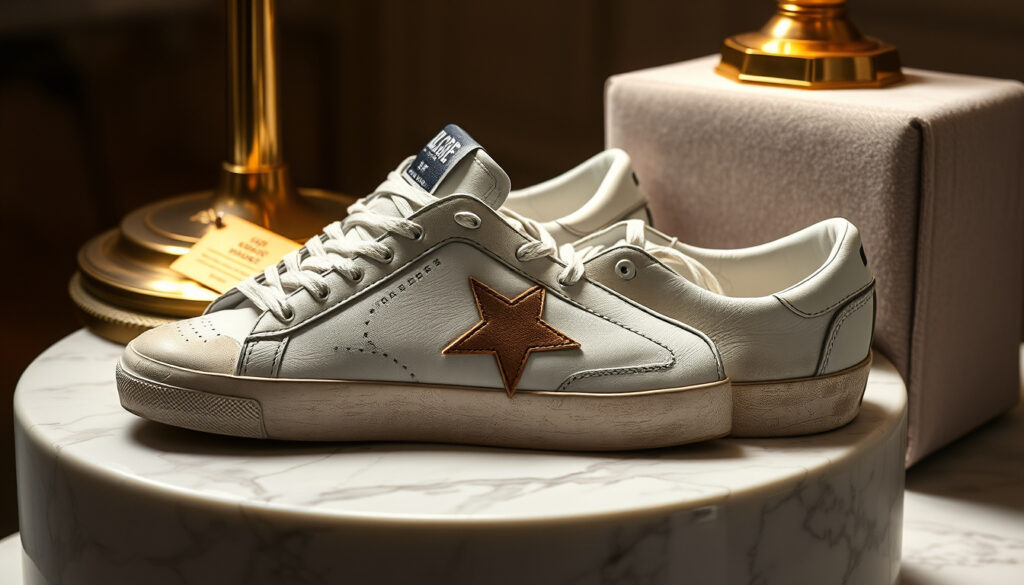
Golden Goose: Why Are They So Expensive? Luxury Sneakers Guide
There’s a certain pleasure in buying something that already looks lived-in, and that’s the strange appeal at the heart of Golden Goose. The Venetian brand, founded in 2000 by Alessandro Gallo and Francesca Rinaldo (Carlyle (private equity firm)), turned deliberately scuffed sneakers into a luxury category — and today’s prices reflect just how far that bet paid off. Here’s what the premium actually buys, how the label compares with other designer sneakers, and whether the worn-in look is worth it.
Average price range: $400–$700 per pair ·
Founded: 2000 in Venice, Italy ·
Known for: Pre-distressed leather sneakers ·
Materials: Italian leather, suede, and metallic finishes
Quick snapshot
- 100% of sneakers are handcrafted in Italy (Golden Goose Group (company homepage))
- Best known for intentionally distressed and worn sneakers (GOAT (sneaker marketplace))
- The Super-Star sneaker debuted in 2007 (Golden Goose Group (heritage page))
- Exact annual production volume is not publicly disclosed
- Resale-value depreciation has no standardized tracking
- 2000 — brand founded in Venice (Carlyle (private equity firm))
- 2013 — after the Style Capital acquisition, the brand shifts from wholesale to direct-to-consumer (Golden Goose Group (brand history))
- 2020 — acquired by private equity firm Permira (Carlyle (private equity firm))
- More direct-to-consumer expansion — already 180+ stores in 23 countries (Golden Goose (official brand story))
- New collections and collaborations keep the worn-in aesthetic in rotation (Golden Goose (official brand story))
Golden Goose at a glance
Eight data points, one pattern: the brand is handmade, scarce, and deliberately exclusive.
| Label | Value |
|---|---|
| Founded | 2000 |
| Founders | Alessandro Gallo and Francesca Rinaldo (Carlyle (private equity firm)) |
| Headquarters | Venice (Marghera), Italy (Wikipedia (company entry)) |
| Signature style | Pre-distressed leather with a star patch (GOAT (sneaker marketplace)) |
| First sneaker | Super-Star, introduced 2007 |
| US retail price | $595–$735 for most men’s sneakers |
| Global footprint | 180+ stores in 23 countries |
| Production | 100% handcrafted in Italy (Golden Goose Group (company homepage)) |
The picture: a footwear-led brand with a deliberately controlled global footprint, built on craft and scarcity.
Why is Golden Goose very expensive?
On the brand’s US site, most men’s sneakers land between $595 and $735, before tax (Golden Goose US (official product catalog)). Across the full catalog, the broader price range runs from roughly $400 to $700. That puts a deliberately scuffed shoe at the same price point as a quality pair of leather dress shoes — and far above most designer canvas styles.
Italian craftsmanship and materials
- The company says 100% of its sneakers are handcrafted in Italy, with roots that remain in Venice (Golden Goose Group (company homepage)).
- Materials run to Italian leather, suede, and metallic finishes — the kinds of inputs you expect at this price.
- Production is deliberately boutique: the brand favors its own stores and a tight wholesale network rather than mass-market saturation.
Craftsmanship explains part of the cost. But Italian labor and good leather alone don’t get a sneaker to $600.
The pre-distressed production process
- Golden Goose is best known for intentionally distressed and worn sneakers (GOAT (sneaker marketplace)).
- The Super-Star, born in 2007, came from watching skaters wear their sneakers down (Golden Goose Group (heritage page)).
- Artisans add scuffs, stains, and irregular stitching so each pair looks like it already has a history.
In other words, the damage is the product. Traditional luxury sells perfection; Golden Goose sells the illusion of a well-lived life.
Limited production runs and brand scarcity
- The brand shifted from wholesale to direct-to-consumer in 2013, which gives it tight control over where and how its shoes are sold (Golden Goose Group (brand history)).
- The retail network stays boutique: 180+ stores across 23 countries, a scale that keeps the brand scarce (Golden Goose (official brand story)).
- Discounts are rare: even the official sale section keeps most items at $595 or above (Golden Goose US (official sale section)).
For the US buyer, the price is less about leather cost and more about brand control: Golden Goose keeps distribution tight, keeps discounts rare, and sells the scuffed look as a status signal.
The pattern is consistent: Golden Goose isn’t priced like other sneakers because it isn’t competing like them. The price is the barrier that keeps the look exclusive.
What does the slang term "golden goose" mean?
Before the brand existed, the golden goose was a fable. In Aesop’s story, a farmer owns a goose that lays a golden egg every day; in his greed, he kills the bird to collect all the eggs at once — and ends up with nothing.
Origin of the phrase (Aesop’s fable)
- The phrase comes from Aesop’s fable of the goose that laid golden eggs.
- The moral: the source of steady, valuable returns is worth more than any single windfall.
Modern usage in business and culture
- A “golden goose” now means a durable source of revenue or advantage — a hit product, a loyal customer base, a protected asset.
- Business writers warn companies not to “kill the goose” by overharvesting a successful line.
The brand’s name borrows that promise: a single valuable asset that keeps producing. For Golden Goose, the asset is a sneaker line people keep coming back to — and the worn-in look is the distinctive “egg” few other labels lay. The irony: the fable warns against destroying a reliable source of value, and Golden Goose built its name on making that value look imperfect.
Does anyone wear Golden Goose anymore?
Yes. The brand has grown from a Venetian workshop to 180+ stores in 23 countries (Golden Goose (official brand story)), and it keeps releasing new collections and collaborations.
Celebrity and influencer endorsements
- Taylor Swift and Kendall Jenner have both been photographed in Golden Goose sneakers, keeping the label visible in celebrity street style.
- The deliberately worn-in look gives famous buyers an easy styling hook: it reads as effortless, not overthought.
Sales data and market presence
- Wikipedia’s company entry puts annual sales at roughly €500 million in 2023, with footwear generating around 90% of revenue (Wikipedia (company entry)).
- The figure is approximate and not independently audited — treat it as a direction, not a precise number.
- The first Americas store opened in New York in 2015, part of the brand’s controlled direct-to-consumer push (Golden Goose Group (brand history)).
The celebrity sightings get the attention; the store count does the talking. Part of the appeal is social proof: a shoe that already looks broken-in says you don’t need to prove anything. The pattern: Golden Goose isn’t fading — it’s consolidating.
What are the top 10 luxury shoe brands?
Golden Goose competes in a crowded field where luxury brands split into two camps: heritage houses that stamp their archives onto sneakers, and contemporary labels that build a whole aesthetic around one silhouette.
Golden Goose’s position among luxury sneaker labels
- Golden Goose owns the “deliberately imperfect” corner of the market (GOAT (sneaker marketplace)).
- Gucci sells polished heritage, Balenciaga sells shock value, and Common Projects sells restraint; Golden Goose sells the opposite — a shoe that looks like it has stories.
Golden Goose’s biggest risk is its own success: once everyone wears the same scuffed star patch, the brand has to keep inventing new ways to look imperfect.
The trade-offs are clear: luxury-sneaker buyers are choosing between instant character, heritage flash, maximalism, and quiet minimalism.
| Brand | Design signature | Market position |
|---|---|---|
| Golden Goose | Pre-distressed leather with a star patch | Entry luxury — $595–$735 at US retail |
| Gucci | Embroidered motifs on polished leather low-tops | Heritage house with global retail scale |
| Balenciaga | Oversized, sculptural soles | Runway-forward statement luxury |
| Common Projects | Minimal leather uppers with understated branding | Quiet luxury with a cult following |
The implication: among these four, only Golden Goose treats wear as the feature rather than the flaw.
Other notable brands: Gucci, Balenciaga, Christian Louboutin, etc.
- Christian Louboutin anchors the dressier end of luxury footwear.
- Most published “top luxury shoe” lists mix heritage houses (Gucci, Balenciaga, Christian Louboutin) with cult labels (Common Projects, Golden Goose).
- Golden Goose holds a unique slot: it is the only major label whose signature is wear, not polish.
The trade-off: choosing Golden Goose means giving up the pristine finish most luxury buyers expect. In a market where everyone sells polish, the scuffs are the differentiator.
What is the most sold shoe in history?
No luxury label appears near the top of the all-time list. That honor belongs to mass-market icons.
Best-selling models globally (e.g., Converse Chuck Taylor, Adidas Stan Smith)
- The Converse Chuck Taylor All Star is widely cited as the best-selling shoe in history, with cumulative sales past the one-billion-pair mark.
- Mass-market icons such as the Adidas Stan Smith and classic Nike silhouettes dominate the volume rankings, not luxury labels.
How Golden Goose compares in volume
- Golden Goose is a niche player by design: its economics depend on high margins from a limited number of pairs, not on mass-market volume.
- The result: a Golden Goose sneaker costs several times a Chuck Taylor while selling in far smaller numbers.
The catch: Golden Goose’s model is the reverse of the world’s best-sellers. It runs on scarcity, not volume — and that is exactly why a scuffed shoe can carry a premium price.
Upsides
- Handcrafted in Italy — the company says 100% of pairs are made there (Golden Goose Group (company homepage)).
- A distinctive, hard-to-copy aesthetic: the intentionally distressed look is instantly recognizable (GOAT (sneaker marketplace)).
- A boutique global footprint that keeps the brand exclusive without being impossible to find.
Downsides
- High entry price: most men’s sneakers run from $595 to $735 (Golden Goose US (official product catalog)).
- Uncertain resale value: no standardized data tracks how distressed styles depreciate.
- The scuffed finish isn’t for everyone — some buyers will always read “damaged” rather than “designer.”
The same distress that makes Golden Goose practical for daily wear cuts against it at resale: cosmetic scuffs are the design, so any additional damage just looks like more of the same — and depreciation is hard to predict.
What’s confirmed, what’s not
Separating verified facts from speculation matters here because most claims about Golden Goose still come from the brand’s own marketing or from listing-based data.
Confirmed facts
- Golden Goose sneakers are made in Italy — the company puts the figure at 100% (Golden Goose Group (company homepage)).
- Most US retail prices for men’s sneakers fall between $595 and $735 (Golden Goose US (official product catalog)).
- The first Americas store opened in New York in 2015 (Golden Goose Group (brand history)).
What’s unclear
- Exact production volumes are not publicly disclosed.
- Resale depreciation rates have no standardized public data.
- The €500 million 2023 revenue figure is an approximation from Wikipedia’s company entry, not an audited statement (Wikipedia (company entry)).
The pattern: the brand’s own claims are consistent, but independent verification is thin. When a company is both manufacturer and main data source, the numbers deserve extra skepticism.
In their own words
The Super-Star was born in 2007 after observing skaters and their worn-down sneakers.
Golden Goose Group (heritage page)
Golden Goose is best known for its intentionally distressed and worn sneakers.
GOAT (sneaker marketplace)
The company reported approximately €500 million in annual sales in 2023.
Wikipedia (company entry)
What this shows: across the brand’s own storytelling, a leading resale platform, and a third-party encyclopedia, the description stays consistent — Golden Goose is defined by its deliberate wear.
The takeaway
Golden Goose is a genuine luxury label, not a fad: it makes its shoes in Italy, runs a boutique retail network, and holds its prices because the worn-in look has real demand. But that demand is for an aesthetic, not for an investment-grade asset. For the style-conscious buyer in the US, the decision is clear: buy Golden Goose if the scuffed, story-filled look genuinely appeals to you and you accept it as a fashion purchase — or choose a cleaner designer sneaker if you want polish and easier resale.
Related reading
goldengoose.com, goldengoose.com, goldengoose.com, goldengoose.com
Frequently asked questions
Are Golden Goose sneakers worth the price?
If you want the worn-in Italian craftsmanship and the story behind it, yes. If you want pristine leather or guaranteed resale, no. Golden Goose sells a deliberate aesthetic, and US retail prices start around $595 (Golden Goose US (official product catalog)).
What materials are used in Golden Goose sneakers?
Italian leather, suede, and metallic finishes are the core materials, with the star patch and heel logo as the most recognizable details.
How do Golden Goose sneakers fit compared to other brands?
Fit varies by model and foot shape. Because the leather is soft and the shoes are designed to look broken in, many buyers find them comfortable quickly. Check the size notes on the specific model page before ordering.
Do Golden Goose sneakers run true to size?
Reports vary, and the brand does not publish a single universal standard across every model. For a shoe at this price, buying from a retailer with free returns — including the brand’s own site — is the safest approach.
Can Golden Goose sneakers be repaired?
Yes, with caveats. The distressed finish means most cosmetic scuffs are part of the design and do not need repair. For structural issues such as sole separation, a professional cobbler is the standard route.
How to clean and maintain Golden Goose sneakers?
For leather pairs, use a soft brush and leather cleaner; for suede, avoid water and use a suede brush. Since the worn-in look is intentional, these shoes do not need to stay spotless — that is the point of the design.
Where can I buy authentic Golden Goose sneakers?
The safest options are the brand’s own stores and its official website. Golden Goose operates 180+ stores in 23 countries and lists current locations on its US site.
More related posts
 David Corenswet Movies and TV Shows – Full Filmography Guide
 Scott van-der-Sluis: Biography, Age & Love Island Career
 Preity Zinta: Biography, Net Worth, and Personal Life
 Liver King: Biography, Net Worth, Steroid Controversy
 Kelly Cates Weight Loss – Facts, Rumors and Timeline
 Marvin Humes: Net Worth, Wife, Children, and Family FAQs
 Henry Cavill: Nationality, Relationships, Health, and Faith
 Jonny Greenwood: Radiohead Guitarist and Oscar-Nominated Composer
