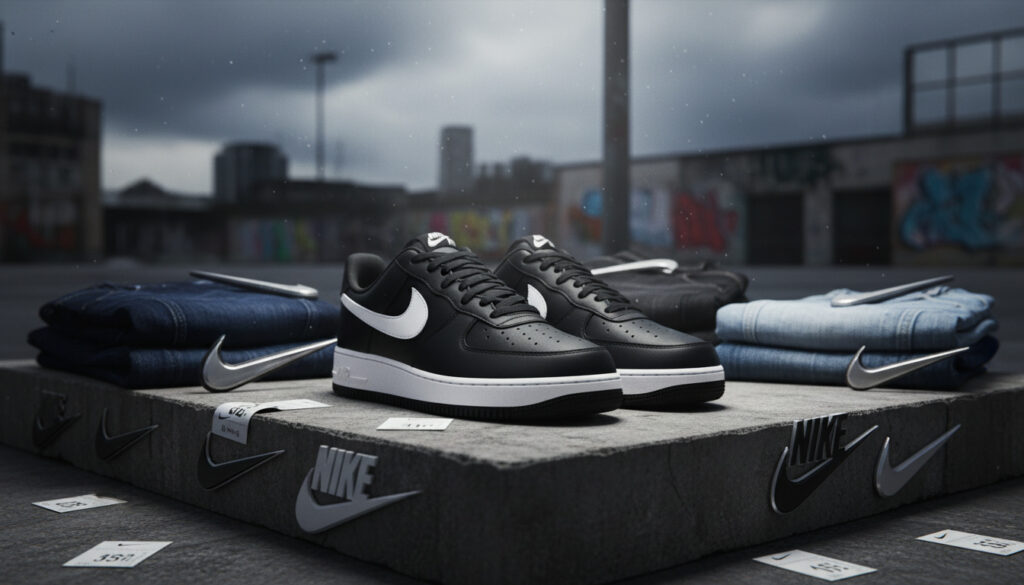
Black Air Force 1 – History, Styling, Sizing and Buying Guide
Black Air Force 1s represent more than a footwear choice. They embody decades of cultural evolution, bridging basketball courts and high fashion runways with effortless stealth. Since their introduction, the all-black colorway has become the definitive choice for those seeking versatility without visual noise.
From Bruce Kilgore’s original 1982 design to contemporary streetwear staples, these sneakers maintain relevance through subtlety. The monochromatic palette conceals scuffs while complementing virtually any wardrobe, establishing the silhouette as a permanent fixture in urban style.
Unlike trend-dependent footwear that cycles out of fashion, black AF1s persist through their architectural integrity and cultural resonance. Their presence in hip-hop, sports, and daily wear creates a rare intersection of function and symbolism.
Why Are Black Air Force 1s So Popular?
The all-black colorway of Nike’s legendary basketball shoe carries four decades of cultural weight.
Designed by Bruce Kilgore as Nike’s first basketball shoe with Air cushioning technology.
Deeply embedded in hip-hop and streetwear traditions, particularly in Harlem where they’re known as “Uptowns.”
Available in low, mid, and high-top constructions to match different aesthetic preferences.
- Stealth Versatility: The monochrome black upper pairs with virtually any outfit while hiding dirt and wear effectively.
- Architectural Durability: Kilgore’s cathedral-inspired sole design creates a stable, wide base that outlasts typical fashion sneakers.
- Celebrity Endorsement: Persistent visibility in music videos and celebrity wardrobes sustains demand across generations.
- Resale Stability: Unlike hyped limited editions, black AF1s maintain consistent $120–$200 secondary market values.
- Baltimore Legacy: The 1984 intervention by Baltimore retailers saved the line from discontinuation, creating the endless demand cycle.
- True-to-Size Reliability: Predictable sizing removes purchase hesitation for online buyers.
| Feature | Details |
|---|---|
| Designer | Bruce Kilgore |
| Original Release | 1982 (High-top), 1983 (Low-top) |
| Primary Materials | Leather upper, Nike Air cushioning unit, rubber outsole |
| Retail Price Range | $110–$140 USD (2025 estimate) |
| Resale Value | $120–$200 standard; $300+ for rare editions |
| Size Range | Men’s 3.5–18, Women’s 5–12 (with 1.5 size conversion) |
| Construction Method | Slip-lasted (first U.S.-made Nike shoe using this technique) |
| Key Technologies | Air unit heel cushioning, concentric tread pattern |
Black Air Force 1 Low vs High: Key Differences
Silhouette and Ankle Support
The high-top version features an ankle strap and extended collar that provide structural support reminiscent of the shoe’s basketball origins. This construction offers stability for athletic movement but creates a bulkier profile. The low-top, released in 1983, cuts below the ankle for a sleeker appearance that dominates contemporary streetwear.
Performance vs. Fashion Applications
Originally, the high-top served professional basketball players like Moses Malone during the 1983 Philadelphia 76ers championship run. Today, the high remains collectible and functional for athletic use, while the low functions primarily as a fashion item. The low’s minimalist profile integrates seamlessly with jeans, cargos, and joggers.
The high-top’s ankle strap and extended height provide measurable stability for lateral movements, while the low prioritizes ankle mobility and lighter weight for daily walking.
Styling Approaches
High-tops demand intentional styling—paired effectively with track pants, shorts, or layered athleisure that accommodates their substantial presence. Low-tops offer unconscious versatility, working with tapered denim, chinos, or technical trousers without visual competition. The black colorway amplifies both silhouettes’ adaptability.
Where to Buy Black Air Force 1s and Current Pricing
How Much Do Black Air Force 1s Cost?
Standard black Air Force 1 lows and highs retail between $110–$140 USD at authorized sellers including Nike.com, Foot Locker, Finish Line, and Shoe Palace. Collaborative editions or special materials command premiums exceeding $200. On resale platforms like StockX and GOAT, standard black pairs typically trade between $120–$200, with original 1982 high-tops or limited variants reaching $300+.
Are Air Force 1s True to Size?
Air Force 1s generally run true to size using Nike’s standard basketball sizing metric. A men’s size 10 accommodates an average foot without socks. Those with wide feet or who prefer thick socks should consider sizing up half a size to account for the padded tongue and collar. Women converting from men’s sizing should add 1.5 sizes for equivalent fit. The leather uppers break in snugly over initial wears, so testing in-store remains advisable when possible.
Authorized Retailers and Availability
Primary distribution occurs through Nike’s official website and flagship athletic retailers including JD Sports, Foot Locker, and Shoe Palace. For discontinued or rare colorways, resale marketplaces provide authenticated options. Standard black colorways rarely sell out completely, though size availability fluctuates seasonally.
How to Clean and Maintain Black Air Force 1s
Routine Cleaning Protocol
The leather upper requires only a damp cloth and mild soap for surface dirt removal. Sole crevices need brushing to dislodge compacted debris. Always air dry away from direct heat sources to prevent material degradation. For deeper restoration, remove laces and insoles for separate soaking in soapy water.
Black AF1s utilize leather uppers, foam midsoles, rubber outsoles, and encapsulated Air units in the heel. Avoid soaking the Air unit during cleaning to preserve cushioning integrity.
Can You Wear Air Force 1s in the Rain?
The leather construction offers water resistance but not waterproofing. Light rain exposure won’t damage the shoe immediately, but saturation risks staining and sole separation. Apply a water-repellent spray before wet weather exposure. If soaked, stuff with newspaper to absorb moisture slowly—never use mechanical dryers as heat warps the midsole foam.
Direct heat application destroys the foam midsole structure. Always allow wet sneakers to dry at room temperature with paper stuffing to maintain shape.
Long-term Preservation
Monthly application of leather conditioner prevents cracking in the upper. Rotating between pairs reduces creasing in the toe box. Store in dust bags away from sunlight to prevent fading of the black pigment, particularly on the Swoosh and heel tab.
History and Cultural Impact of Nike Air Force 1
-
Nike releases the high-top Air Force 1, designed by Bruce Kilgore. It becomes the first basketball shoe with Nike Air technology, featuring a concentric tread pattern inspired by Notre-Dame Cathedral’s architecture.
-
The low-top variant debuts. Moses Malone wears the high-top while leading the Philadelphia 76ers to an NBA championship, cementing athletic credibility.
-
Nike plans discontinuation after the standard product lifecycle. Baltimore retailers Charlie Rudo Sports, Downtown Locker Room, and Cinderella Shoes collectively order thousands of pairs, forcing continued production. Paul Blinken reportedly sells 2,400 pairs instantly upon restocking.
-
Kilgore discovers ongoing production in Taiwan factories, realizing the shoe’s commercial staying power exceeds corporate projections.
-
Nelly releases the single “Air Force Ones,” driving mainstream demand and cementing the shoe’s place in hip-hop culture.
-
The silhouette becomes ubiquitous in Harlem as “Uptowns” and transitions into high fashion through runway appearances and luxury collaborations.
What Information Is Definitive vs. Variable
| Established Facts | Information That Varies |
|---|---|
| Bruce Kilgore designed the AF1 in 1982 as Nike’s first Air basketball shoe | Exact resale prices fluctuate between $120–$200+ depending on size and platform |
| Baltimore retailers prevented discontinuation in 1984 | Availability of specific sizes at retail changes seasonally |
| Construction uses slip-lasted leather with cupsole durability | Break-in period varies by individual foot shape and wear frequency |
| Black colorways dominate streetwear as “stealth” options | Collaborative release dates and pricing vary by partnership terms |
| Harlem’s “Uptowns” nickname reflects early regional adoption | Long-term durability depends on maintenance routines and climate exposure |
Best Ways to Style Black Air Force 1s
Black Air Force 1s function as a neutral foundation within minimalist streetwear aesthetics. The low-top variant pairs effortlessly with raw denim, tapered joggers, or technical cargo pants. Hoodies and overshirts complete casual ensembles without competing for attention.
For athletic-inspired outfits, the high-top accommodates track pants and layered outerwear. The monochromatic black treatment allows integration into high-fashion contexts—runway styling often features black AF1s with tailored trousers or experimental silhouettes. The key lies in the shoe’s ability to ground bold garments while maintaining its own visual identity.
Athletic data and performance reviews often appear alongside lifestyle coverage, similar to how Knicks vs Boston Celtics Stats provide context beyond basic box scores.
Perspectives from Designers and Historians
“The Air Force 1 represents the most influential sneaker architecture of the modern era. Its cathedral-inspired stability and Air cushioning created a template that transcended basketball.”
— Bruce Kilgore design philosophy, documented via WearTesters
“Baltimore didn’t just save a shoe. They proved that consumer demand could override corporate product cycles, creating the first ‘retro’ before retro existed.”
— Sneaker historian analysis via The RealReal
Summary
Black Air Force 1s endure through architectural innovation and cultural adoption. From Kilgore’s 1982 design to current streetwear ubiquity, the silhouette offers verified quality and versatile aesthetics. Whether choosing low or high cuts, buyers invest in footwear with documented history and consistent manufacturing standards. For those evaluating athletic performance footwear across different sports, consulting an Under Armour Golf Shoes Review demonstrates similar attention to technical specification and value assessment.
Common Questions
Are Air Force 1s true to size?
Yes, they run true to Nike’s standard basketball sizing. Consider half-size up for wide feet or thick socks.
Can you wear Air Force 1s in the rain?
The leather resists light rain but isn’t waterproof. Use water-repellent spray and air dry if soaked.
Why are they called Air Force 1?
Named after the U.S. presidential aircraft Air Force One, reflecting the premium status of Nike’s first Air basketball shoe.
How long do black Air Force 1s last?
With proper rotation and monthly leather conditioning, pairs typically last 2–3 years of regular wear.
Do black AF1s hide dirt better than white?
The all-black colorway conceals scuffs and dirt effectively, requiring less frequent cleaning than white variations.
More related posts
 Adam Smith: Father of Modern Economics – Biography & Theories
 Vodafone WiFi Not Working? Troubleshoot & Fix in Minutes
 Helen McCrory: Her Private Battle with Breast Cancer
 Cody Gakpo: Biography, Salary, Family Tragedy, and Career
 Komodo Dragon: Venomous Bite, Attacks, Size & Key Facts
 Jeans Marks Spencer: Styles for Older Women & Trends 2026
 Katie Derham: Current Role, Net Worth, and Career Highlights
 Nisha Katona: Biography, Family, and Mowgli Founder Facts
