Edward the Black Prince: Life, Love, War, Illness
Ask anyone to name a medieval knight, and Edward the Black Prince often surfaces—a figure of chivalry, battlefield triumph, and a mysterious end. Yet the man behind the legend was more than a warrior: he married for love, fought through chronic illness, and left a legacy that still shapes the British crown — here’s what historians actually know about his life, his battles, and the disease that may have killed him.
Full name: Edward of Woodstock ·
Born: 15 June 1330 ·
Died: 8 June 1376 (aged 45) ·
Titles: Prince of Wales, Duke of Cornwall, Prince of Aquitaine ·
Famous battles: Battle of Crécy (1346), Battle of Poitiers (1356) ·
Spouse: Joan of Kent
Quick snapshot
- Edward of Woodstock was the eldest son of Edward III (Encyclopaedia Britannica)
- He died on 8 June 1376 and is buried in Canterbury Cathedral (BBC History)
- He married Joan of Kent in 1361 (World History Encyclopedia)
- The exact origin of the nickname “Black Prince” — first recorded in the 16th century, not in his lifetime (HistoryExtra)
- The specific disease that killed him — possibly dysentery, malaria, or a combination (BMJ Military Health)
- Whether the sack of Limoges (1370) was as brutal as later chronicles claim (Wikipedia)
- 1330: Born at Woodstock (Encyclopaedia Britannica)
- 1356: Victory at Poitiers, capturing the French king (BBC History)
- 1376: Dies at Westminster, predeceasing his father (BBC History)
- His son became Richard II, but the crown passed through a turbulent line (Wikipedia) (The History Press)
- Modern historians continue debating the nickname’s true source (The History Press)
- Medical research still probes the illness that ended his reign-in-waiting (BMJ Military Health) (The History Press)
Seven key facts define Edward’s life, one pattern: a prince who won on the battlefield but lost the throne to illness.
| Fact | Detail |
|---|---|
| Full name | Edward of Woodstock |
| Born | 15 June 1330, Woodstock, Oxfordshire |
| Died | 8 June 1376, Westminster, London |
| Burial | Canterbury Cathedral, Kent |
| Spouse | Joan of Kent (m. 1361) |
| Children | Edward of Angoulême (died 1371), Richard II (born 1367) |
| Major battles | Crécy (1346), Poitiers (1356), Nájera (1367) |
The implication: Edward’s story is one of promise cut short—military genius shadowed by a body that failed him.
Why was Edward called the Black Prince?
No one called him the Black Prince while he lived. Contemporaries knew him as Edward of Woodstock, a name that reflects his birthplace rather than any dark legend (BBC History). The sobriquet emerged later, and its true origin remains a puzzle.
Theories behind the nickname
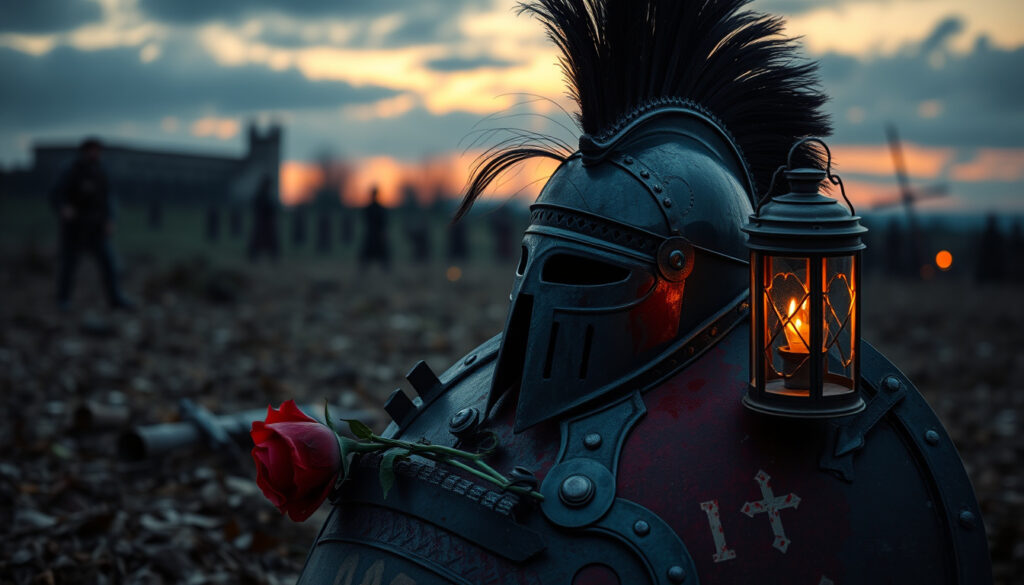
- Black armour: one theory holds he wore black armour, but The History Press (historical publisher) calls this “unsubstantiated”—no inventory or chronicle from his lifetime mentions it.
- Black shield: another idea points to a black shield with three white ostrich feathers used in jousting, noted by HistoryExtra (British history magazine).
- Harsh reputation: some argue the name reflects his brutal campaigns in Aquitaine, where his rule left lasting resentment (HistoryExtra).
Contemporary sources on the name
The first written record appears in Richard Grafton’s Chronicle of England in 1568, nearly two centuries after Edward’s death (Encyclopaedia Britannica). This timing suggests the nickname is a posthumous invention, not a title he earned in life.
A warrior remembered by a name he never used—historians agree the label stuck because of later fame, not contemporary practice.
The pattern: the nickname reflects legacy, not life. What this means: when you read “Black Prince” in a medieval source, you’re reading a Tudor-era projection onto a Plantagenet hero.
Did Edward the Black Prince love Joan of Kent?
Evidence suggests the marriage was more than political. Edward married Joan of Kent in 1361, a union that required a papal dispensation because they were cousins (World History Encyclopedia). Joan was already a widow and a wealthy heiress, making the match advantageous—but chronicles hint at genuine devotion.
Their marriage and relationship
- Joan was his cousin, daughter of Edmund of Woodstock, Earl of Kent (Encyclopaedia Britannica).
- They had two sons: Edward of Angoulême (born 1365) and Richard (born 1367), the future Richard II (Wikipedia).
- When Edward lay dying, Joan was at his side; his will left her substantial properties (World History Encyclopedia).
Joan’s previous marriage
Joan had been married to Thomas Holland before Edward, a match that itself required papal intervention. Her history complicated the 1361 marriage, which some contemporaries viewed as irregular despite the dispensation (Wikipedia).
Edward’s loyalty
Unlike many medieval princes, Edward appears to have remained faithful to Joan. No contemporary source records mistresses or illegitimate children—a notable contrast with his father’s long relationship with Alice Perrers (HistoryExtra).
The marriage’s stability gave Richard II a secure upbringing, shaping the young king who would later face the Peasants’ Revolt.
The trade-off: a love match cost Edward political capital—the dispensation and Joan’s history drew criticism—but bought him domestic peace. The implication: personal loyalty strengthened his dynastic line even as it strained court opinion.
Was Edward the Black Prince a good warrior?
By any military measure, yes. Edward’s victories at Crécy and Poitiers rank among the greatest English triumphs of the Hundred Years’ War, and contemporaries celebrated him as the model of chivalric knighthood (Encyclopaedia Britannica).
Military campaigns and victories
- At Crécy (1346), aged just 16, Edward led the vanguard and helped secure a decisive English victory (BBC History).
- At Poitiers (1356), he captured King Jean II of France—a feat that made his reputation and brought a massive ransom (Encyclopaedia Britannica).
- In Spain, he won the Battle of Nájera (1367), restoring Pedro of Castile to the throne (World History Encyclopedia).
Reputation as a chivalric leader
The Chandos Herald, a contemporary poet who knew Edward personally, wrote a Life of the Black Prince praising his skill and generosity (Wikipedia). Jean Froissart, the era’s most famous chronicler, depicted Edward as the epitome of knighthood—courteous to prisoners, bold in battle (Wikipedia).
Criticisms and limitations
The sack of Limoges in 1370 stains that reputation. After the city’s surrender, Edward ordered an assault that included killing civilians—a massacre that chronicler Thomas Walsingham condemned (Wikipedia). Some modern historians question the scale of the slaughter, but the act undeniably hurt his standing in France (HistoryExtra).
He was the flower of all chivalry—the most courteous, the most generous, and the most formidable knight of his age.
— Jean Froissart, 14th-century chronicler (Wikipedia)
Edward’s military brilliance is undeniable; his moral record is mixed. The sack of Limoges shows a commander capable of cruelty when frustrated—illness had frayed his patience by then.
The trade-off: a warrior’s glory often comes at a human cost. What this means: Edward earned his legend in battle, but the legend ignores the civilians who paid for it.
What illness did the Black Prince have?
Edward’s health declined after 1367, when he fell ill during or after the Spanish campaign. He returned to England in 1371, too sick to govern Aquitaine effectively, and never recovered (BBC History).
Symptoms and chronic health issues
- Recurring fevers and weakness after 1367, with worsening episodes through the early 1370s (BMJ Military Health).
- Dropsy (oedema) appeared in his final years, suggesting kidney or heart complications (Wikipedia).
- He was bedridden from 1371, unable to campaign or attend parliament (World History Encyclopedia).
Historical diagnoses
A 2024 article in BMJ Military Health (peer-reviewed military medicine journal) concludes later accounts typically describe the death as dysentery, often amoebic dysentery—consistent with an infection contracted during the Spanish campaign. The same article stresses he died from disease, not battle wounds.
Wikipedia’s synthesis of the historical debate lists further possibilities: P. vivax malaria, brucellosis, inflammatory bowel disease, or complications of acute dysentery. No consensus exists, and a definitive modern diagnosis is impossible without tissue samples.
His death was probably caused by an illness contracted in Spain—likely a form of dysentery that never fully healed.
— BBC History
Without a modern autopsy, the exact pathogen stays unknowable. Chroniclers called it “dropsy” and “flux,” leaving historians to infer from symptoms alone.
The implication: a single infection, likely picked up in Spain, ended a dynasty’s hopes. What this means: had Edward lived, England might have skipped the disastrous reign of Richard II—and perhaps the Wars of the Roses.
What happened to Edward the Black Prince?
Edward died on 8 June 1376 at Westminster Palace, aged 45 (BBC History). He never became king—he predeceased his father, Edward III, by a year.
Decline in health and death
His final years were marked by progressive incapacity. He made his last will in June 1376, just days before death, leaving detailed instructions for his funeral and for the care of his wife and son (World History Encyclopedia).
Death at Westminster Palace
Edward died in the royal residence, surrounded by his family. His death triggered national mourning—he was, in the words of contemporary chroniclers, the hope of the realm (Wikipedia).
Succession and legacy
- His son Richard became Richard II in 1377, at age 10 (BBC History).
- Edward’s tomb in Canterbury Cathedral bears his bronze effigy, still visible today (Westminster Abbey).
- His heraldic achievements—shield, surcoat, and helmet—hang above the tomb, among the oldest surviving medieval funeral regalia in England (Canterbury Cathedral).
Richard II’s reign collapsed in 1399, leading to Henry IV’s usurpation. The Black Prince’s early death thus indirectly triggered a century of dynastic instability.
The pattern: a single premature death reshaped English history. The implication: the Plantagenet line might have held had Edward survived his father by even five years.
Was Edward the Black Prince a good person?
The evidence paints a complex figure: a devout Christian, a generous patron, a ruthless commander—and a man who ordered the slaughter of civilians at Limoges.
Contemporary accounts of character
- Chroniclers uniformly praised his courtesy and piety; he founded religious houses and gave generously to the Church (Encyclopaedia Britannica).
- He negotiated the Poitiers ransom with fairness, treating King Jean II with respect rather than humiliation (World History Encyclopedia).
- His will shows concern for his soldiers’ debts, instructing executors to settle them (Wikipedia).
The sack of Limoges (1370)
The massacre remains the strongest counter-evidence. After Limoges surrendered, Edward ordered a general assault; chronicles describe the killing of women and children, though later historians question the scale (Wikipedia). Thomas Walsingham, a monastic chronicler, called it an act of “wickedness” (Wikipedia).
Piety and religious foundations
Edward’s religious devotion is well documented. He funded the rebuilding of several churches and left generous bequests in his will (Canterbury Cathedral). His tomb chapel at Canterbury became a pilgrimage site after his death.
The men of Limoges paid dearly for their treachery—but the price included innocents.
— Thomas Walsingham, 14th-century chronicler (Wikipedia)
Medieval standards judged Edward kind by his era’s lights; modern ethics condemn Limoges. The honest verdict: a man of his time, exceptional in war, flawed in mercy.
Why this matters: the “good person” question depends on the yardstick. By 14th-century norms, Edward was a model prince; by universal standards, Limoges remains a stain.
Edward the Black Prince: Timeline of a Life
- 15 June 1330 — Born at Woodstock Palace (Encyclopaedia Britannica)
- 1343 — Created Prince of Wales (Encyclopaedia Britannica)
- 1346 — Fought at the Battle of Crécy (BBC History)
- 1356 — Led victory at Poitiers, capturing King Jean II (Encyclopaedia Britannica)
- 1361 — Married Joan of Kent (World History Encyclopedia)
- 1362 — Appointed Prince of Aquitaine (Encyclopaedia Britannica)
- 1367 — Campaign in Spain; victory at Nájera; falls ill afterwards (BBC History)
- 1370 — Sack of Limoges (Wikipedia)
- 1371 — Returns to England due to failing health (World History Encyclopedia)
- 8 June 1376 — Dies at Westminster Palace (BBC History)
- 1376 — Buried in Canterbury Cathedral (BBC History)
The pattern: the dates trace a warrior’s decade, then a slow decline—Limoges, his last campaign, came six years before his death, and the rest was illness.
Confirmed vs. Unclear: What We Know
Confirmed facts
- Edward of Woodstock was the eldest son of Edward III (Encyclopaedia Britannica)
- He fought at Crécy and Poitiers and captured the French king (BBC History)
- He married Joan of Kent in 1361 (World History Encyclopedia)
- He died on 8 June 1376 (BBC History)
- He is buried in Canterbury Cathedral (BBC History)
What’s unclear
- The exact origin of the nickname “Black Prince” (HistoryExtra)
- The specific nature of his illness (dysentery, malaria, or combination) (BMJ Military Health)
- Whether the sack of Limoges was as brutal as later chronicles claim (Wikipedia)
- The depth of his personal feelings for Joan of Kent (World History Encyclopedia)
- Whether Edward actually wore black armour — no record from his lifetime mentions it (The History Press)
The takeaway: confirmed facts anchor the biography; the unclear items show where historians rely on inference rather than record.
en.wikipedia.org, historynet.com, thecollector.com, historic-uk.com, historycollection.com
Frequently asked questions
Where is Edward the Black Prince buried?
He is buried in Canterbury Cathedral, where his tomb features a bronze effigy and surviving funeral regalia (BBC History; Canterbury Cathedral).
What was Edward the Black Prince’s motto?
His motto was “Ich dien,” German for “I serve”—a phrase that became the motto of the Prince of Wales and appears in the royal arms of the heir apparent (Wikipedia).
How old was Edward the Black Prince when he died?
He died at age 45, on 8 June 1376 (BBC History).
Did Edward the Black Prince ever become king?
No—he predeceased his father, Edward III, by one year, so the crown passed to his son Richard II (BBC History).
Who were Edward the Black Prince’s children?
He had two sons with Joan of Kent: Edward of Angoulême (born 1365, died 1371) and Richard (born 1367), who became Richard II (World History Encyclopedia).
What armour did Edward the Black Prince wear?
Historical records do not mention black armour—despite the nickname, no contemporary inventory or chronicle describes him wearing black plate. His actual funeral regalia at Canterbury Cathedral includes a surcoat and helmet, though their color is not documented (Canterbury Cathedral; The History Press).
Is Edward the Black Prince related to the current British royal family?
Yes—Edward III is an ancestor of the current royal line. Through Edward’s son Richard II and his brother John of Gaunt, the Plantagenet bloodline flows into the Tudors and eventually the present House of Windsor (Wikipedia).
The pattern: even the FAQ answers depend on the same thin documentary record—a reminder that much of the Black Prince’s fame is posthumous.
Related reading
For further context on the medieval world Edward inhabited, explore our coverage of the Hundred Years’ War and the Plantagenet dynasty. The Edward of Woodstock profile tracks his life from birth to tomb, while the origin of the Black Prince nickname deep-dives into the Tudor-era mystery.
Edward the Black Prince died at 45, but his death changed England more than his life did. The throne passed to a child, Richard II, whose reign collapsed in 1399—unleashing the dynastic struggles that culminated in the Wars of the Roses. For modern readers, the lesson is stark: a single illness, contracted on a distant battlefield, can redraw the map of a kingdom. For historians, the Black Prince remains a cautionary figure—proof that brilliance in war guarantees nothing about peace, and that a name earned after death can overshadow a life lived in complexity.
More related posts
 Derek Fowlds: Biography, Heartbeat, Yes Minister, and Death
 Cheapest SIM Only Deals UK: Lebara vs Tesco vs Vodafone
 Quentin Willson: Top Gear Presenter Dies at 68 After Lung Cancer
 Dartboard Distance: Official Rules, Height, and Setup Guide
 Double Decker Bus: Capacity, History, and Global Use
 Etihad Airways vs Emirates: Safety, Service & Which is Better
 Iliman Ndiaye – Age, Height, Career Stats, and Personal Life
 Jet Li Health 2024: Diagnosis, Net Worth, and Why He Stopped Acting
