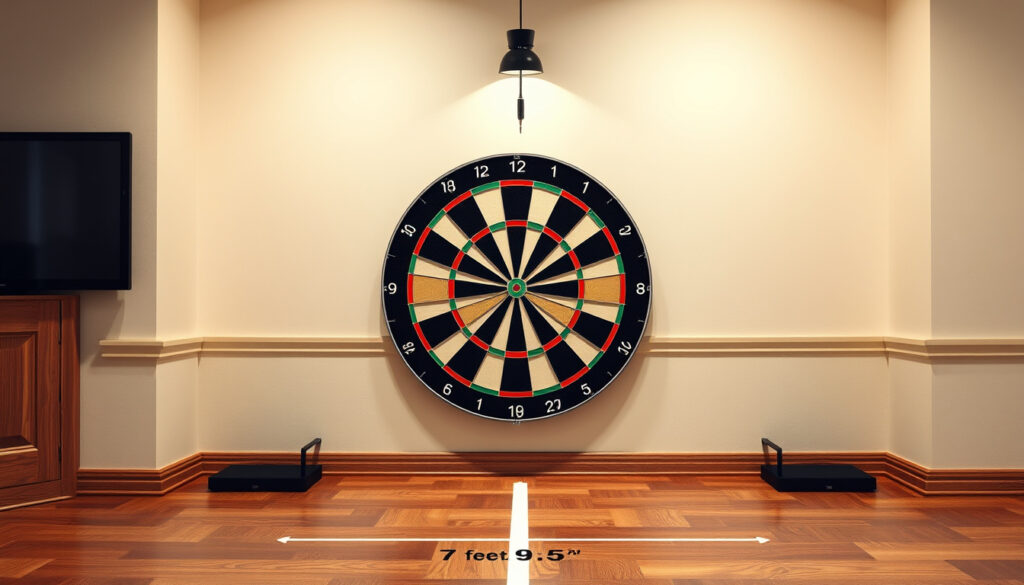
Dartboard Distance: Official Rules, Height, and Setup Guide
Anyone who’s ever stood at the wrong end of a dartboard knows the difference a few inches can make — a throw that feels off often comes down to the distance. This guide lays out exact numbers for steel-tip and soft-tip play, and how to measure your setup with confidence.
Standard steel-tip distance: 2.37 m (7 ft 9.25 in) ·
Soft-tip distance: 2.44 m (8 ft) ·
Bullseye height: 1.73 m (5 ft 8 in) ·
Diagonal (bullseye to oche): 2.93 m (9 ft 7.5 in) ·
Oche width: Minimum 61 cm (24 in)
Quick snapshot
- Steel‑tip distance: 2.37 m (7 ft 9.25 in) from board face to oche (Shot Darts, equipment retailer)
- Bullseye height: 1.73 m (5 ft 8 in) from floor (Shot Darts)
- Soft‑tip distance: 2.44 m (8 ft) in most leagues (Darts‑UK, specialist setup guide)
- Whether some electronic dartboards require a different distance (some manufacturers recommend 2.37 m) (University of Wisconsin darts reference).
- The exact historical origin of the 7 ft 9.25 in measurement (Darts Nutz, player forum).
- Whether raised oche is required for soft‑tip play (PDC uses raised oche only for steel‑tip) (Darts‑UK).
- 1920s – Standardization of height and distance in the UK (University of Wisconsin darts reference).
- 1970s – BDO formalises rules, confirming 2.37 m (Red Dragon Darts, manufacturer).
- 2024 – Current regulations remain unchanged; PDC and WDF still use 2.37 m for steel‑tip (Shot Darts).
- Always check your league’s rulebook: soft‑tip distances can vary by region.
- Measure the diagonal (2.93 m) to double‑check your horizontal setup.
These official dimensions apply to both professional and home setups.
| Measurement | Value |
|---|---|
| Official steel‑tip distance | 2.37 m (7 ft 9.25 in) |
| Official soft‑tip distance | 2.44 m (8 ft) |
| Bullseye height | 1.73 m (5 ft 8 in) |
| Diagonal from bullseye to oche (steel) | 2.93 m (9 ft 7.5 in) |
| Oche width | ≥61 cm (24 in) |
How far do I stand from a dartboard?
That depends on whether you’re throwing steel‑tip or soft‑tip darts. The two disciplines use different throwing distances, and mixing them up will throw off your game.
Steel‑tip throwing distance
- The official steel‑tip distance is 2.37 m (7 ft 9.25 in) measured from the face of the board to the front of the oche. This is the standard used by the PDC, BDO, and WDF (Shot Darts).
- Steel‑tip boards are traditionally bristle boards with thinner segment wires (University of Wisconsin darts reference).
Soft‑tip throwing distance
- Soft‑tip darts and electronic boards normally use a throw line of 2.44 m (8 ft) (Darts‑UK, specialist setup guide).
- The extra 6.75 cm (about 2¾ in) compensates for the lighter weight of plastic‑tip darts and reduces the risk of bouncing out (Darts501, training resource).
Measuring the distance accurately
- Use a steel tape measure for precision (Red Dragon Darts, manufacturer).
- Place the tape at the front face of the board — not the wall — and measure horizontally to the back edge of the oche line.
- Mark the oche line at least 61 cm (24 in) wide.
- Check the diagonal from bullseye to oche: it should measure 2.93 m (9 ft 7.5 in) for steel‑tip (Red Dragon Darts).
Home players who use the wrong distance develop muscle‑memory for the wrong angle. A 6 cm shift at the oche changes the dart’s entry point by roughly one segment ring — the difference between a double and a triple.
The implication for home players: Choose one distance and practice exclusively at that line — switching distances rewires your depth perception and hurts consistency.
What is the correct height to hang a dartboard?
Height is the one dimension that stays constant between steel‑tip and soft‑tip boards. Get it wrong and even a perfect throw will land off‑centre.
Bullseye height standard
- The centre of the bullseye must be 1.73 m (5 ft 8 in) above the floor (Shot Darts).
- This measurement is identical for both steel‑tip and soft‑tip boards (Sports Warehouse, Australian retailer).
Height for different dart types
- No difference — 1.73 m is universal across all regulated play (Red Dragon Darts).
- For wheelchair users, some guides suggest lowering the board height; consult your local league’s rules.
Mounting methods
- Use a wall mount or a dedicated dart‑board cabinet to lock the height in place.
- Measure from the floor to the centre of the bullseye — double‑check with a spirit level.
The height standard hasn’t changed since the 1920s. The pattern is clear: governing bodies prioritise consistency over innovation. For home setups, this means once you hang the board correctly, you can trust it for years.
What is the regulation distance for a dartboard?
“Regulation distance” is shorthand for the measurement used in official tournaments and league play. It’s not a vague guideline — it’s a fixed number with a binding definition.
Official governing body rules
- The World Darts Federation (WDF), British Darts Organisation (BDO), and Professional Darts Corporation (PDC) all specify 2.37 m (7 ft 9.25 in) for steel‑tip (Shot Darts).
- Soft‑tip regulations are less centralised; most US leagues use 2.44 m (8 ft), while European electronic‑dart tournaments often stick to 2.37 m (Darts‑UK).
Variations between leagues
- Local leagues may adjust the throw line, especially for soft‑tip. Always confirm with your league’s rulebook (Darts‑UK).
- Some electronic‑board manuals still recommend 2.37 m — check yours before marking the floor.
Measurement from the board face
- The distance is always measured from the front of the dartboard to the back of the oche — not from the wall (Red Dragon Darts).
- A raised oche (about 38 mm high and 610 mm long) is used in PDC events, but it doesn’t change the horizontal measurement.
The biggest trap for home players: measuring from the wall instead of the board face. A typical dartboard is about 3–4 cm thick, so that error alone puts you a centimetre or two behind regulation — just enough to drop your dart a ring lower.
What this means: Always confirm with your league instead of assuming a universal standard.
Is the distance different for soft tip darts?
Yes, and the difference matters more than most players think. A throw line that’s off by 7 cm changes the angle of entry on the board and can affect scoring consistency.
The differences extend beyond just the throw line.
| Feature | Steel‑tip | Soft‑tip |
|---|---|---|
| Throwing distance (oche) | 2.37 m (7 ft 9.25 in) | 2.44 m (8 ft) |
| Board type | Bristle (sisal) | Electronic (plastic segments) |
| Board diameter | 45.1 cm (17¾ in) | 15.5 in (39.4 cm) common |
| Segment wire thickness | Typically thinner | Thicker, built into electronics |
| Bullseye height | 1.73 m (5 ft 8 in) | Same |
| Diagonal to oche | 2.93 m (9 ft 7.5 in) | ~2.98 m (9 ft 9.5 in) |
Difference in distance
- Soft‑tip lines are typically 7 cm (2¾ in) further than steel‑tip lines (Darts‑UK).
- The diagonal from bullseye to oche increases to about 2.98 m (9 ft 9.5 in) for soft‑tip.
Why soft tip uses a longer distance
- Soft‑tip darts are lighter (12–18 g vs 20–26 g for steel‑tip) and have plastic points that can bounce off the board’s surface (Shot Darts).
- The extra distance gives the dart more time to stabilise in flight, improving accuracy and reducing bounce‑outs.
Electronic board considerations
- Some electronic boards follow the steel‑tip distance of 2.37 m. Always check the manufacturer’s instructions.
- Leagues that host both steel‑tip and soft‑tip events often mark two separate oche lines.
The trade‑off is clear: soft‑tip’s longer distance improves safety and reduces bounce‑outs, but it forces steel‑tip players to retrain their depth perception when switching formats.
The catch for competitive players: Switching from steel to soft tip without adjusting your oche line will ingrain incorrect timing and angle — retrain separately.
How to measure the dartboard distance accurately?
Accuracy starts with the right tools and a repeatable method. Skip the guesswork — this is the same routine professionals use.
Tools needed
- Steel tape measure (at least 3 m long)
- Spirit level
- Marker or tape for the oche line
- Pencil and paper to note measurements
Step‑by‑step measurement
- Hang the board so the bullseye is at 1.73 m from the floor. Secure it with a wall mount or cabinet. Use the spirit level to ensure the board is vertical.
- From the front face of the board, measure horizontally 2.37 m (steel‑tip) or 2.44 m (soft‑tip) to the floor. That point is the back edge of the oche.
- Mark the oche line a minimum of 61 cm wide. Use non‑slip tape or a raised bar if possible.
- Double‑check the diagonal: from the centre of the bullseye to the oche line, the distance should be 2.93 m (± a few cm). If it’s off, re‑check your horizontal and vertical measurements (Red Dragon Darts).
Common mistakes to avoid
- Measuring from the wall instead of the board face.
- Using a flexible cloth tape that sags.
- Forgetting to account for a raised oche (the back edge of the oche is the reference, not the front).
- Assuming the diagonal measurement is enough — it’s a check, not a primary measure.
A diagonal check might show the correct number even if the board is tilted or the oche is in the wrong spot. Always verify the horizontal line first — it’s the only way to guarantee consistency.
The pattern: Precise setup is a one-time investment that pays off in every throw.
What’s confirmed and what’s still unclear
Confirmed facts
- Steel‑tip throwing distance: 2.37 m (7 ft 9.25 in) from board face to oche.
- Bullseye height: 1.73 m (5 ft 8 in) from floor (Sports Warehouse).
- Soft‑tip distance is 2.44 m (8 ft) in most leagues.
- The diagonal from bullseye to oche for steel‑tip is 2.93 m (9 ft 7.5 in).
What remains unclear
- Whether some electronic dartboards require a different oche distance (some manufacturers still recommend 2.37 m).
- The exact historical origin of the 7 ft 9.25 in measurement — despite decades of use, no single document from the 1920s pinpoints the rationale.
- How much local soft‑tip leagues actually vary from the 2.44 m standard; reported differences of 2.44 m vs 2.37 m appear in different regions.
What the experts say
“The official distance for steel‑tip darts is 2.37 m (7 ft 9.25 in) from the face of the dartboard to the front of the oche, with the bullseye at 1.73 m (5 ft 8 in). These measurements have been the backbone of tournament play for decades.”
— World Darts Federation rulebook (via Shot Darts, equipment retailer)
“Soft‑tip distances can vary by venue, but most tournaments we’ve seen settle on 8 ft. The extra few inches give the lighter darts a chance to stabilise and cut down on bounce‑outs.”
— Discussion on Darts Nutz, player forum
reddit.com, chinadart.com, youtube.com, youtube.com, youtube.com, storylab.uk
Frequently asked questions
What is the diagonal distance from the bullseye to the oche?
For steel‑tip it’s 2.93 m (9 ft 7.5 in). For soft‑tip at 2.44 m oche, the diagonal comes to about 2.98 m (9 ft 9.5 in). Use the diagonal as a quick check after you’ve set the horizontal distance.
Can I use a makeshift oche line?
Yes — tape, a strip of wood, or even a piece of string works for casual play. For tournaments, the oche must be clearly marked, at least 61 cm wide, and often raised (38 mm high in PDC events).
What if my room is too short for regulation distance?
You can shorten the distance for home practice, but be aware that your muscle memory will differ from regulation play. Some players add a temporary shorter oche line for drills and a full‑distance line for match practice.
Is the dartboard distance the same for women or youth?
Yes — all standard dartboard dimensions apply equally regardless of gender or age, unless a local league specifically adjusts for youth divisions. The bullseye height and oche distance stay the same.
Do I need to use a throw line mat?
Not required, but a mat protects the floor and gives you a non‑slip surface. Some mats have the oche line printed on them, making setup easier. Ensure the mat doesn’t shift the effective oche position.
How often should I verify the distance?
At least once a season if the board or oche is moved. Even a slight bump can shift the board angle or push the oche line forward by a centimetre.
Related reading
- Leah Shutkever: Records, Technique, Partner, Health – Full Guide
- Picture Rail: Purpose, Differences & Installation Tips
For home players setting up a practice corner, the choice is straightforward: buy a steel tape measure, spend 10 minutes marking both the steel‑tip and soft‑tip lines, and commit to one standard. Switching distances mid‑session rewires your depth perception and turns a fun game into a frustration. Pick one distance, own it, and throw with confidence.
If you’re preparing for tournament play, the most important step is checking your league’s rulebook — especially for soft‑tip, where the oche distance can differ from the 8‑ft norm. A quick email to your league secretary can save you from practicing at the wrong line for weeks. For the casual player, just remember: steel‑tip 2.37 m, soft‑tip 2.44 m, bullseye always 1.73 m. Everything else is details.
More related posts
 Motsi Mabuse: Weight Loss, Children, Earnings, and Sister Oti
 Talk Talk Customer Service – Official Numbers and Hours
 Warren Buffett: How He Got Rich, Key Rules, and Personal Life
 When Does the Premier League Start – 2024/25 Dates Fixtures Guide
 TUI BLUE Sensatori Biomar: Reviews, Facilities & Booking
 Geraint Thomas 2025: Current Role, Net Worth & Family
 Isa Guha: Biography, Husband, Children, and Career
 What Is a Mortgage? Definition, How It Works, and Examples
