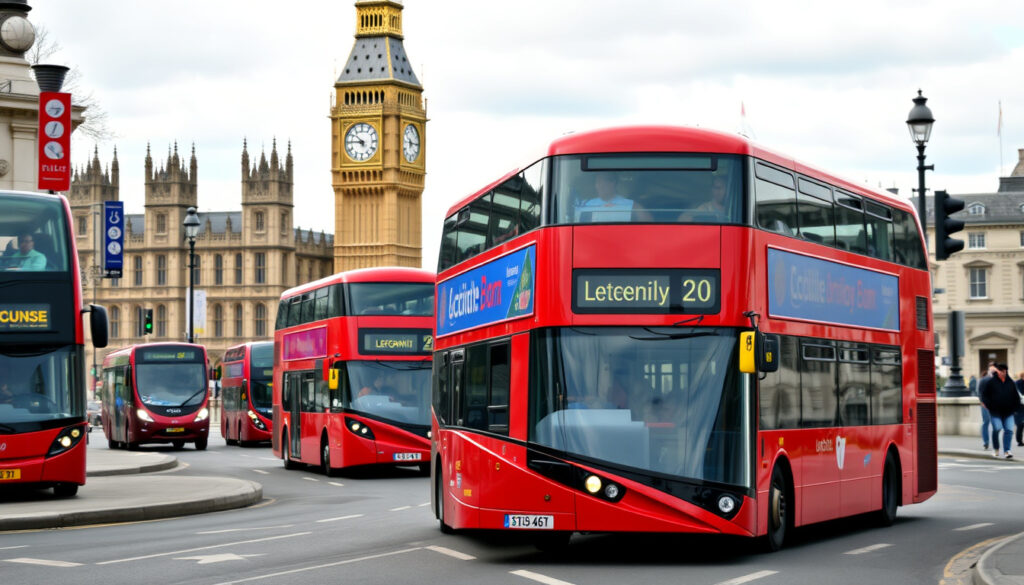
Double Decker Bus: Capacity, History, and Global Use
If you’ve ever watched a red double-decker pull away from a Dublin curb, you’ve seen one of the world’s most recognisable vehicles. Yet for all its fame, this two‑level bus remains surprisingly rare outside a handful of countries.
Height of typical double-decker bus: 4.4 meters (14 ft 5 in) ·
Maximum seating capacity: 72–84 passengers ·
Double-decker buses in London: Approximately 8,500 ·
First double-decker bus introduced: 1847 (horse‑drawn, Paris)
Quick snapshot
- Double‑decker buses operate in Dublin, Ireland (Wikipedia (encyclopedia))
- Brits call them “double‑decker buses” (Dublin Inquirer (local news site))
- US low bridge clearances are a major barrier (Move Electric (electric vehicle news))
- London does not have a monopoly on double‑deckers in the UK (route‑one (bus industry publication))
- Exact number of double‑decker buses in Ireland (no official census found)
- Whether double‑deckers can be legally used on all US roads without special permits (varies by state)
- Specific historic timeline of double‑decker use in Ireland outside Dublin
- Model variety in Galway beyond the Enviro400ER is not publicly documented
- 1847: first horse‑drawn double‑decker in Paris (Urban Transport Magazine (industry news))
- 2023: Dublin tests first electric double‑deckers (Move Electric (electric vehicle news))
- Zero‑emission double‑deckers entering service in Dublin and London (Urban Transport Magazine (industry news))
- Increased adoption in Irish regional cities like Galway (route‑one (bus industry publication))
Six facts give the quickest handle on the double‑decker’s specs and reach:
| Specification | Value | Source |
|---|---|---|
| First double‑decker | 1847, horse‑drawn in Paris | Urban Transport Magazine (industry news) |
| London fleet size | ~8,500 | route‑one (bus industry publication) |
| Standard height | 4.4 m (14 ft 5 in) | Dublin Inquirer (local news site) |
| Typical seated capacity | 72–84 passengers | Dublin Inquirer (local news site) |
| Total capacity (incl. standing) | Up to 95–100 passengers | Dublin Inquirer (local news site); Move Electric (EV news) |
| Maximum speed (UK) | 50 mph (80 km/h) | route‑one (bus industry publication) |
Are there double‑decker buses in Ireland?
Yes — and they’re everywhere in Dublin. Most buses in the Greater Dublin area are double‑deckers operated by Dublin Bus (Wikipedia (encyclopedia)). The National Transport Authority confirmed that standard double‑deckers purchased in recent years carry up to 95 passengers (Dublin Inquirer (local news site)).
Where in Ireland are double‑decker buses operated?
- Dublin: Dublin Bus runs the largest fleet, with Euro 6 models introduced from 2014‑2016 (Dublin Inquirer (local news site)).
- Galway: Bus Éireann operates double‑deckers; a 2020 order allocated Enviro400ER models to the city (route‑one (bus industry publication)).
- Other cities: Private operators like Nolan Coaches and Murray & Son Coaches offer double‑decker hire across the country.
Who provides double‑decker coach hire in Ireland?
Several companies specialise in large‑capacity private hire:
- Nolan Coaches operates a 76‑seater double‑decker for hire in Dublin (Nolan Coaches (Irish coach operator)).
- Murray & Son Coaches offers an 80‑seat configuration, or 76 seats with one wheelchair space (Martin Twomey / Murray & Son Coaches (Irish coach operator)).
- Express Bus lists a 74‑seat double‑decker in its fleet (Express Bus (Irish coach operator)).
The takeaway: Ireland’s double‑decker market is split between public mass transit and a vibrant private‑hire sector that caters to groups, tourists, and events.
What do Brits call a double‑decker bus?
The everyday term in the UK is simply a “double‑decker bus” — or just “double‑decker” for short. The phrase has become the standard name, even among transport professionals.
What is the official name for a double‑decker bus in the UK?
Officially, British bus companies refer to them by manufacturer and model, e.g. “Wrightbus StreetDeck” or “Alexander Dennis Enviro400.” The term “double‑decker” is informal but universal.
Is “Routemaster” a specific model?
Yes. The Routemaster is the iconic London model introduced in 1954 and withdrawn from regular service in 2005. It’s a specific design — open rear platform, front engine — not a generic term for all double‑deckers.
The pattern: in the UK, “double‑decker” is the everyday label, while model names (Routemaster, Enviro400) signal specific engineering choices.
Why doesn’t America have double‑decker buses?
Low bridge clearances are the primary obstacle. Many US cities have bridges and tunnels with clearances below 4.4 m, making a standard double‑decker unusable on most routes.
What infrastructure obstacles exist in the US?
- Low overpasses and tunnels restrict height to around 3.7–4.0 m in many downtown areas.
- Transit agencies opt for articulated single‑deckers (bendy buses) that carry 100+ passengers without height issues.
- Higher purchase costs and limited domestic manufacturing also play a role.
Are there any exceptions (sightseeing or experimental)?
Yes. Double‑deckers are used for sightseeing tours in New York, Las Vegas, and other tourist cities. Some private charter operators also run them, but they remain absent from regular public transit outside a few trial routes.
A 4.4‑metre bus is simply too tall for standard US urban clearance. Until bridges are raised or a low‑height double‑decker is widely adopted, America’s transit will stay mostly single‑deck.
The catch is clear: until infrastructure changes, double‑deckers will remain a niche in the US.
How many does a double‑decker bus hold?
The seated capacity of a typical double‑decker ranges from 72 to 84 passengers, but total capacity — including standing — can exceed 100 (Dublin Inquirer (local news site)).
What is the typical seated capacity?
- Nolan Coaches: 76 seats (Nolan Coaches (Irish coach operator))
- Murray & Son: 80 seats (or 76 + wheelchair) (Martin Twomey / Murray & Son Coaches (Irish coach operator))
- Express Bus: 74 seats (Express Bus (Irish coach operator))
- Alexander Dennis Enviro400XLB: up to 100 seats (including tip‑up) for town routes (Alexander Dennis (bus manufacturer))
How does standing capacity affect total capacity?
In urban operations, standing passengers can push total load well past 90. Dublin Bus models hold up to 95 passengers (Dublin Inquirer (local news site)); the Wrightbus Electroliner can carry 96 (Move Electric (EV news)).
The gap between “seated” and “total” is where capacity flexibility lives — a 76‑seater can legally carry 20+ standees, making it a different vehicle from a 76‑seat coach with no standing allowed.
The implication: capacity varies hugely by operator and regulation. For groups, the “number of seats” is the binding figure; for transit agencies, total legal capacity matters more.
Why does only London have double‑decker buses?
It doesn’t — double‑deckers run in many UK cities and across Ireland. London’s buses are simply the most famous because of their red colour and the Routemaster’s cultural status.
Is London the only city with double‑deckers in the UK?
No. Manchester, Glasgow, Birmingham, and others operate double‑deckers on many routes. The UK’s bus network relies on them for high‑capacity urban transport.
What makes London’s double‑deckers iconic?
The combination of the Routemaster design (1954‑2005), the consistent red livery, and their starring role in tourism marketing has made London’s buses a global symbol. That doesn’t mean other cities don’t have them — they just don’t get the postcards.
Why this matters: the “London‑only” myth discourages other cities from considering double‑deckers where they could be useful — such as Irish regional hubs with narrow streets but high demand.
Comparison: double‑decker adoption across markets
Three markets, different outcomes — one pattern:
| Market | Typical use | Capacity model | Main barrier |
|---|---|---|---|
| United Kingdom | Public transit (urban and interurban) | 70–85 seated, 90+ total | None (infrastructure adapted) |
| Ireland | Public transit (Dublin, Galway) + private hire | 74–80 seated, up to 95 total | Limited fleet outside Dublin |
| United States | Sightseeing / charter only | 70–80 seated (no standing) | Low bridges, regulation, cost |
The trade‑off: where infrastructure allows, double‑deckers move more people per driver than single‑deckers; where it doesn’t, agencies pick articulated buses instead.
For a city like Dublin, double‑deckers are the backbone of public transit. For a city like New York, they’re a novelty. The difference is not demand — it’s three metres of vertical clearance.
The implication: infrastructure determines the bus type, not demand.
Quotes from the experts
“The double‑decker bus is a bus that has two decks or levels.”
“Our 76‑seater double‑decker offers comfort and capacity for group travel.”
“Dublin Bus introduced Euro 6 double‑decker buses into service between 2014 and 2016, with standard units holding up to 95 passengers.”
— Dublin Inquirer (local news site)
For Ireland, the choice is clear: double‑deckers already move thousands daily, and the electric transition will deepen their role. For US operators still on the fence, the decision hinges on bridge heights — a simple measurement that decides whether a double‑decker can even enter the city.
policyline.uk, oi.ie, murrayandsoncoaches.ie, canadianreport.org
Frequently asked questions
What is the maximum speed of a double‑decker bus?
In the UK, double‑deckers are typically limited to 50 mph (80 km/h).
How many wheels does a double‑decker bus have?
Most double‑deckers have six wheels: two at the front and dual rear wheels on each side.
Are double‑decker buses wheelchair accessible?
Modern models include wheelchair spaces on the lower deck. For example, the Wrightbus Electroliner has a permanent wheelchair space (Move Electric (EV news)).
What is the fuel efficiency of a double‑decker bus?
Efficiency varies by engine and route; a typical diesel double‑decker achieves around 6–8 mpg (0.35–0.25 km/L). Electric models offer lower per‑km costs.
Can you stand on the upper deck of a double‑decker bus?
Standing on the upper deck is prohibited for safety reasons in most countries. Passengers must be seated when the bus is moving.
How much does a double‑decker bus weigh?
A typical double‑decker weighs around 10–12 tonnes unladen, and up to 18 tonnes fully loaded.
What is the difference between a double‑decker bus and a coach?
A double‑decker can have two passenger decks; a coach is a single‑deck vehicle designed for longer journeys with luggage space. Some coaches are also double‑deck, but the terms describe different layout and purpose.
Related reading
More related posts
 Barbara Eden Today: Age 95, Larry Hagman, and Life Facts
 Picture Rail: Purpose, Differences & Installation Tips
 Who Is the New Pope – Leo XIV, First US Pope After Francis
 Carlos Tevez: Scars, Man Utd Exit, and Life After Football
 Terence Stamp: Life, Career, and Death at 87
 John Frusciante: Biography, Addiction, and Guitar Legacy
 Sansa Stark: Complete Character Guide and Timeline
 NHS Band 6 Salary – 2025/26 Pay Scales and 2026 Rates
