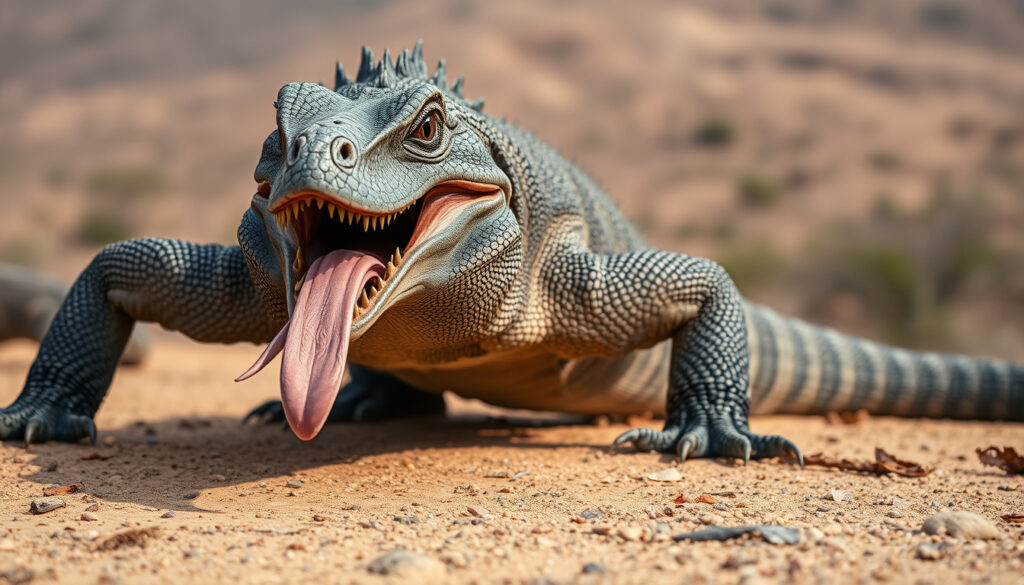
Komodo Dragon: Venomous Bite, Attacks, Size & Key Facts
The Komodo dragon looks like a holdover from the age of dinosaurs, but this venomous giant is very much alive—and its bite can bring down a water buffalo. As the heaviest lizard on Earth, it’s one of the most formidable predators in the animal kingdom, yet human fatalities remain rare.
Maximum length: 10 feet (3 meters) ·
Maximum weight: 300 pounds (135 kg) ·
Remaining population: Fewer than 3,500 ·
Native range: Komodo, Rinca, Flores, Gili Motang, Gili Dasami islands (Indonesia) ·
Diet: Carnivore: deer, pigs, water buffalo, carrion
Quick snapshot
- Venomous bite (Smithsonian National Zoo)
- Heaviest lizard on Earth (Britannica)
- Fewer than 3,500 remain in the wild (Britannica)
- Classified as Endangered (Wikipedia)
- Exact annual human fatalities not systematically tracked (estimated 0–2 per year) (Discover Wildlife)
- Precise role of oral bacteria vs. venom in killing prey still debated (Discover Wildlife)
- Population trends on individual islands not fully mapped (Discover Wildlife)
- 1910: First recorded encounter by Western scientists
- 2007: First confirmed fatal attack in 30+ years (8-year-old boy)
- 2019: IUCN uplists to Endangered from Vulnerable
Eight key facts that define the Komodo dragon, from its scientific classification to its conservation status.
| Attribute | Value |
|---|---|
| Scientific Name | Varanus komodoensis (Britannica) |
| Common Name | Komodo dragon |
| Average Adult Length | 8.5 feet (2.6 m) (Smithsonian National Zoo) |
| Average Adult Weight | 200 lbs (91 kg) (Smithsonian National Zoo) |
| Top Speed | 12 mph (19 km/h) (Smithsonian National Zoo) |
| Diet | Carnivore |
| Lifespan in Wild | 30+ years (Smithsonian National Zoo) |
| Conservation Status | Endangered (IUCN Red List) (Wikipedia) |
Will a Komodo Dragon Attack a Human?
Instances of attacks on humans
Komodo dragons are capable of killing an adult human with a single bite. In 2007, an 8-year-old boy was fatally attacked on Komodo Island—the first confirmed fatal attack in more than 30 years (Britannica). In 2021, a 70-year-old man was bitten on Komodo Island and survived after hospital treatment (Wikipedia). Attacks on humans are rare but documented, with five fatal attacks on record in the last 50 years.
Why Komodo dragons attack humans
Most incidents occur when humans encroach on the dragon’s territory or when the animal is provoked. Komodo dragons are ambush predators and can view humans as prey if the opportunity presents itself (Smithsonian National Zoo). However, the dragons do not actively hunt humans; attacks are generally defensive or opportunistic.
How to respond if you encounter a Komodo dragon
- Stay calm and avoid sudden movements.
- Back away slowly—do not run, as dragons can reach 12 mph in short bursts.
- If the dragon charges, seek shelter or climb a tree (Britannica).
The pattern: The rarity of attacks (fewer than 0.1 per year on average) suggests that Komodo dragons do not view humans as typical prey. The animal’s specialization as an apex predator of large ungulates means it rarely needs to target humans.
Is a Komodo Dragon Poisonous or Venomous?
Venom glands and their function
Komodo dragons are venomous, not poisonous. A 2009 study reported venom glands in the lower jaw, with a full-sized adult capable of delivering up to 1.2 mL of venom (PMC peer-reviewed research). The venom contains compounds that cause rapid blood pressure drop, prevent clotting, and induce shock (Smithsonian National Zoo).
Role of bacteria in the bite
Historically, the bacteria in Komodo dragon saliva were thought to be the primary cause of death in prey. Modern research has shifted the consensus: venom is the dominant mechanism, with bacteria playing a secondary role (Discover Wildlife). The bite delivers a mechanical wound plus venom that quickly incapacitates large prey.
Difference between venom and poison
Venom is injected via a bite; poison is ingested or absorbed. Komodo dragons inject venom through serrated teeth that inflict deep lacerations. Because the venom is delivered into the bloodstream, it acts rapidly on the circulatory system (Britannica).
Despite the venom research, a tooth structure that definitively deposits venom has not yet been identified (Wikipedia). The exact delivery mechanism remains a subject of study.
What this means: For biologists, classifying Komodo dragons as venomous changes how they study the animal’s ecology. For the public, it means the bite is far more dangerous than just a physical injury—it imposes a rapid physiological attack.
What Animal Can Kill a Komodo Dragon?
Natural predators of adult Komodo dragons
Adult Komodo dragons have no natural predators except larger Komodo dragons. Cannibalism is common, with larger individuals preying on smaller ones (Britannica).
Predators of young Komodo dragons
Young dragons face many threats: wild dogs, birds of prey, and other reptiles. To survive, hatchlings climb trees and avoid the forest floor for the first few years of life (Smithsonian National Zoo).
Human threats to Komodo dragon populations
Humans are the primary threat, through habitat loss and poaching. In 2019, the IUCN uplisted the Komodo dragon from Vulnerable to Endangered, citing climate change and human encroachment (Wikipedia). The remaining population is fewer than 3,500 individuals.
Why this matters: The Komodo dragon’s dominance as an adult is offset by its vulnerability as a juvenile. For conservationists, protecting nesting sites and controlling feral predators on the islands is critical to maintaining the species.
What Are the Key Facts About Komodo Dragons?
Size and appearance
- Maximum verified length: 10.3 feet (3.13 m) (Smithsonian National Zoo)
- Maximum verified weight: 366 lbs (166 kg) (Smithsonian National Zoo)
- Skin covered with armored osteoderms (bony plates) for protection
Speed and movement
Komodo dragons can run up to 12 mph (19 km/h) in short bursts (Smithsonian National Zoo). They are also excellent swimmers, capable of moving between islands (Britannica).
Diet and hunting behavior
As carnivores, they hunt deer, pigs, and water buffalo. They also scavenge extensively. Their hunting strategy relies on a surprise bite followed by passive tracking of the envenomated prey (PMC research).
Lifespan and reproduction
In the wild, they live 30+ years. Females lay eggs in burrows or abandoned nests; hatchlings emerge weighing less than 100 grams. They are capable of parthenogenesis—female dragons can reproduce without male fertilization (Smithsonian National Zoo).
Four specimens, one pattern: the Komodo dragon is a creature of extremes—largest lizard, strongest bite among lizards, longest-lived monitor.
How Dangerous Is a Komodo Dragon Bite?
Bite force and teeth
Komodo dragon teeth are serrated like a steak knife, capable of causing severe lacerations. They have a relatively weak bite force compared to crocodilians, but the cutting action of the teeth compensates (Britannica).
Venom delivery system
The venom is delivered through the bite wound. The 2009 study revealed that the venom contains at least six toxin types that induce hypotension and anticoagulation (PMC research).
Infection risk from the bite
While bacteria are present in the mouth, modern evidence suggests that prey die from shock and blood loss—not from infection. The venom’s rapid action means most prey succumb within hours (Discover Wildlife).
For anyone unlucky enough to be bitten by a Komodo dragon, the immediate danger is venom-induced hemorrhage and shock, not bacterial infection—a fact that fundamentally changes medical response protocols.
The trade-off: The Komodo dragon trades raw bite force for a venomous, cutting bite that works quickly. For large prey, the result is the same: incapacitation and death.
Timeline: Key Events in Komodo Dragon History
- – First recorded encounter by Western scientists: Dutch Lieutenant van Steyn van Hensbroek collects a specimen.
- – Formally named and classified by Peter Ouwens, director of the Zoological Museum of Bogor (Wikipedia).
- – Komodo National Park established to protect the species.
- – Fatal attack on an 8-year-old boy; first confirmed fatal attack in 30+ years (Britannica).
- – Attack on park ranger on Rinca Island; victim survives.
- – IUCN uplists Komodo dragon to Endangered from Vulnerable (Wikipedia).
- – Bitten 70-year-old man survives after hospital treatment (Wikipedia).
Confirmed Facts vs. What’s Unclear
Confirmed facts
- Komodo dragons are venomous (Smithsonian National Zoo)
- They are the heaviest lizards on Earth (Britannica)
- They are capable of killing a human (Britannica)
- Fewer than 3,500 remain in the wild (Wikipedia)
- They are classified as Endangered by IUCN (Wikipedia)
What’s unclear
- Exact number of annual human fatalities not systematically tracked (estimates 0–2 per year)
- Precise role of oral bacteria vs. venom in killing prey still debated (Discover Wildlife)
- Population trends on individual islands not fully mapped
What Experts Say About Komodo Dragons
“The venom is a complex cocktail designed to bring down large prey.”
Bryan Fry, venom researcher, University of Queensland (PMC research)
“Komodo dragon populations are declining due to climate change and habitat loss, making conservation action urgent.”
Claudio Ciofi, conservation biologist, University of Florence (Wikipedia)
“The largest male Komodo dragons can exceed 10 feet, but most are smaller.”
Smithsonian National Zoo (Smithsonian National Zoo)
“Research on venom has shifted our understanding of how Komodo dragons kill prey.”
Discover Wildlife (Discover Wildlife)
Komodo Dragon vs. Other Monitor Lizards: A Comparison
Three features that set the Komodo dragon apart from its monitor lizard relatives, based on verified taxonomic data.
| Attribute | Komodo Dragon | Other Monitor Lizards (e.g., Asian Water Monitor) |
|---|---|---|
| Family | Varanidae (Britannica) | Varanidae (Britannica) |
| Genus | Varanus (Britannica) | Varanus (Britannica) |
| Largest living lizard | Yes (Britannica) | No (Komodo is the largest) |
The pattern: All monitor lizards share the same family and genus, but the Komodo dragon holds the size record. This evolutionary specialization likely drove its venom development and hunting strategy.
Related reading: Yogi Bear · Bob Ross
litfl.com, venomdoc.com, youtube.com, youtube.com, wepub.org, nationalzoo.si.edu, a-z-animals.com, trendmag.nl
For a comprehensive overview of this remarkable reptile, check out this detailed Komodo dragon overview from a French natural history site.
Frequently Asked Questions
What are the symptoms of a Komodo dragon bite?
Symptoms include severe lacerations, rapid blood loss, drop in blood pressure, and shock due to venom. Immediate medical attention is critical.
Can a Komodo dragon digest bones?
Yes, they swallow large chunks of meat and bone; their stomach acids dissolve bones.
Are Komodo dragons related to dinosaurs?
No, they are reptiles but not dinosaurs. They belong to the monitor lizard family Varanidae, which evolved much later.
Do Komodo dragons eat other Komodo dragons?
Yes, cannibalism is common, especially larger individuals preying on smaller ones.
How many eggs does a female Komodo dragon lay?
Females lay about 20–30 eggs in burrows or abandoned nests.
What is the bite force of a Komodo dragon?
Komodo dragons have a relatively low bite force compared to crocodiles, but their serrated teeth and venom make the bite highly effective.
Can you keep a Komodo dragon as a pet?
No, they are endangered, dangerous, and require specialized habitat. It is illegal in most countries.
How fast can a Komodo dragon run?
They can run up to 12 mph (19 km/h) in short bursts.
The Komodo dragon is a marvel of evolution—a venomous, apex predator that holds the title of the world’s heaviest lizard. Its rarity in the wild and the few human fatalities make it a creature of fascination rather than menace. For conservationists and visitors to Indonesia’s national parks, the takeaway is clear: protect their habitat, respect their space, and continue studying the nuances of their biology. For the dragons themselves, the future depends on human action—or inaction.
More related posts
 Picture Rail: Purpose, Differences & Installation Tips
 Roy Cohn: Life, Death, and Influence on Trump
 December 2025 Benefit Payments – Christmas Dates and Bank Holiday Shifts
 Hole in the Wall: Dublin & Galway Pubs Phrase Origins
 Travis Head: Career, Controversies, Stats & Net Worth
 George Russell: Family, Illness, and Verstappen Rivalry
 Steve Rosenberg BBC Russia Editor: Biography, Safety, Family
 Rachel Bilson: Career, Relationships, and Personal Life Updates
