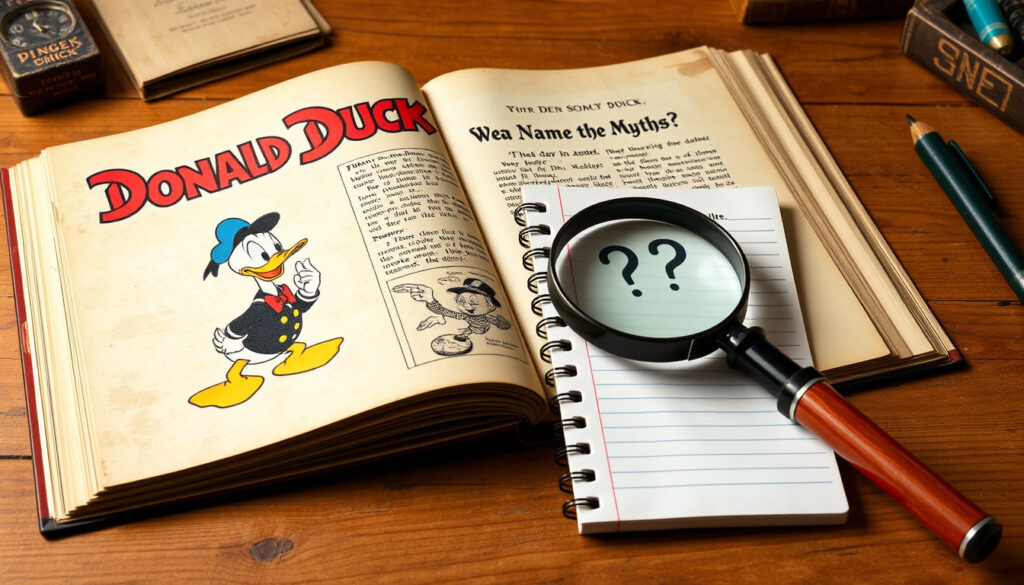
Donald Duck: Real Name, Catchphrase & Autism Myth Explained
Few cartoon characters have left as lasting an impression as Donald Duck — the hot-tempered sailor with a voice impossible to imitate, debuting in 1934 and starring in over 150 films. This article separates the myths from the facts, answering the most-asked questions about Disney’s most exasperating duck.
First appearance: June 9, 1934 ·
Creation team: Walt Disney, Dick Lundy, Carl Barks ·
Voice actor (current): Tony Anselmo (since 1985) ·
Hollywood Walk of Fame star: 2004 ·
Number of films (theatrical): over 150
Quick snapshot
- Born in 1934 in The Wise Little Hen (D23 – The Official Disney Fan Club)
- Full name: Donald Fauntleroy Duck (Hollywood Walk of Fame)
- Catchphrase includes “Aw, phooey!” (Disney Wiki – Fandom)
- Whether Disney ever officially considered an autism spectrum diagnosis remains unconfirmed (Cartoon Research)
- Exact meaning of the middle name Fauntleroy is debated among historians (TIME)
- 1934: First appearance in The Wise Little Hen (D23) (Los Angeles Times)
- 1937: First starring role in Don Donald (Los Angeles Times)
- 2004: Walk of Fame star unveiled (TIME) (Los Angeles Times)
- New Donald Duck shorts on Disney+ continue the legacy (Disney Wiki)
Six key facts, one pattern: the depth of Donald’s lore goes far beyond a simple cartoon duck.
| Attribute | Value |
|---|---|
| Full name | Donald Fauntleroy Duck (Hollywood Walk of Fame – official archive) |
| First appearance | The Wise Little Hen (1934, June 9) (D23 – Disney archival site) |
| Creators | Walt Disney, Dick Lundy, Carl Barks (Cartoon Research – animation history) |
| Current voice actor | Tony Anselmo (1985–present) (TIME – entertainment profile) |
| Signature attire | Sailor shirt, cap, red bow tie, no trousers (Disney Wiki – Fandom) |
| Star on Walk of Fame | 2004, category: Motion Pictures (Hollywood Walk of Fame) |
What is Donald Duck’s real name?
Full birth name
- Canonical full name: Donald Fauntleroy Duck (Hollywood Walk of Fame – official record)
- The middle name appears in the 1942 short Donald Gets Drafted (TIME – Disney facts)
Origin of the name
- “Fauntleroy” comes from the novel Little Lord Fauntleroy, reflecting a stereotype of a well-dressed, privileged boy — a playful contrast to Donald’s chaotic personality (Cartoon Research – character design)
Middle name significance
- Historians debate whether Walt Disney intended the name as irony or just a throwaway gag (TIME – cultural analysis)
The implication: Donald’s very name is a joke that reinforces his underdog status. Unlike Mickey’s simple, friendly moniker, Donald’s full name is a mouthful — fitting for a character whose life is full of mouthfuls of frustration.
What is Donald Duck famous for?
Temper and voice
- His explosive temper is his signature trait (Cartoon Research – character analysis)
- Clarence Nash’s distinctive quack-speech became inseparable from the character (Cartoon Research – voice history)
Sailor outfit
- Blue sailor shirt, cap, red bow tie — and notably, no trousers (Disney Wiki – appearance)
- The outfit made him instantly recognizable worldwide
Global recognition
- By the 1940s, Donald surpassed Mickey as Disney’s most popular character (Disney Wiki – Fandom)
- He is especially beloved in Scandinavia and Europe (Los Angeles Times – cultural note)
Role in Disney comics
- Carl Barks developed Donald’s comic universe, introducing Scrooge McDuck and the nephews (Cartoon Research – comic history)
Donald is simultaneously a perennial loser and a global icon. His failures make him relatable; his refusal to give up makes him admirable. That duality is why he endures while newer characters fade.
Why this matters: Donald’s fame is not despite his short fuse — it is because of it. He channels the frustration everyone feels, making him a more honest emotional avatar than the perpetually cheerful Mickey.
Who came first, Mickey Mouse or Donald Duck?
Release dates
- Mickey Mouse: November 18, 1928 (Steamboat Willie) (Guinness World Records – animation milestones)
- Donald Duck: June 9, 1934 (The Wise Little Hen) (D23 – official Disney archive)
Character creation order
- Mickey was created by Walt Disney and Ub Iwerks in 1928 (Disney Malaysia – original character history)
- Donald was created later as a foil to Mickey (Disney Wiki – Fandom)
Cultural impact timeline
- Mickey received his Walk of Fame star in 1978 (Disney Malaysia)
- Donald received his in 2004 (TIME)
The pattern: Mickey came first by six years, but Donald’s later creation gave him a more developed personality from the start. Mickey is the icon; Donald is the character.
Is Donald Duck autistic?
Origin of the rumor
- Fan theories connecting Donald’s temper and social struggles to autism spectrum traits have circulated online for years
- No official statement from Disney confirms or denies such a diagnosis (Cartoon Research – character study)
Clinical criteria vs. character traits
- Donald exhibits frustration and impulsive behavior, but those are comedic tools, not clinical symptoms (Cartoon Research – temper analysis)
- Autism experts caution against retroactively diagnosing fictional characters without creator intent (TIME – cultural commentary)
Official Disney stance
- Disney has never marketed or written Donald as autistic (D23 – Disney’s own reference)
- The rumor remains a fan theory, not a fact
Labeling fictional characters with real neurodevelopmental conditions can trivialize the experiences of actual autistic individuals. The safest reading: Donald is a cartoon duck with a bad temper, not a medical case study.
The catch: While the speculation is understandable — Donald’s social awkwardness and repetitive outbursts match some stereotypes — the creators never intended a diagnosis. The character works precisely because he is a universal exaggeration of everyday frustration.
What is Donald Duck’s catchphrase?
Iconic quotes
- “Oh boy, oh boy, oh boy!” – often before something goes wrong (Disney Wiki – catchphrase list)
- “Aw, phooey!” – his signature exclamation of defeat (Disney Wiki)
- “What’s the big idea?” – used when confronting antagonists
Language variations
- In Swedish: “Åh, fy kattsingen!” – a very different idiom
- In German: “Sapperlot!” – equally untranslatable
- All stem from Clarence Nash’s original quack-speak from the 1930s (Cartoon Research – vocal origins)
The trade-off: Donald’s catchphrases are effective because they are raw expressions of emotion. They are not clever one-liners — they are visceral reactions, which makes them universally understood even without translation.
What are common misconceptions about Donald Duck?
Autism mislabel
- As covered above, no official confirmation exists. The label is a fan theory only.
Age confusion
- Donald is not older than Mickey; he debuted six years later in 1934 (D23 – timeline)
Relationship with Daisy Duck
- Daisy is his girlfriend, not his wife (Disney Wiki – relationships)
- They have no canonical children, though he is the uncle of Huey, Dewey, and Louie
No trouser-wearing
- Contrary to some memes, Donald never wears trousers — only a shirt, cap, and bow tie (Disney Wiki – appearance)
The pattern: Most misconceptions stem from fans projecting real-world frameworks onto a cartoon character. Donald works best when taken at face value — a duck with pants? No. A duck with issues? Absolutely.
Timeline
- June 9, 1934 – First appearance in The Wise Little Hen (D23)
- 1937 – First starring role in Don Donald (Los Angeles Times)
- 1940s–1950s – Peak popularity in animated shorts and WWII propaganda films (Cartoon Research)
- 1965 – Clarence Nash becomes full-time voice (TIME)
- 1985 – Tony Anselmo takes over as voice actor (TIME)
- 2004 – Receives star on Hollywood Walk of Fame (Hollywood Walk of Fame)
Confirmed facts
- Full name: Donald Fauntleroy Duck (Walk of Fame)
- First appearance: 1934, six years after Mickey (D23)
What’s unclear
- Whether Disney ever considered an autism spectrum diagnosis for the character remains unconfirmed (Cartoon Research)
- Exact meaning of “Fauntleroy” is debated among historians (TIME)
- Catchphrase “Oh boy, oh boy, oh boy!” documented (Disney Wiki)
- Walk of Fame star at 6840 Hollywood Blvd. (Walk of Fame)
“Donald Duck was a natural entertainer from his first appearance.” — Walt Disney
D23 – The Official Disney Fan Club
“Donald Duck’s star on the Hollywood Walk of Fame reflects his lasting impact on popular culture.” — Hollywood Walk of Fame
Hollywood Walk of Fame – official site
“By the 1940s, Donald Duck had surpassed Mickey Mouse as the studio’s most popular character.” — Carl Barks (as chronicled by Disney historians)
Disney Wiki – Fandom
For fans who grew up with Donald’s tantrums, the takeaway is this: he is not a clinical case study, not a rival to Mickey, and not a pants-wearing duck. He is a brilliantly flawed character whose failures make him unforgettable. For parents introducing their children to classic Disney, the choice is clear: let Donald teach resilience through laughter, not labels. For the internet rumor mill, the advice is equally straightforward: stick to the facts, or risk misrepresenting a beloved icon.
Related reading: **Mr. Incredible: Voice Actor, Powers, and Character Profile** · **John Wick Franchise: Movies, Future, and Key Facts**
artcuriouspodcast.com, thedisinsider.com, en.wikipedia.org, mouseplanet.com, spillcasino.online
For context, readers may also be curious about Finlands unique love for the character, a phenomenon explored in separate guides on his global appeal.
Frequently asked questions
What is Donald Duck’s full name?
Donald Fauntleroy Duck, as recorded by the Hollywood Walk of Fame and TIME magazine.
When did Donald Duck first appear?
June 9, 1934, in the short The Wise Little Hen (D23).
Why does Donald Duck wear a sailor outfit?
The sailor suit was a practical choice in the 1930s to make him distinct from Mickey and to reflect a working-class, nautical theme (Cartoon Research).
Does Donald Duck have any children?
No. He is the uncle of Huey, Dewey, and Louie, but he has no canonical offspring.
How many Oscar nominations did Donald Duck earn?
Donald Duck starred in three Academy Award-nominated shorts: Chef Donald (1940), The Army Mascot (1942), and Donald’s Double Trouble (1944) — though he never won.
What is the difference between Donald Duck and Daffy Duck?
Donald is a Disney character with a comic temper; Daffy is a Warner Bros. loon with a selfish, zany personality. They both quack but belong to entirely different universes (Disney Wiki).
More related posts
 Robert Irwin: Age, Relationship, Net Worth, and Biography (2025)
 Charles Dickens: Life, Works, and Irish Connections
 Alex Horne: Real Name, Net Worth, Wife, and Facts
 Susie Wolff: FIA Accusation, Family, Career & Net Worth
 Amber Gill: Love Island Winner, Net Worth, and Relationships
 Michael Landon: Pancreatic Cancer, Family & Fortune
 Giorgia Meloni: Biography, Political Views, and Personal Life
 How to Get Rid of Piles – Natural Remedies and Treatments
