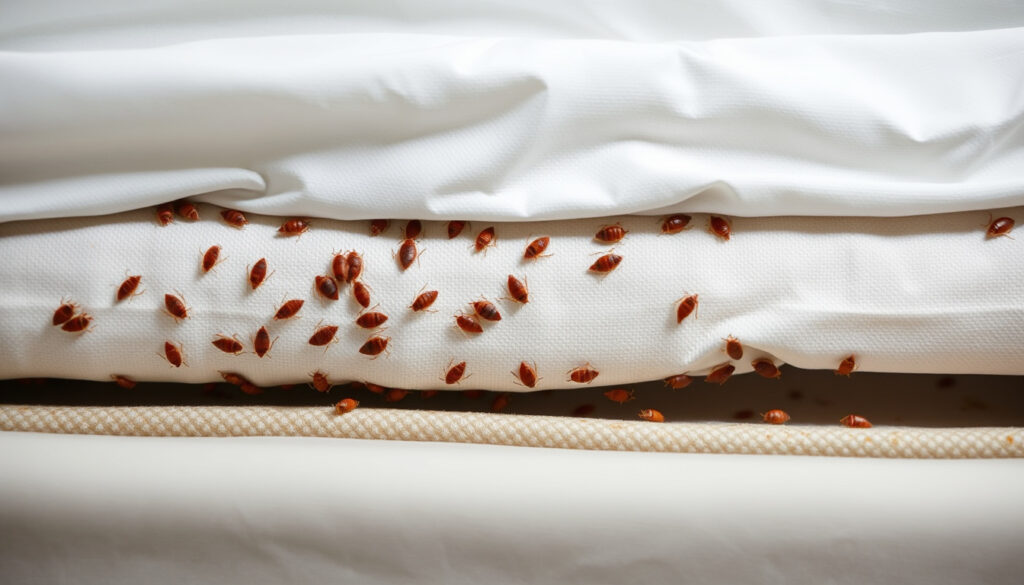
Bed Bug: Signs, Causes, and How to Get Rid of Them
You wake up with unexplained bites, spot tiny rust-colored stains on your sheets, or catch a whiff of something musty near your bed — and suddenly you’re wondering if those tiny insects have moved in. Adult bed bugs are about the size of an apple seed (4–5 mm long), according to the CDC DPDx parasitology resource, and they’re notoriously good at hiding. Here’s how to identify them, what actually causes an infestation, and which treatments work — so you can act fast with confidence.
Adult size: 4–5 mm (apple seed) ·
Eggs laid per day: 1–5 ·
Time to hatch: 6–10 days ·
Max lifespan without feeding: Up to 400 days ·
Common bite reaction: Itchy red welts
Quick snapshot
- Size and color — apple seed sized, reddish-brown (CDC DPDx)
- Bite patterns — clusters or lines on exposed skin (CDC About Bed Bugs)
- Common hiding spots — mattress seams, box springs, furniture cracks (US EPA)
- Signs of infestation — rusty stains, dark spots, shed skins, musty odor (CDC About Bed Bugs)
- How bed bugs enter homes — accidental transport on luggage, clothing, used furniture (CDC About Bed Bugs)
- Myths about cleanliness — not caused by poor hygiene (US EPA IPM guidance)
- Travel and used furniture risks — high-turnover locations are common sources (CDC About Bed Bugs)
- Heat treatment — 120°F (49°C) for 90 minutes kills all stages (US EPA IPM guidance)
- Steam cleaning — effective for furniture and mattresses (US EPA IPM guidance)
- EPA-approved sprays — pyrethroids and desiccants work within hours (US EPA IPM guidance)
- Vacuuming and encasements — traps bugs and aids detection (US EPA IPM guidance)
- Professional extermination — often required for full elimination (US EPA IPM guidance)
- Integrated pest management — multi-step approach with monitoring (US EPA IPM guidance)
- Follow-up inspections — interceptors confirm success (US EPA IPM guidance)
- Prevention after treatment — vigilance with travel and secondhand items (US EPA IPM guidance)
Six key biological and behavioral specs, one pattern: bed bugs are built to persist. Here’s what the data says about their physical profile and life cycle.
| Specification | Detail |
|---|---|
| Scientific name | Cimex lectularius (and Cimex hemipterus in tropical regions) |
| Adult length | 4–5 mm |
| Color | Reddish-brown after feeding, translucent when unfed |
| Body shape | Oval, dorsoventrally flattened |
| Lifespan | Up to 12 months under optimal conditions |
| Egg development | 6–10 days to hatch at room temperature |
| Feeding frequency | Every 5–10 days |
| Maximum survival without feeding | Up to 400 days (adults) |
| Heat lethality threshold | 120°F (49°C) for 90 minutes kills all life stages |
| Cold lethality threshold | 0°F (−18°C) for at least 4 days |
| Flight ability | None — they crawl, cannot fly or jump |
| Primary attractant | Carbon dioxide and body heat from hosts |
How can I tell if I had bed bugs?
What are the early signs of bed bugs?
- Rusty or reddish stains on sheets or mattresses from crushed bugs (US EPA — pest identification guidance)
- Dark spots (excrement) on mattresses, bedding, walls, and furniture (CDC About Bed Bugs)
- Pale yellow shed skins and empty eggshells in crevices (US EPA — pest identification guidance)
- A sweet, musty odor in heavily infested rooms (CDC About Bed Bugs)
The US EPA recommends using a flashlight and a credit card to inspect mattress seams, box springs, baseboards, and furniture joints. Live bugs are wingless, apple seed sized, and reddish-brown — easiest to spot when they’ve recently fed.
What do bed bug bites look like?
- Bites often appear in clusters or straight lines on exposed skin (face, neck, arms, legs)
- Individual welts are red, raised, and intensely itchy
- Reaction times vary — some people develop welts within hours, others take days (NHS — bed bug health guidance)
- Bites can lead to secondary infections if scratched excessively (CDC About Bed Bugs)
The CDC notes that most bite reactions do not require medical treatment, though antiseptic creams can ease itching and antihistamines help control the response (CDC About Bed Bugs). The catch: bites alone are not a reliable confirmation — about 30% of people show no reaction at all, so visual inspection remains the gold standard.
Where do bed bugs hide during the day?
- Mattress seams and tufts, box spring cracks, and bed frame joints
- Behind headboards, baseboards, and loose wallpaper
- Inside electrical outlets, picture frames, and curtain pleats
- In furniture crevices, upholstery folds, and under sofa cushions
The US EPA emphasizes checking within a 6–8 foot radius of the bed — bed bugs rarely wander far from their host during the day. Using a crevice tool on a vacuum and a stiff brush can dislodge hidden bugs and eggs.
The implication: Quick detection gives you a decisive advantage over a multiplying infestation.
What is the main cause of bed bugs?
Are bed bugs due to poor hygiene?
- No — bed bugs are not attracted to dirt or filth
- Infestations occur equally in clean and cluttered environments
- Clutter does provide more hiding spots, making detection harder
- The primary cause is accidental transport from infested areas (CDC About Bed Bugs)
The CDC is explicit: bed bugs are not a sign of poor housekeeping. They’re hitchhikers. The implication is that stigma around bed bugs can delay treatment — people may avoid seeking help out of embarrassment, allowing the infestation to grow.
How do bed bugs spread from one place to another?
- They hide in luggage, clothing, and personal items during travel
- Used furniture and mattresses are common vehicles for spread
- They can crawl through wall cracks, pipe chases, and electrical conduits between rooms (Wikipedia — bed bug biology overview)
- High-turnover buildings (hotels, dorms, apartment complexes, shelters) are primary transmission hubs
The US EPA advises inspecting secondhand furniture before bringing it inside and keeping luggage off hotel room floors as first-line prevention. For apartment dwellers, sealing cracks around baseboards and electrical outlets can slow spread between units.
Bed bugs do not discriminate between clean and dirty homes — they follow carbon dioxide and body heat. Travelers and apartment residents face the highest risk because proximity and mobility are the real vectors, not hygiene.
What this means: Focus on preventing hitchhiking rather than cleaning more.
What kills bedbugs immediately?
Does heat kill bed bugs?
- Yes — high heat at 120°F (49°C) for 90 minutes kills all life stages, including eggs (US EPA IPM guidance)
- Steam cleaning kills bugs on contact for furniture, mattresses, and upholstery
- Putting bedding and clothing in a dryer at high heat for 30 minutes kills bugs and eggs — washing alone generally will not (US EPA IPM guidance)
- Cold treatments below 0°F (−18°C) for at least 4 days can eliminate some infestations, but this is impractical for most households (US EPA IPM guidance)
Are chemical sprays effective instantly?
- EPA-registered insecticides containing pyrethroids or desiccants can kill within hours but often require repeat applications (US EPA IPM guidance)
- Diatomaceous earth works more slowly (days) by dehydrating bugs through their exoskeleton
- No spray kills eggs — treatment must be repeated after eggs hatch (typically 6–10 days) (CDC DPDx)
- The EPA warns against “bug bombs” and foggers, which can scatter bed bugs deeper into walls
The US EPA emphasizes that pesticides should be only one part of a multi-step Integrated Pest Management (IPM) plan — not the sole solution.
What smell do bed bugs hate the most?
Some essential oils — tea tree, lavender, peppermint, and eucalyptus — have shown repellent properties in lab settings, but their killing power is limited. The US EPA does not list essential oils as registered bed bug treatments. They may deter bugs from a small area temporarily, but they won’t eliminate an infestation. For actual control, heat and EPA-approved insecticides remain the evidence-backed choices.
The catch: Without repeated application, newly hatched nymphs will restart the cycle.
Will bed bugs go away on their own?
Do bed bugs go away if you shower?
- No — showering has no effect on an infestation
- Bed bugs live in furniture, bedding, and structural crevices — not on human skin
- They feed for 5–10 minutes then retreat to their hiding spots (Wikipedia — bed bug feeding behavior)
- Personal hygiene does not deter them; they are attracted to carbon dioxide, not sweat or dirt
Can bed bugs survive without feeding for months?
- Yes — adults can survive several months without a blood meal under cool conditions (CDC DPDx)
- At room temperature, survival without feeding is typically 2–4 months
- Nymphs (young bed bugs) need a blood meal to molt and progress through life stages
- A female can lay 1–5 eggs per day for weeks after a single feeding, so populations grow quickly
The CDC confirms that infestations do not resolve themselves — they expand. The pattern is exponential: a few bugs can become hundreds within two months. Professional treatment is required for reliable full elimination.
Bed bugs will not leave on their own. A single mated female can seed a colony that grows into hundreds within two months. The worst move is waiting — each week without treatment doubles the problem.
What this means: Waiting is the one strategy that guarantees failure.
What time of year is worst for bed bugs?
Are bed bugs more common in summer?
- Peak travel season (June–August) correlates with more infestations because bed bugs hitchhike on luggage and clothing (Wikipedia — bed bug spread patterns)
- Reports to pest control services often spike in late summer and early fall
- Indoor environments are temperature-controlled year-round, so bed bugs remain active in all seasons
- No true “off-season” — activity depends on host availability, not outdoor weather
Does cold weather kill bed bugs?
- Freezing temperatures below 0°F (−18°C) sustained for at least 4 days can kill bed bugs (US EPA IPM guidance)
- Home freezers typically don’t reach or maintain this temperature reliably
- Cold treatment is impractical for most households because of the duration and temperature required
- Bed bugs in insulated walls or near heat sources can survive outdoor winter conditions
What the seasonality data means: summer travel drives spread, but bed bugs are a year-round problem. The CDC notes that vigilance matters most after travel, regardless of the month.
How to get rid of bed bugs: a step-by-step plan
Seven steps, one logic: combine heat, mechanical removal, and chemical treatment in the right order. The US EPA’s Integrated Pest Management (IPM) approach is the evidence-backed framework.
- Confirm the infestation. Use a flashlight and credit card to inspect mattress seams, box springs, bed frames, and furniture crevices. Look for live bugs (4–5 mm, reddish-brown), dark fecal spots, shed skins, and eggs (US EPA — how to find bed bugs).
- Isolate and contain. Encase mattresses, box springs, and pillows in bed bug proof covers to trap existing bugs and prevent new ones from hiding (US EPA IPM guidance).
- Launder and heat-treat fabrics. Place bedding, clothing, and curtains in a dryer at high heat for 30 minutes. Washing alone will not kill bed bugs, but the heat cycle will (US EPA IPM guidance).
- Clean and declutter. Vacuum thoroughly — mattresses, baseboards, furniture, and floors. Immediately dispose of the vacuum bag in a sealed plastic bag outside. Reduce clutter to eliminate hiding spots.
- Apply approved insecticides. Use EPA-registered products labeled for bed bugs — look for pyrethroids, neonicotinoids, or desiccants. Apply only to cracks, crevices, and along baseboards. Never use outdoor pesticides indoors. Repeat after 10–14 days to catch newly hatched nymphs.
- Monitor with interceptors. Place bed bug interceptors under bed legs and furniture. These plastic traps catch crawling bugs and confirm whether treatment is working (US EPA IPM guidance).
- Consider professional treatment. If the infestation persists after 2–3 weeks of DIY measures, contact a licensed pest control professional. Heat treatment (whole-room or whole-home) is one of the most effective professional options (US EPA IPM guidance).
The pattern: Follow the sequence and each step reinforces the next.
What we know and what remains uncertain
Confirmed facts
- Bed bugs are attracted to carbon dioxide and body heat (CDC DPDx)
- Bites can cause secondary infections from scratching (CDC About Bed Bugs)
- Heat above 120°F (49°C) kills all life stages (US EPA IPM guidance)
- Bed bugs are not caused by poor hygiene or dirty homes
What’s unclear
- Efficacy of ultrasonic repellents is not supported by strong evidence
- Long-term effectiveness of natural remedies like essential oils varies and is poorly documented
- Exact prevalence of insecticide resistance in wild populations is region-dependent and evolving
- Whether certain home freezer treatments reliably reach lethal temperatures for the required duration
- Whether professional treatment is always required for full elimination — some infestations can be controlled with rigorous DIY IPM
- Exact survival duration without feeding varies by temperature and humidity; some sources report up to 400 days, others 2–4 months
- While bed bugs do not fly or jump, some species can climb and crawl quickly
What this means: The gaps in knowledge highlight where caution is needed — rely on proven methods first.
Expert perspectives on bed bug behavior and health
“Look for rusty or reddish stains and dark spots on bed sheets and mattresses, and check for pale yellow shed skins and live bed bugs.”
US EPA — official bed bug inspection guidance
“Bed bug bites can cause itchy, red bumps. Try not to scratch the bites, as this can cause an infection. Antiseptic creams or lotions may help with the itching.”
“Bed bugs are obligate blood-feeders that feed mainly on humans. An adult bed bug can survive for several months without a blood meal.”
What these three sources together show: identification, health management, and biological understanding reinforce each other. The EPA tells you where to look, the NHS tells you how to treat bites safely, and the biological data explains why persistence matters — bed bugs can outlast your patience if you don’t use the right approach.
Summary
Bed bugs are not a reflection of cleanliness, and they will not vanish on their own. The evidence from the CDC, EPA, NHS, and entomological research is consistent: early detection through visual inspection, heat treatment for fabrics and furniture, and a multi-step IPM approach offer the best path to elimination. The deterrent effect of essential oils is real but weak — heat and EPA-registered insecticides remain the proven tools. For anyone dealing with an active infestation, the choice is clear: act within the first week of spotting signs, or face a population that doubles every 16 days. Waiting is the one strategy that guarantees failure.
Frequently asked questions
Do bed bugs live on pillows?
Bed bugs prefer to hide in mattress seams, box springs, and bed frame crevices rather than on the surface of pillows. However, they can crawl onto pillows at night to feed on the face and neck. Pillow encasements and regular hot drying (30 minutes on high heat) eliminate any bugs that may be present.
How to trick bed bugs out of hiding?
Bed bugs emerge at night in response to carbon dioxide and body heat. A DIY monitor can be made by placing a small bowl of soapy water under a bed leg with an inverted lid or interceptor cup. Commercial interceptors are more reliable. The US EPA recommends these devices to confirm whether treatment is working.
What if I slept in a bed with bed bugs?
If you suspect you slept in an infested bed, strip your bedding and place it directly into a sealed plastic bag. Wash and dry on high heat for 30 minutes. Shower and inspect your skin — bites may not appear immediately. Check your luggage and clothing before entering other rooms. The NHS advises treating bites with antiseptic cream and avoiding scratching to prevent infection.
How to get rid of bed bugs without chemicals?
Heat is the most effective non-chemical method — 120°F (49°C) for 90 minutes kills all life stages. Steam cleaning, high-heat drying of fabrics, and thorough vacuuming with immediate bag disposal all work without chemicals. Diatomaceous earth is a non-chemical desiccant but works slowly over days.
Can bed bugs transmit diseases?
Current evidence indicates that bed bugs do not transmit diseases to humans through their bites, according to the CDC. However, their bites can cause secondary skin infections from scratching, and heavy infestations have been linked to allergic reactions, insomnia, and psychological distress.
How long before bed bug bites appear?
Reaction time varies significantly between individuals. Some people develop red, itchy welts within hours of being bitten, while others may not show any reaction for several days. The CDC notes that about 30% of people have no visible reaction to bed bug bites at all, making bites an unreliable way to confirm an infestation.
What should I do if I find one bed bug?
Finding one bed bug does not always mean a full infestation, but it should be treated as a serious warning. Capture the bug for identification (seal it in a plastic bag or tape to a white card). Inspect the entire sleeping area thoroughly using a flashlight and credit card. The US EPA recommends starting immediate preventive steps: encase the mattress, dry all bedding on high heat, and place interceptors under bed legs. If you find additional signs (stains, eggs, shed skins), contact a pest control professional.
Are bed bug bites dangerous for pets?
Bed bugs prefer human blood but will bite pets — including dogs, cats, and birds — if humans are not available. Bites on pets can cause itching, hair loss, and skin irritation. However, bed bugs do not live on pets or in their fur long-term. The CDC advises treating pet bedding with the same heat methods as human bedding.
More related posts
 £480 Universal Credit Eligibility: How Much Would I Get
 Anneka Rice: Biography, Age, Relationships, and Career Updates
 Katherine LaNasa: Biography, Cancer Battle, Career & Family
 Matthew McConaughey: Arrest, Family, and Net Worth
 Jaafar Jackson: Relationship to Michael Jackson & Biopic Role
 Imran Khan Pakistan: From Cricket Legend to Prime Minister to Prisoner
 Maxi Skirt Co Ord – Trends, Styling and Shops 2024
 Udo Kier Dies at 81: Cause of Death, Movies, and Legacy
