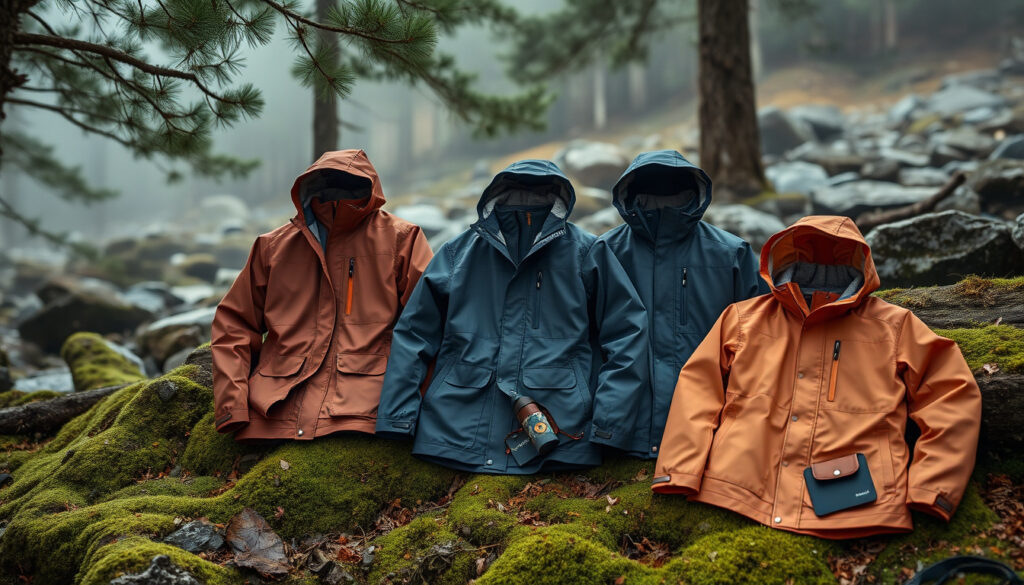
Rain Jackets Buying Guide for UK: Best Picks & Ratings
Every UK walker knows the moment: the sky opens, and the ‘showerproof’ jacket grabbed in a hurry stops being a friend. That is the line between a shell rated for heavy rain and one that simply looks the part.
Average customer rating for top rain jackets: 4.3 out of 5 stars ·
Most common waterproof rating on popular jackets: 10,000 mm ·
Estimated annual UK rain jacket sales: £500 million ·
Major rain jacket brands reviewed this year: 25+
Quick snapshot
- 10,000mm equals a 10-metre water column — the hydrostatic-head definition used by Runner’s World UK (Runner’s World UK (running-gear testers)).
- 10,000mm or more is the working threshold for heavy rain, per Outdoors Magic (Outdoors Magic (outdoor-gear editors)).
- Taped seams are non-negotiable because stitching lets water in (Good Housekeeping UK (consumer test lab)).
- There is no universal ‘waterproof’ standard; published guidance ranges from above 1,500mm to roughly 6,000–10,000mm (Runner’s World UK).
- Breathability figures are not standardised, so 10,000g on one label may not mean the same on another (Runner’s World UK).
- The long-term durability of eco-friendly waterproof fabrics is not yet proven by independent testing. (Runner’s World UK)
- UK editors are featuring 20,000mm, 22,000mm and 28,000mm jackets as the heavy-rain benchmark (Countryfile (BBC Countryfile magazine)).
- Underarm vents are appearing on premium shells as the fix for internal condensation (Countryfile (BBC Countryfile magazine)).
- At £99.95, the Craghoppers Dynamic Pro III puts a 20,000mm rating within reach (The Independent’s men’s gear guide).
- For women, the packable Sealskinz Ashwellthorpe leads The Independent’s guide at £145 (The Independent’s women’s gear guide).
The numbers that matter — and where UK editors draw the lines.
| Spec | What the numbers mean | Reference |
|---|---|---|
| Waterproof rating scale | 5,000 mm (light rain) to 30,000 mm (extreme) | Editorial market range |
| Breathability scale | 5,000 g/m²/24h (low) to 20,000+ g/m²/24h (high) | Editorial market range |
| Average jacket weight | 300–500 g for packable; 600–900 g for insulated | Editorial market range |
| Hydrostatic head | 10,000 mm = a 10-metre water column | Runner’s World UK (running-gear testers) |
| “Waterproof” threshold | No universal standard; guidance spans above 1,500 mm to about 6,000–10,000 mm | Runner’s World UK (running-gear testers) |
| Light vs heavy rain | 5,000 mm suits light rain; 10,000 mm+ for heavy rain | Outdoors Magic (outdoor-gear editors) |
| Breathability testing | Not standardised across brands | Runner’s World UK (running-gear testers) |
Are Rains jackets good quality?
Rains is the Danish brand that made rainwear look like fashion, and the quality question is really two questions. Are the jackets well made? And are they right for the weather you actually face? The honest answer: they are built to a clear urban brief, and that brief stops where serious outdoor conditions begin.
Build quality and materials used in Rains jackets
- PU-coated fabric: a waterproof synthetic layer fused to the face fabric.
- Taped seams: present on Rains jackets, closing the stitch lines that otherwise leak.
- Urban design brief: slim silhouettes, minimalist styling, built for commutes.
Those three choices explain most of the Rains experience. The PU coating does the waterproofing work, and the taping closes the needle holes that would otherwise defeat it — the same reason any serious waterproof shell needs taped seams. Rains positions itself on design rather than technical specifications, so the brand conversation is about style and day-to-day comfort rather than lab-style test results.
Comparison with other Scandinavian rainwear brands
- Rains (Denmark): style-led urban shells with PU coating and taped seams.
- Berghaus (UK): outdoor heritage brand with technical membranes and tested ratings.
- Craghoppers (UK): value-focused hiking shells — a 20,000mm model sits at £99.95 (see snapshot above).
Within the Nordic-style lane, Rains is the name most UK buyers meet first. The brands UK editors actually stress-test, however, are British outdoor specialists — and the gap shows in the spec sheet. A Craghoppers hiking shell carries a 20,000mm waterproof rating, the kind of figure fashion raincoats rarely publish.
Customer reviews and durability reports
Rains is a good jacket for light-to-moderate city rain, with a design polish most outdoor brands cannot match. For a prolonged UK downpour, buy a tested shell from an outdoor specialist instead.
Durability reports for fashion raincoats are thinner than for outdoor shells, because consumer testers rarely run them through the same abuse. The practical rule: if a brand publishes a hydrostatic head rating, you can verify its waterproofing. If it does not, you are buying a design piece, not a tested piece of weather protection.
What this means: Rains makes very good urban rainwear, but its lane is style. The moment your rain jacket needs to be a tool rather than an outfit, the answer is a rated outdoor shell.
What is the best rain jacket to buy?
There is no single best rain jacket, because the right pick changes with your weather exposure. But the editor-tested shortlist below keeps coming up in UK roundups.
Top-rated all-purpose rain jackets
- Best all-round value (men’s): Craghoppers Dynamic Pro III — 20,000mm waterproofing, 15,000g breathability, £99.95 (The Independent’s men’s gear guide, see snapshot above).
- Best packable city-to-trail (women’s): Sealskinz Ashwellthorpe packable jacket — £145 (The Independent’s women’s gear guide, see snapshot above).
- Best premium mountain shell: a 20,000mm jacket with underarm vents at £545 in Countryfile (BBC Countryfile magazine)‘s hiking roundup.
Best rain jackets for men
The men’s market in the UK roundups is dominated by British hiking brands, and the Craghoppers Dynamic Pro III is the reference point: 20,000mm waterproofing and 15,000g breathability at £99.95. Those numbers match shells that cost three times as much, which is why The Independent put it at the top of its men’s guide.
Best rain jackets for women
For women, The Independent’s pick is the Sealskinz Ashwellthorpe packable jacket at £145. It is lighter and more packable than a mountain shell, which makes it a strong commuter-to-trail choice for the UK’s mixed weather.
Budget-friendly options
- Structure beats price: a £99.95 rated shell outperforms a £150 fashion raincoat in heavy rain.
- Check whether seams are fully taped or only critically taped — it changes real-world waterproofing.
- Budget jackets often cut breathability first; if you walk at any pace, that matters.
The best value in the research is the Craghoppers shell at £99.95, because it publishes the two numbers that count: 20,000mm waterproofing and 15,000g breathability.
Will a rain jacket keep you warm?
No — a rain jacket alone will not keep you warm. It is a wind and water barrier, not an insulation layer.
How rain jackets trap body heat
- They trap a thin layer of air against your clothing, which slows heat loss.
- They block wind, removing the wind-chill that strips body heat fast.
- They do not generate or store meaningful warmth on their own.
That is why a shell feels cold on a winter commute unless you layer underneath. The membrane’s job is keeping rain out; warmth is the mid-layer’s job. This is also why three-layer shells exist — they combine waterproofing, wind protection and breathability in one jacket, as Good Housekeeping UK notes.
Insulated vs shell rain jackets
- Insulated rain jacket: shell fabric plus a fleece or synthetic liner — warmer, bulkier, less packable.
- Shell rain jacket: a single waterproof layer that you pair with insulation underneath.
If you want one jacket for a British winter, an insulated waterproof is tempting. If you want a jacket that works across seasons, a shell plus a changeable mid-layer is more flexible. Our guide to puffer jacket fills explains how different insulation types change warmth and packability (Puffer Jacket Guide: Fill, Fit and 2026 Trends).
Layering strategies for warmth
- Base layer: wicks sweat off the skin.
- Mid layer: fleece or insulated jacket provides the actual warmth.
- Shell: blocks wind and rain from reaching the layers underneath.
On a cold, wet British day, a merino base, a synthetic mid layer and a properly rated waterproof shell will keep you warmer than any single ‘warm raincoat’. The shell is the last piece of the system, not the first.
A rain jacket is a weather barrier, not a heater — budget for a mid-layer or accept a cold commute.
Which jacket is best for heavy rain?
Heavy rain is the test most jackets fail. Surviving a proper UK front comes down to a small set of measurable features.
Key features for heavy rain protection
- Waterproof rating of 10,000mm or more — the threshold editors use for heavy rain (see key facts above).
- Adjustable, rollable hood — wind-driven rain attacks your head and neck first (The Independent’s women’s gear guide).
- Covered zips, storm flaps and adjustable cuffs to stop water at the entry points (The Independent’s guide).
- Fully taped or critically taped seams (Good Housekeeping UK).
No feature matters more than seam construction in a downpour. A face fabric can be perfectly waterproof and still leak along every stitch line if the seams are not taped. That is why tested roundups treat taping as non-negotiable, and why any jacket without taped seams is a light-shower jacket in disguise.
Top heavy-rain jackets compared
- Compare ratings, breathability, hood design and closure systems before price.
- Ignore marketing words — read the numbers.
Four jackets, one pattern: the numbers are what separate heavy-rain contenders from the fashion pack, and UK editors priced them from under £100 to over £500.
| Jacket | Best for | Waterproof rating | Breathability | Price | Reference |
|---|---|---|---|---|---|
| Craghoppers Dynamic Pro III (men’s) | Heavy-rain hiking and commutes | 20,000 mm | 15,000 g/m²/24h | £99.95 | The Independent (men’s guide) |
| Sealskinz Ashwellthorpe (women’s) | Packable city-to-trail | Not stated in cited guide | Not stated in cited guide | £145 | The Independent (women’s guide) |
| Countryfile premium shell | Mountain days | 20,000 mm | Underarm vents fitted | £545 | Countryfile |
| Rains classic shell | Urban commutes in style | No rating cited | Not stated | Mid-premium | Rains brand positioning |
The pattern: the two jackets with measurable heavy-rain credentials come from outdoor specialists, and one of them costs £99.95. The fashion raincoat keeps dry in light showers but does not publish the numbers that matter in a sustained downpour.
Waterproof ratings: what 10,000mm vs 20,000mm means
- 10,000mm = a 10-metre water column — the entry floor for heavy UK rain (Runner’s World UK).
- 20,000mm = what Good Housekeeping UK calls extremely waterproof.
- 28,000mm+ = the top end already on sale in UK roundups (Countryfile).
One spec sheet, three numbers that matter — here is how to read a rain jacket label without the marketing noise.
| Spec | What it means | What to look for |
|---|---|---|
| Hydrostatic head | The height of a water column the fabric withstands before leaking; 10,000mm = 10m column (Runner’s World UK, see key facts above). | 10,000mm+ for heavy rain (Outdoors Magic, see key facts above). |
| Breathability | Moisture vapour escape in g/m²/24h; testing is not standardised across brands (Runner’s World UK). | 10,000g+ for active use; underarm vents help (Countryfile). |
| Seam taping | Water enters through stitching when seams are untaped (Good Housekeeping UK). | Fully taped or critically taped (Good Housekeeping UK). |
| Hood | Wind-driven rain hits head and neck first (The Independent). | Adjustable, rollable, with a decent peak. |
| Fabric layers | Three-layer shells combine waterproofing, wind protection and breathability (Good Housekeeping UK). | Three-layer for mountain days; packable two-and-a-half-layer for the city. |
| Weight | Packable shells run 300–500g; insulated shells 600–900g (editorial market range). | Match to distance and pack space. |
| Price | From £99.95 (Craghoppers) to £545 (premium shell) — anchored in the snapshot above. | Set your budget against your worst weather, not your best. |
| “Waterproof” label | No universal threshold; guidance spans above 1,500mm to about 6,000–10,000mm (Runner’s World UK, see key facts above). | Treat 1,500mm as water-resistant and 20,000mm as extreme (Good Housekeeping UK). |
Condensation is the second wet-out: a 20,000mm shell can still leave you soaked from the inside if breathability does not keep up with your output.
The trade-off: high waterproof ratings and high breathability pull against each other. A heavy-rain jacket is a system — membrane, taped seams, hood, vents — not a single number on the tag.
How to pick a good rain jacket?
Picking a rain jacket is an exercise in matching numbers to reality. Work through four steps and you will end up dry without paying for features you do not need.
Here is the honest trade-off, based on the sources above:
Upsides
- A rated shell at 10,000mm+ genuinely handles heavy rain.
- Taped seams and storm features keep water out at the weak points.
- A breathable membrane stops you boiling inside the jacket.
Downsides
- Internal condensation can still wet you from the inside during hard exertion.
- There is no universal ‘waterproof’ label, so you must read the numbers yourself.
- Premium-rated shells climb past £500.
Step 1: Determine your primary use
- Commute: light, packable, decent hood, easy to layer.
- Day hiking: breathable three-layer shell with pit vents.
- Mountain walking: 20,000mm+ rating, fully taped, helmet-compatible hood.
A jacket that is perfect for a bus stop is wrong for a ridge. Define the worst weather you will actually walk in, not the weather you hope for, and buy for that.
Step 2: Check waterproof and breathability ratings
Light rain: 5,000 mm ·
Heavy rain: 10,000 mm+ ·
Extreme: 20,000 mm ·
Active breathability: 10,000 g+
These are the lines UK editors actually use: Outdoors Magic puts 5,000mm at light rain and 10,000mm or more at heavy rain; Good Housekeeping UK calls 20,000mm extremely waterproof. Breathability matters just as much — if sweat cannot escape, you end up wet from the inside.
Step 3: Evaluate fit and features
- Hood: adjustable with a wired or stiffened peak; packable when not needed.
- Zips: covered or water-repellent, with a storm flap behind the front zip.
- Cuffs: adjustable, close enough to seal out wind-driven rain.
- Fit: try the jacket on over the mid-layers you will actually wear.
A jacket that fits perfectly over a thin jumper may bind over a fleece. The fit test should include your winter layering system, not just a t-shirt.
Step 4: Compare prices and warranties
- £50–£100: usable shells with modest ratings; check seam taping carefully.
- £100–£250: the value zone — 20,000mm shells such as the Craghoppers at £99.95 sit right here.
- £250+: lighter fabrics, better breathability, longer warranties.
The £545 jacket in Countryfile’s roundup earns its price with 20,000mm waterproofing and underarm vents, but the gap between £99.95 and £545 is not five times more dryness. It is better breathability, lighter fabric and more refined detail.
The best rain jacket is the one that matches your worst weather. Once you know the number you need, the marketing noise disappears.
Why this matters: the best rain jacket is the one that matches your worst weather. Once you know the number you need, the marketing noise disappears.
What’s confirmed — and what’s unclear
Separating established fact from marketing noise is the real skill in rainwear. Here is where the evidence stands.
Confirmed facts
- 10,000mm+ is the threshold editors use for heavy rain (Outdoors Magic (outdoor-gear editors)).
- Three-layer shells combine waterproofing, wind protection and breathability in one jacket (Good Housekeeping UK (consumer test lab)).
- A 10,000mm rating corresponds to a 10-metre water column — a measurable standard, not a slogan (Runner’s World UK, key facts above).
What’s unclear
- There is no universal industry threshold for calling a jacket waterproof; published guidance ranges from above 1,500mm to roughly 6,000–10,000mm (Runner’s World UK, key facts above).
- Breathability figures are not standardised across brands, so comparable claims are hard to verify.
- Whether any jacket stays truly 100% waterproof in practice remains doubtful — sweat and condensation can wet you from inside.
- Long-term durability of eco-friendly waterproof fabrics is not yet proven by independent testing.
The pattern: the marketing word ‘waterproof’ is weaker than the number behind it. Trust the millimetres, not the slogan.
“There is no universal industry-wide threshold for calling a jacket waterproof; published guidance ranges from above 1,500mm to approximately 6,000–10,000mm.”
Runner’s World UK (running-gear testers)
“5,000mm is generally suitable for light rain, while 10,000mm or more is suitable for heavy rain and more extreme conditions.”
Outdoors Magic (outdoor-gear editors)
“Fully or critically taped seams are important because water can enter through stitching even when the face fabric and membrane are waterproof.”
The verdict is simple: a rain jacket is a waterproof shell with an attitude problem — it keeps rain out but will not keep you warm, and it is only as honest as its hydrostatic head number. For UK commuters, a 10,000mm+ shell with taped seams is the rational minimum. For UK hikers, the choice is equally clear: buy a 20,000mm-rated jacket with real breathability, or plan on changing base layers in the carpark.
Related reading
- Puffer Jacket Guide: Fill, Fit and 2026 Trends — how to add the warmth a rain shell cannot provide.
- Jimmy Choo: Prices, History & Celebrity Ties — what premium positioning looks like in another fashion category.
Frequently asked questions
What are the best men’s rain jackets in the UK?
For 2026, the editor-tested top pick is the Craghoppers Dynamic Pro III: 20,000mm waterproofing, 15,000g breathability, and a £99.95 price point in The Independent’s men’s guide. For heavier mountain use, Countryfile’s roundup includes premium shells at 20,000mm and above.
What rain coat is actually waterproof?
Any jacket with taped seams and a verifiable hydrostatic head rating. The practical floor for heavy UK rain is 10,000mm; 20,000mm is what Good Housekeeping UK calls extremely waterproof.
Is there a 100% waterproof jacket?
In practice, no. There is no universal waterproof standard, and even a 28,000mm-rated shell can wet you from internal condensation when you sweat. Waterproof means waterproof to a tested pressure, not forever.
Which raincoat company is best for heavy rain?
Outdoor specialists lead the roundups: Craghoppers for value, and premium technical brands for extreme conditions, according to The Independent and Countryfile. Fashion raincoats rarely publish the ratings needed for a real downpour.
Where can I buy a good quality raincoat?
Start with specialist outdoor retailers in the UK, where staff can explain hydrostatic head and breathability. Online, buy from manufacturers or reputable outdoor gear shops, and check the spec tag before you pay.
What are the best premium rain coats for men?
Premium means lighter fabrics, better breathability and details like underarm vents. Countryfile’s roundup includes a 20,000mm shell at £545; the extra cost buys comfort in the mountains, not just a higher number.
What are the best raincoats in 2026?
The 2026 trend is breathable heavy-rain shells: jackets with 10,000–20,000mm ratings, taped seams and pit vents. Brands that publish real hydrostatic head numbers, like Craghoppers, are easier to trust than those that only say ‘waterproof’.
More related posts
 Isaac Newton: Discoveries, Personal Life, and Fascinating Facts
 Alex Oxlade-Chamberlain: Career, Family & Net Worth
 Simon Cowell Son Illness – Rumors Debunked, Facts Confirmed
 Paul Smith Comedy: Tour, Wife, Net Worth & ADHD
 Lulu Chu: Verified Facts, Biography, and Career Overview
 Martin Brundle: F1 Driver to Broadcasting Icon, Net Worth & Career
 Sophie Hermann: Reality Star’s Life, Wealth & Name Change
 Things to Do in Llandudno – Family, Couples and Rainy Day Guide
