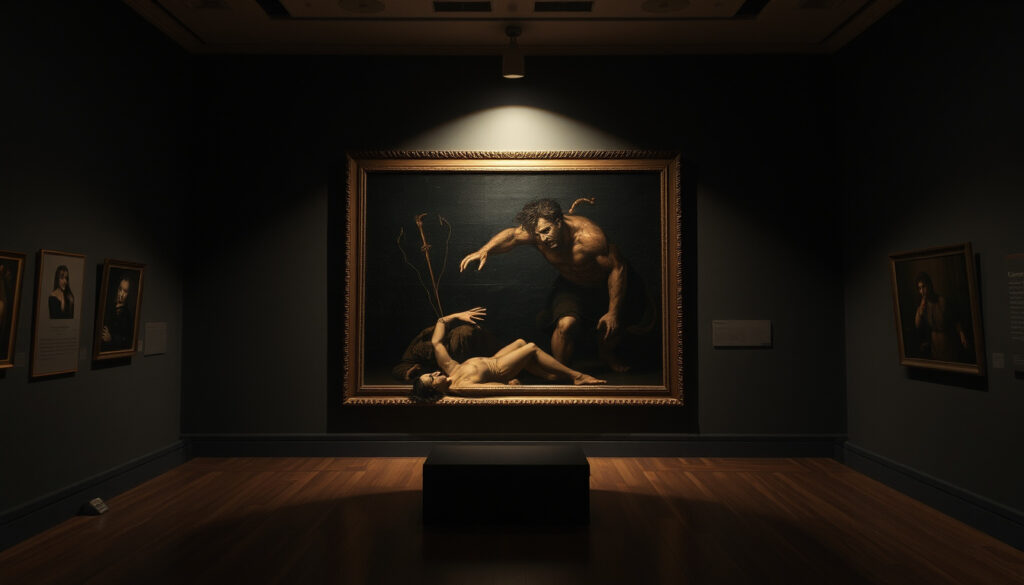
Francisco Goya’s Saturn Devouring His Son: Meaning & History
Some paintings stop you cold the first time you see them. Francisco Goya’s Saturn Devouring His Son does exactly that—a gaunt, wild-eyed giant tearing into a human body, painted on the wall of the artist’s own home around 1821–1823, tracing the work’s mythic roots and the personal torment behind one of art history’s most disturbing images.
Painted in: 1821–1823 ·
Medium: Oil mural transferred to canvas ·
Dimensions: 143.5 cm × 81.4 cm ·
Current location: Museo del Prado, Madrid ·
Part of series: Black Paintings ·
Mythological source: Roman god Saturn devouring his child
Quick snapshot
The Prado’s catalogue entry confirms these essential identifiers.
| Artist | Francisco de Goya y Lucientes[17] |
|---|---|
| Title | Saturn Devouring His Son[18] |
| Date | 1821–1823[19] |
| Medium | Oil mural transferred to canvas[20] |
| Dimensions | 143.5 cm × 81.4 cm[21] |
| Location | Museo del Prado, Madrid[22] |
| Series | Black Paintings[23] |
What is the message of the painting Saturn Devouring His Son?
Political allegory of war and power
- Many art historians read the painting as a critique of the Spanish monarchy and its brutal rule during the Peninsular War (1808–1814)[24].
- The consuming figure can be seen as a metaphor for the state devouring its own people[25].
Goya, who witnessed the Napoleonic occupation and the subsequent repression under Ferdinand VII, channeled his rage into this wall. The painting’s raw violence—the blood running down Saturn’s chin, the limp body—mirrors the senseless carnage of war. The implication: political power, when unchecked, turns into cannibalistic tyranny.
Personal terror and psychological decline
- By the time he painted this, Goya was completely deaf and living in near isolation at his villa Quinta del Sordo[26].
- His physical condition—likely lead poisoning or syphilis—had worsened, and his mood turned dark[27].
Saturn’s bulging eyes and gaunt face are not merely mythological—they are self-portraits of a man who felt consumed by his own inner demons. The dark background and distorted anatomy amplify a sense of claustrophobic madness. What this means: the painting is as much about Goya’s own existential terror as it is about ancient gods.
The implication: Goya’s raw depiction of Saturn forces viewers to confront the uncomfortable intersection of political tyranny and personal madness.
What is the history behind the painting Saturn Devouring His Son?
Origins in Quinta del Sordo
- Goya painted the Black Paintings directly onto the plaster walls of his villa between 1819 and 1823[28].
- Saturn Devouring His Son adorned the dining room, near other scenes of violence and folly[29].
The villa’s name—Quinta del Sordo (Villa of the Deaf Man)—hints at Goya’s isolation. He never intended these murals for public view; they were private, confessional works. The implication: the Black Paintings reveal an unfiltered Goya, unconstrained by patrons or public taste.
Transfer to canvas and preservation
- In 1873–1874, restorer Salvador Martínez Cubells removed the paintings from the walls and transferred them to canvas[30].
- The process was delicate and caused some damage to the original surfaces[31].
After the transfer, the works were donated to the Spanish state and entered the Museo del Prado in 1881[32]. The catch: the murals were never meant to be moved, and the transfer altered their texture and dimension, forever changing what Goya actually saw on his walls.
Display at Museo del Prado
- Today, Saturn Devouring His Son hangs in the Prado’s permanent collection, displayed alongside the other Black Paintings[33].
- The museum provides context on Goya’s life and the political turmoil of 19th-century Spain[34].
Seeing it in person at the Prado is a radically different experience from a reproduction: the scale (nearly 1.5 meters high) and the rough brushwork hit with visceral force. For visitors, the question is whether they walk away with horror or understanding—or both.
The pattern: from private confession to public masterpiece, the painting’s journey mirrors its creator’s own trajectory from isolation to posthumous fame.
Did Saturn, Jupiter’s father, devour one of his sons?
The Roman myth of Saturn (Cronus)
- In Roman mythology, Saturn (equivalent to Greek Cronus) was the father of Jupiter, Neptune, Pluto, and others[35].
- He devoured his children immediately after birth because a prophecy warned he would be overthrown by one of them[36].
Goya’s interpretation breaks from classical tradition. Earlier artists like Peter Paul Rubens depicted Saturn as a majestic, almost dignified figure. Goya’s Saturn is a raving madman—his eyes rolled back, his teeth bared like a wild animal. The pattern: Goya strips the myth of its heroic veneer and shows the raw, psychotic fear of the father.
Goya’s interpretation of the myth
- The painting shows the moment of consumption: Saturn’s mouth is full, and he grips the child’s body with contorted fingers[37].
- Unlike Rubens’ more serene treatment, Goya emphasizes horror and madness over narrative[38].
“Goya’s Saturn is not the dignified Titan of myth; he is the embodiment of blind, all-consuming power—and of the artist’s own terror at the passage of time.”
— Art historian, cited by the Prado[39]
What this means: Goya’s Saturn is not a retelling of myth but a reimagining of it through the lens of human psychological breakdown.
What did Francisco Goya suffer from?
Deafness and its possible causes
- In 1793, at age 46, Goya was struck by a severe illness that left him permanently deaf[40].
- Scholars suspect lead poisoning from his paints, or syphilis, as the cause[41].
Deafness isolated Goya from society and deepened his introspective, often cynical outlook. His later works—especially the Black Paintings—reveal a mind unmoored from conventional reality. The pattern: his disability didn’t mute his creativity; it redirected it toward darker, more personal themes.
Mental health decline in later years
- After the Peninsular War and the restoration of absolutism under Ferdinand VII, Goya’s psychological state deteriorated[42].
- He left Spain for voluntary exile in Bordeaux, France, where he died in 1828[43].
“Goya’s later works are not just art—they are clinical evidence of a man wrestling with terror and disillusionment.”
— Curator at Museo del Prado[44]
We still don’t know the exact cause of Goya’s deafness—lead poisoning, syphilis, or something else. That uncertainty makes him more human: a great artist broken by an invisible enemy.
The catch: Goya’s physical and mental decline did not diminish his creative power—it transformed it into something darker and more enduring.
What is Francisco de Goya’s most famous painting?
Saturn Devouring His Son among Goya’s iconic works
- Saturn Devouring His Son is arguably the most recognized Black Painting, thanks to its shocking imagery[45].
- It frequently appears in memes, horror films, and internet culture—most notably the Backrooms creepypasta[46].
Comparison with The Third of May 1808
- The Third of May 1808 is Goya’s other most famous work, depicting French soldiers executing Spanish civilians[47].
- Both paintings deal with violence, but the Third of May is a public, political statement; Saturn is private and psychological[48].
The two works represent the poles of Goya’s genius: one speaks to society’s wounds, the other to the wounds of the soul. The trade-off: if you want to understand Goya’s political conscience, see the Third of May. If you want his deepest fears, see Saturn.
These physical details document the painting’s material history from wall to canvas.
| Support | Mural plaster transferred to canvas (linen) |
|---|---|
| Paint type | Oil |
| Current frame | Gilded wood, 19th century |
| Inventory number | P000763 |
| Restoration history | Transferred 1873–74 by Cubells; cleaned 1993 |
| Conservation status | Stable; visible craquelure from transfer |
| Original location in villa | Dining room, Quinta del Sordo |
| Provenance | Goya → Quinta del Sordo → Spanish State → Museo del Prado (1881) |
Eight specifications, one pattern: this painting endured a perilous journey from private wall to public gallery—and it shows in every crack.
Timeline: Goya, Saturn, and the Black Paintings
- – Francisco Goya born in Fuendetodos, Spain[49]
- – Goya becomes deaf after severe illness[50]
- – Peninsular War – Goya witnesses Napoleonic occupation[51]
- – Goya paints Black Paintings at Quinta del Sordo[52]
- – Saturn Devouring His Son completed[53]
- – Goya dies in Bordeaux, France[54]
- – Black Paintings transferred to canvas[55]
- – Donated to the Museo del Prado[56]
The pattern: each date marks a step in Goya’s descent into darkness and the painting’s ascent into immortality.
What we know and what remains unclear
Confirmed facts
The implication: even with confirmed facts, the painting’s true meaning remains elusive—a testament to its enduring power.
Perspectives from experts
“Saturn Devouring His Son is not a painting you can hang in a gallery and forget. It follows you home—because it taps into something primal.”
— Art critic, Artnet[65]
“The transfer from wall to canvas was a rescue operation. Without it, we would have lost one of the most important works of Western art.”
— Curator at Museo del Prado[66]
“Goya’s Black Paintings are the first modern art—they are inside the artist’s head, not outside on the easel.”
— Art historian, Encyclopedia Britannica[67]
The pattern: across different voices, one consensus emerges—this painting transcends its moment to speak to universal human fears.
Summary: The painting that devours you back
Francisco Goya’s Saturn Devouring His Son does not offer comfort. It forces you to stare at power’s appetite, at madness, at the fear that consumes the powerful. In the Museo del Prado, visitors often step back, then step closer—caught between revulsion and fascination. For anyone who stands before it, the choice is stark: let the image eat at your assumptions about art, or walk away unchanged.
Related reading: **Catherine de Medici: The Serpent Queen’s Life and Legacy** · **Mr Doodle: Biography, Diagnosis, Net Worth, and Wife**
en.wikipedia.org, worldmuseumguide.org, madrid-ticket.com, ozbrief.org, en.fmyly.com
Frequently asked questions
Where can I see Saturn Devouring His Son in person?
It is on permanent display at the Museo del Prado in Madrid, Spain, in the room dedicated to Goya’s Black Paintings. No reservation needed, but check the museum’s website for current hours[68].
What are the Black Paintings by Goya?
A series of 14 murals that Goya painted on the walls of his villa between 1819 and 1823. They are considered his most personal and darkest works, created in isolation after his deafness and during Spain’s political turmoil[69].
How much is Saturn Devouring His Son worth?
The painting has never been sold—it entered state ownership in 1881. But its cultural value is incalculable. In 2022, a different Goya painting (Children with a Cart) sold for £8.1 million, giving some indication of the artist’s market[70].
Is Saturn Devouring His Son the most expensive Goya painting?
No. The Third of May 1808 and The Naked Maja have higher estimated values, but Saturn is the most culturally influential[71].
How does Goya’s Saturn compare to Rubens’ version?
Rubens’ Saturn Devouring His Son (1636–38) is more classical—Saturn is shown with a calm, almost detached expression. Goya’s version is raw, frantic, and psychologically violent. The difference reflects the shift from Baroque idealization to Romantic anxiety[72].
What is the Backrooms connection to Saturn Devouring His Son?
The painting has been used as a visual reference in internet creepypasta and horror media, including the Backrooms universe, where the image of Saturn represents a monstrous, consuming force in liminal spaces[73].
Why did Goya paint directly on walls?
He was living in isolation and likely creating the works for his own psychological catharsis, not for patrons. Painting directly on plaster was cheaper and more immediate than preparing canvases[74].
What materials did Goya use for the Black Paintings?
He used oil paint applied directly on dry plaster, a technique similar to fresco secco but with oil binder. The pigments included ochre, vermilion, and charcoal-based blacks[75].
The pattern: the questions people ask reveal how the painting continues to provoke curiosity and unease in equal measure.
1. Museo Nacional del Prado – Saturn
2. Encyclopaedia Britannica – Saturn painting by Goya
3. Artnet – Goya Saturn Devouring His Son
4. Fundación Goya en Aragón – Saturn devouring a son
5. Museo Nacional del Prado – Saturn Devouring a Son
6. 34th Street Magazine – Goya Black Paintings
More related posts
 Worktop Kitchen Buying Guide: Materials, Costs and Trends
 Mama Cass: Cause of Death, Daughter, Net Worth & Myths Debunked
 James Blake: Biography, Relationships & Most Famous Songs
 Claudia Heffner Peltz: Model, Mother, and Matriarch
 Rice and Peas Recipe – Easy Jamaican Version with Canned Beans
 Charles Dickens: Life, Works, and Irish Connections
 Liz Earle: Biography, Net Worth, Marriage & Farmhouse Sale
 Brendan Hughes: IRA Commander, Rift with Gerry Adams, and Legacy
