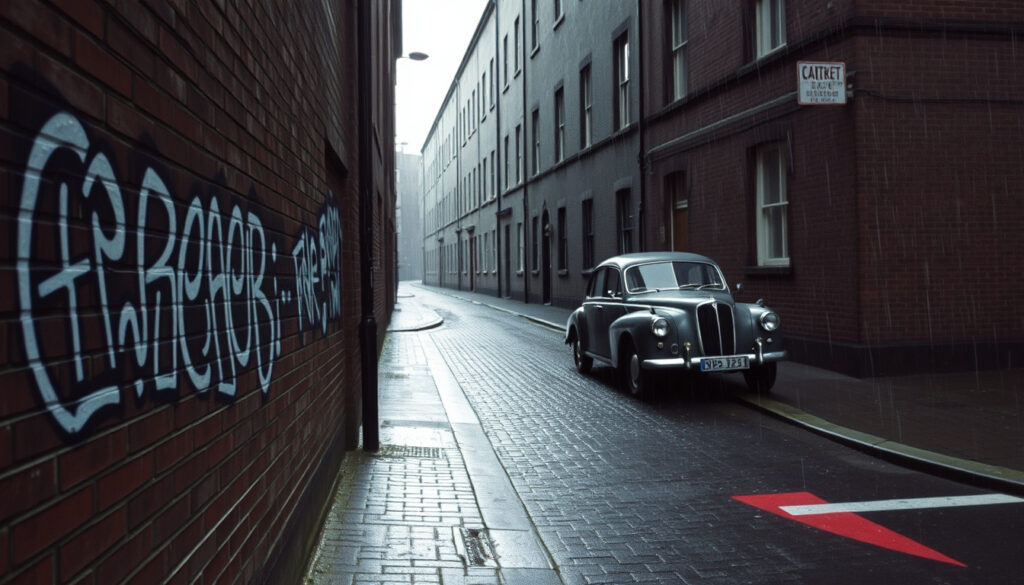
Brendan Hughes: IRA Commander, Rift with Gerry Adams, and Legacy
Few relationships in the Troubles ended as bitterly as the one between Brendan Hughes and Gerry Adams — once close friends and fellow internees, later separated by a rift that would echo through Irish republicanism for decades. This article traces Hughes’ journey from Belfast Brigade commander and hunger strike leader to the man whose posthumous testimony placed Adams at the centre of one of the conflict’s most troubling mysteries, backed by primary sources and timelines.
Born: June 1948 ·
Died: 16 February 2008 (aged 59) ·
Nickname: Darkie ·
Former role: Officer Commanding, Belfast Brigade, Provisional IRA
Quick snapshot
- Born June 1948 in Belfast (Public Books academic analysis)
- Joined the IRA in the 1960s (Public Books academic analysis)
- Rose to become OC of Belfast Brigade (Public Books academic analysis)
- Known as ‘Darkie’ (Public Books academic analysis)
- Hughes and Adams were once close allies and interned together in 1971 (The Guardian UK national newspaper)
- Hughes broke from Adams over the peace process direction (The Guardian UK national newspaper)
- Hughes alleged Adams was involved in Jean McConville’s murder (The Guardian UK national newspaper)
- 1980: Led hunger strike at Maze Prison (Public Books academic analysis)
- 2004: Gave interviews alleging Adams’ involvement (Public Books academic analysis)
- 2010: Posthumous tape broadcast publicly (BBC News UK public broadcaster)
- The Boston College archive continues to fuel debate around Adams’ role (Sky News UK news broadcaster)
- Adams was arrested in 2014 but not charged (Sky News UK news broadcaster)
- Hughes’ allegations remain contested among historians and republicans (Sky News UK news broadcaster)
The facts below capture eight details that define Hughes’ life and the controversy that followed his death.
| Label | Value |
|---|---|
| Full name | Brendan Hughes |
| Born | June 1948 |
| Died | 16 February 2008 |
| Cause of death | Cancer |
| Nickname | Darkie / The Dark |
| IRA position | Officer Commanding, Belfast Brigade |
| Notable | Led 1980 hunger strike |
| Known for | Rift with Gerry Adams, allegations about Jean McConville |
What happened between Gerry Adams and Brendan Hughes?
The split between Brendan Hughes and Gerry Adams wasn’t a single event — it was a slow rupture that mirrored the evolving direction of the republican movement itself. Hughes and Adams had been close, interned together at Long Kesh in 1971, and both rose through the ranks of the Provisional IRA. But as Adams shifted toward political negotiations in the 1990s, Hughes saw a betrayal of republican principles.
Why did they fall out?
Hughes became disillusioned with what he saw as Adams’ centralisation of power and willingness to compromise on core republican goals. The peace process, which Adams championed, struck Hughes as a surrender. By the early 2000s, Hughes was openly critical of the Sinn Féin leadership, breaking a long-standing code of silence among former IRA members.
What did Hughes say about Adams?
In interviews recorded for the Boston College oral history project, Hughes made explosive claims: that Adams had authorised the killing of Jean McConville and had control over the unit that carried it out. BBC News UK public broadcaster reported that Hughes said on tape that Adams was “in charge of the IRA” and gave the order. Adams has consistently and categorically denied these allegations.
The Hughes allegations shifted the McConville case from a historical tragedy into an active political crisis, leading directly to Adams’ arrest in 2014 and forcing Sinn Féin to confront uncomfortable questions about its past.
The implication: Hughes’ testimony, delivered after his death, remains the most direct public accusation against Adams from within the IRA’s own ranks — and it has never been tested in a courtroom.
What happened to Brendan Hughes?
Brendan Hughes lived a life that straddled two eras of Irish republicanism — the gun and the ballot box — and he died distrustful of both outcomes.
How did Brendan Hughes die?
Hughes died of cancer on 16 February 2008 at the age of 59. BBC News UK public broadcaster reported his death as marking the loss of a key figure from the 1980 hunger strike era. He was not in prison at the time of his death; he had been released years earlier following the 1981 hunger strike settlement.
What was his role in the IRA?
Hughes served as Officer Commanding of the Belfast Brigade of the Provisional IRA, a senior operational role that placed him at the centre of the conflict in Northern Ireland’s capital. Public Books academic analysis describes him as a key figure in the 1980 hunger strike and later a critic of Sinn Féin leadership. In 1980, he led a 53-day hunger strike at the Maze Prison alongside other republican prisoners demanding political status.
Hughes was both a hardline IRA commander and a man who later used his voice to expose what he saw as hypocrisy within the movement — a contradiction that made him a hero to some and a traitor to others.
The catch: Hughes’ military record is well-documented, but his shift from loyalist-to-the-cause to whistleblower makes it difficult to separate genuine testimony from personal bitterness.
What did Brendan Hughes say about Jean McConville?
Jean McConville was a widowed mother of 10 who disappeared from her home in 1972. BBC News UK public broadcaster reports that her remains were recovered in 2003 on Shelling Hill Beach in County Louth — one of the most prominent cases of the Troubles’ ‘Disappeared’.
What was the context of his allegations?
Hughes gave interviews to the Boston College oral history project in the early 2000s, recordings that were not made public until after his death. In them, he claimed that he had been aware of McConville’s murder and burial, and that Gerry Adams had authorised the operation. Sky News UK news broadcaster reported that the Boston College archive interviews became central to the public controversy around the McConville allegations.
How did his testimony affect Sinn Féin?
Hughes’ allegations placed the party under intense scrutiny. In 2014, Gerry Adams was arrested and questioned for four days in connection with McConville’s murder. The Guardian UK national newspaper reported that the 2014 police action followed renewed attention on the Boston tapes. Adams was released without charge, but the political damage was lasting.
The pattern: Hughes’ testimony did not produce a conviction, but it shattered the wall of silence around Adams’ alleged role in the Troubles’ most notorious disappearances.
Why was Brendan Hughes called Darkie?
The nickname ‘Darkie’, also used as ‘The Dark’, is believed to have originated from Hughes’ dark hair or complexion. The Blanket / Indiana University archive republican history resource notes the nickname as a common identifier within republican circles. The moniker stuck throughout his IRA career, appearing in historical accounts and news reports covering his activities.
The trade-off: While the nickname is widely used, its exact origin is not definitively documented — a small but telling gap in the historical record of a man whose life became a fault line in Irish republicanism.
Did Gerry Adams attend Brendan Hughes’ funeral?
Gerry Adams did not attend Hughes’ funeral in 2008, an absence that was widely interpreted as confirmation of the deep rift between the two men. The Guardian UK national newspaper reported that the distance between them had been such that their relationship was described as having ended in a “falling out.”
The significance of the absence cannot be overstated within republican culture, where attendance at a comrade’s funeral is both a political statement and a mark of respect. Adams’ decision not to attend signalled that the break was irreparable — and it ensured that the story of their rift would outlive both men.
Timeline: Brendan Hughes’ life and legacy
- June 1948: Brendan Hughes born
- 1970s: Joined Provisional IRA, became OC of Belfast Brigade
- 1971: Interned at Long Kesh with Gerry Adams (The Guardian UK national newspaper)
- 1980: Led 53-day hunger strike at Maze Prison (Public Books academic analysis)
- 2003: Jean McConville’s remains recovered in County Louth (Public Books academic analysis)
- 2004: Hughes gave interviews to Boston College archive alleging Adams’ involvement
- 16 February 2008: Hughes died of cancer
- 2010: Hughes’ tape broadcast publicly (BBC News UK public broadcaster)
- 2014: Gerry Adams arrested in connection with Jean McConville murder (Sky News UK news broadcaster)
Confirmed facts and what remains unclear
Confirmed facts
- Brendan Hughes was born in June 1948
- He died on 16 February 2008
- He was OC of Belfast Brigade
- He was known as Darkie
- He led the 1980 hunger strike
- He accused Gerry Adams of involvement in Jean McConville’s murder
- Gerry Adams did not attend his funeral
What’s unclear
- The exact nature of Adams’ role in McConville’s murder
- Whether Hughes’ allegations were fully accurate
“Gerry Adams was in charge of the IRA and he gave the order to execute Jean McConville.”
— Brendan Hughes (posthumous interview, Boston College archive)
“I have never been involved in the killing of Jean McConville. These allegations are false.”
— Gerry Adams (statement to media, BBC News UK public broadcaster)
“The Boston tapes changed everything — they brought the McConville case back into the public eye and directly implicated the Sinn Féin leadership.”
— Guardian journalist (reporting on Hughes’ testimony, The Guardian UK national newspaper)
For Northern Ireland, the Hughes-Adams rift is not a historical footnote but an active wound. The question of what Gerry Adams knew, and when he knew it, remains unresolved — and Hughes’ posthumous testimony ensures it will not go away. For republicans who trusted Adams, the choice is stark: accept the word of a man who led them through the peace process, or believe the dying testimony of a former commander who had nothing left to lose.
en.wikipedia.org, irishcentral.com, theguardian.com, reddit.com, bobbysandstribute.weebly.com, sbs.com.au
Frequently asked questions
What book did Brendan Hughes write?
Brendan Hughes did not write a book himself. His testimony was recorded for the Boston College oral history project and later featured in coverage by The Guardian and other outlets, most notably in the context of the Jean McConville case.
Was Brendan Hughes married?
Details about Hughes’ marital status are not widely documented in public sources. The primary records of his life focus on his IRA activities and the 1980 hunger strike.
How many children did Brendan Hughes have?
There is no verified public information about Brendan Hughes having children. His personal life was largely kept private, with most historical attention on his military and political roles.
What was Brendan Hughes’ role in the hunger strike?
Hughes was a leader of the 1980 hunger strike at the Maze Prison, participating in a 53-day fast alongside other republican prisoners demanding political status. Public Books academic analysis identifies him as a key figure in that protest.
Did Brendan Hughes die in prison?
No. Hughes died of cancer on 16 February 2008, years after his release from prison. He was not incarcerated at the time of his death.
What is the meaning of his nickname?
The nickname ‘Darkie’ (also ‘The Dark’) is believed to refer to Hughes’ dark hair or complexion, a common practice in republican circles where nicknames were used as identifiers. The Blanket / Indiana University archive republican history resource notes the term’s usage.
Where is Brendan Hughes buried?
The specific location of Brendan Hughes’ grave is not widely reported in public sources, but his funeral was held in Belfast and was notably not attended by Gerry Adams.
Related reading
More related posts
 Zack Snyder: Director of 300, Justice League, and Man of Steel
 Solid Snake: Canon Name, Voice Actors & Appearances
 Blake Shelton: Age, Wife, Children, and Latest News
 Ed O’Neill: Biography, Career, Net Worth, and Personal Life
 Bed Bug: Signs, Causes, and How to Get Rid of Them
 Harold Shipman: Doctor Death – Latest Facts & Verified Info
 UK Income Tax Bands – 2025/26 Rates and Allowances Guide
 Tom Hiddleston’s Partner, Relationship Timeline, and Family Life
