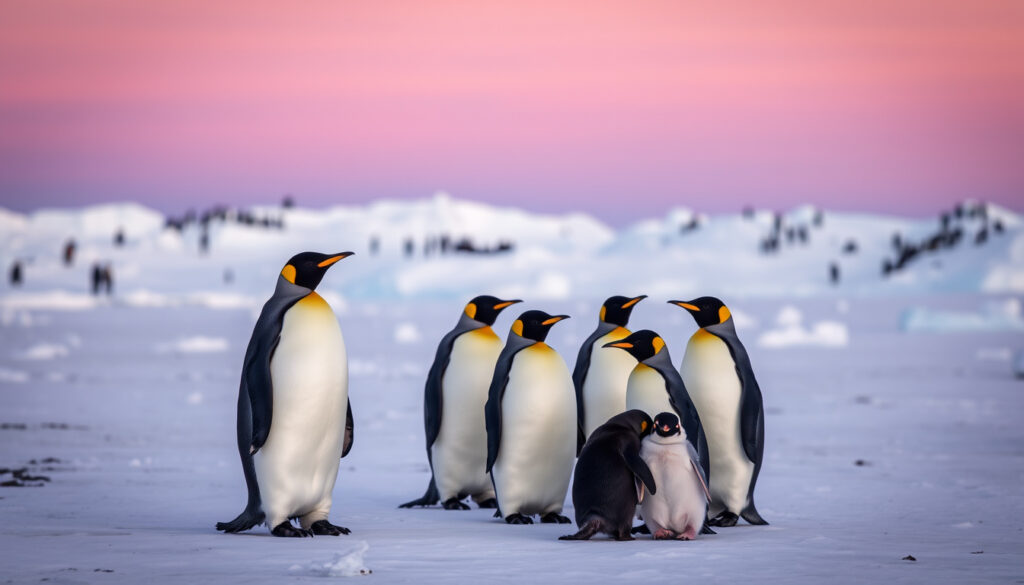
Emperor Penguin: Facts, Habitat, Behavior, and Conservation
The emperor penguin stands as the tallest penguin species, but its fame rests on something more extreme: it’s the only animal that voluntarily spends the harshest winter on Earth raising its young. This guide breaks down what science actually knows about the world’s tallest penguin, from its record-breaking dives to its uncertain future on melting ice.
Height: Up to 1.3 m (4.3 ft) · Weight: Up to 45 kg (99 lb) · Population: Estimated 650,000 (2023) · Breeding Cycle: Winter breeding (April–December) · Conservation Status: Near Threatened (IUCN) · Lifespan: 15–20 years in the wild
Quick snapshot
- Largest living penguin species (Australian Antarctic Division – government research agency)
- Only penguin that breeds during Antarctic winter (Australian Antarctic Division – breeding cycle)
- Males incubate eggs on their feet for 65–75 days (British Antarctic Survey – polar research institute)
- Can dive deeper than 500 m (Wikipedia)
- Exact global population size due to remote breeding colonies (IUCN Red List Species of the Day)
- Long-term impact of climate change on specific colonies (IUCN press release)
- Whether they exhibit true grief behavior (anecdotal evidence only) (Encyclopaedia Britannica – natural history)
- Breeding cycle: April–December, with egg laid in May (British Antarctic Survey)
- Listed as Near Threatened (IUCN), but projected to undergo moderately rapid decline (Australian Antarctic Division)
- Eight Antarctic Specially Protected Areas designated by 2019 for breeding sites (Trathan et al. 2019)
- IUCN reclassification to Endangered in 2026 due to climate-driven sea-ice loss (IUCN press release)
- Conservation response depends on climate mitigation and habitat protection (IUCN Red List Species of the Day)
Here is how the emperor penguin’s key traits stack up against the data.
| Attribute | Value |
|---|---|
| Scientific Name | Aptenodytes forsteri |
| Class | Aves |
| Order | Sphenisciformes |
| Family | Spheniscidae |
| Lifespan | 15–20 years in the wild |
| Diet | Fish, krill, squid |
| Incubation Period | 65–75 days |
| Number of Eggs | 1 per breeding season |
| Conservation Status | Near Threatened |
| Population Estimate | ~650,000 (2023) |
The pattern: every physical and behavioral trait is tuned for one environment—stable Antarctic sea ice.
What are 5 interesting facts about emperor penguins?
Five facts capture what makes this species extraordinary, and each one is tied directly to its survival in the world’s coldest environment.
How do emperor penguins survive the Antarctic winter?
- They breed on sea ice during the winter, enduring temperatures as low as -60°C (Australian Antarctic Division – breeding cycle).
- Males huddle together in tightly packed groups to conserve heat, rotating positions so each bird gets a turn in the warm center (British Antarctic Survey – polar research institute).
- Feathers provide four layers of insulation, and a thick layer of blubber adds extra protection (Wikipedia).
What do emperor penguins eat?
- Their diet consists mainly of Antarctic silverfish, krill, and squid (Australian Antarctic Division – government research agency).
- They forage at depths up to 500 m, holding their breath for up to 20 minutes (Encyclopaedia Britannica – natural history).
How long do emperor penguins live?
- In the wild, emperor penguins typically live 15–20 years (Australian Antarctic Division).
- They can begin breeding at age three, but many don’t start until age six (British Antarctic Survey).
The emperor penguin’s entire life cycle is a gamble on stable sea ice. If the ice breaks up early, chicks can’t fledge, and the colony fails. That’s why the IUCN reclassified it as Endangered in 2026, citing climate-driven sea-ice loss as the primary threat.
The implication: the very trait that makes emperor penguins unique—winter breeding on sea ice—is also their Achilles’ heel in a warming world.
Which penguin is bigger, king or emperor?
Size is the most obvious difference, but the two species also diverge in habitat, breeding strategy, and conservation outlook. Three key contrasts, one pattern: emperor penguins are built for the brutal Antarctic winter, while king penguins are adapted to milder sub-Antarctic conditions.
| Feature | Emperor Penguin | King Penguin |
|---|---|---|
| Height | Up to 1.3 m (4.3 ft) | Up to 1.0 m (3.3 ft) |
| Weight | Up to 45 kg (99 lb) | Up to 18 kg (40 lb) |
| Breeding range | Antarctic sea ice | Sub-Antarctic islands (Australian Antarctic Division – king penguin) |
| Breeding cycle | Annual, winter (April–December) | 14–18 months, breeds twice in three years (Encyclopaedia Britannica) |
| Egg incubation | Male incubates on feet for 65–75 days | Both parents incubate, about 54 days |
| Conservation status | Near Threatened (Endangered from 2026) | Least Concern (Australian Antarctic Division) |
What are the key physical differences between emperor and king penguins?
- Emperor penguins are roughly 30% taller and 2.5 times heavier than king penguins.
- King penguins have more vibrant orange patches on the head and neck, while emperor patches are more yellow-orange (Wikipedia – king penguin).
- Both belong to the genus Aptenodytes, but they rarely overlap in the wild because they occupy different latitudinal bands.
King penguin populations are stable or increasing at most breeding sites, while emperor penguins face a steep decline. The irony: the larger, more famous species is the one at greater risk, precisely because its breeding habitat is disappearing.
The trade-off: emperor penguins invest in one massive chick per year on a precarious ice platform; king penguins split their effort over two chicks in three years on solid ground. The latter is a safer bet in a warming climate.
Are emperor penguins friendly?
Curiosity, not aggression, best describes their behavior toward humans. But “friendly” is a human label that doesn’t map neatly onto wild animal instincts.
Which penguin is the friendliest?
- Adélie penguins are often considered the most curious and likely to approach humans (Australian Antarctic Division – Adélie penguin).
- Emperor penguins may approach out of curiosity, but they are still wild animals with strong social bonds within their colony (Wikipedia – behaviour).
Do emperor penguins show aggression toward humans?
- They rarely show aggression, but they will defend their chick or egg if approached too closely (British Antarctic Survey).
- Antarctic tourism guidelines require a minimum distance of 5 m to avoid disturbing colonies (IAATO – Antarctic tourism regulators).
The catch: “friendliness” is a human construct. For emperor penguins, any close encounter is a potential stressor, especially during breeding.
Why are penguins called emperors?
The name owes to the species’ imposing size and regal bearing. German naturalist Johann Friedrich von Brandt first described the species in 1847, and the scientific name Aptenodytes forsteri honors the naturalist Johann Reinhold Forster (Wikipedia – taxonomy). No other penguin species is larger, so it was deemed the “emperor” of penguins. Just as George Washington earned the title “Father of His Country” for his singular role, the emperor penguin’s name reflects its unmatched status among penguins.
The pattern: the name is a straightforward statement of biological fact—the largest penguin gets the highest title.
Do penguins grieve when their mate dies?
Emperor penguins form strong pair bonds each breeding season, but the evidence for grief is anecdotal rather than scientifically confirmed.
What is a sad fact about penguins?
- Emperor penguins face high chick mortality due to harsh conditions; if a chick falls off the parent’s feet, it can freeze within minutes (British Antarctic Survey).
- A sad fact: a single egg is laid each year, so losing the chick means losing the entire breeding effort for that season.
How do emperor penguins cope with the loss of a partner?
- Some studies describe signs of distress or searching behavior after a mate dies, but the birds typically find a new mate the next breeding season (Encyclopaedia Britannica – reproduction).
- Whether this constitutes “grief” remains an open question; the scientific consensus leans toward opportunistic pair-bonding for reproductive success.
What this means: the emotional lives of penguins are still a frontier. What looks like grief may be a practical response to a broken partnership.
Certainty and uncertainty
Confirmed facts
More related posts
 Mike Brewer: Biography, Wheeler Dealers & Edd China Split
 Ian Beale: Why He Left, Return, and 2026 Prison Storyline
 Josephine Tewson: Life, Death, and Friendship with Routledge
 Susannah Fielding: Career, Age, and Baby Meaning
 Susanna Reid: Relationship, Partner, Children, Career
 Lewis Moody MND: What Happened to the Rugby Legend
 Carlos Tevez: Scars, Man Utd Exit, and Life After Football
 Things to Do in Llandudno – Family, Couples and Rainy Day Guide
