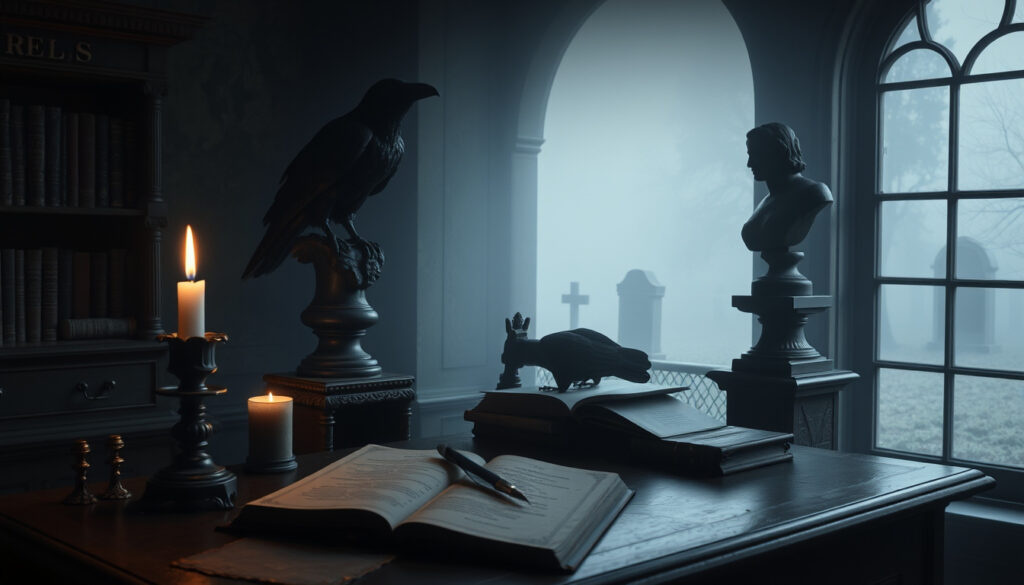
Edgar Allan Poe: Biography, Poems, and Mysterious Death
There’s a reason the name Edgar Allan Poe still sends a shiver down the spine, even 175 years after his death. Born into tragedy and orphaned by age two, Poe transformed a life of relentless loss into stories and poems that defined the horror and mystery genres.
Full name: Edgar Allan Poe ·
Born: January 19, 1809, Boston, Massachusetts ·
Died: October 7, 1849, Baltimore, Maryland ·
Occupation: Writer, poet, editor, literary critic ·
Notable works: The Raven, The Tell-Tale Heart, The Fall of the House of Usher ·
Spouse: Virginia Eliza Clemm Poe (m. 1836–1847)
Quick snapshot
- Poe married his first cousin Virginia Clemm when she was 13 (Encyclopaedia Britannica biography)
- His last words were “Lord help my poor soul” (Encyclopaedia Britannica biography)
- Published “The Raven” in 1845 (New York Public Library literary overview)
- Exact cause of death remains unknown (Encyclopaedia Britannica biography)
- Whether he had alcoholism or other medical conditions (Poetry Foundation poet profile)
- Details of his final days in Baltimore (The Poe Museum biographical timeline)
- 1809–1849: 40-year life packed with tragedy and literary output (Encyclopaedia Britannica biography)
- 1845: “The Raven” brought overnight fame (New York Public Library literary overview)
- 1847: Wife Virginia died of tuberculosis (Encyclopaedia Britannica biography)
- Ongoing scholarly debate over cause of death (Poetry Foundation poet profile)
- Legacy as father of detective fiction continues to grow (Encyclopaedia Britannica biography)
The key facts table below summarizes the essential biographical data for Edgar Allan Poe.
| Label | Value |
|---|---|
| Full Name | Edgar Allan Poe |
| Born | January 19, 1809 |
| Died | October 7, 1849 |
| Spouse | Virginia Eliza Clemm Poe |
| Notable Works | The Raven, The Tell-Tale Heart |
| Genre | Gothic fiction, mystery, horror |
What is Edgar Allan Poe most famous for?
Poe is best known for his poetry and short stories involving mystery and the macabre, a reputation cemented by work he produced in his 30s. His most famous poem, “The Raven,” published in 1845 in The Evening Mirror, became an instant sensation and remains one of the most recognizable poems in English literature (New York Public Library literary overview).
What is Poe’s most famous quote?
- “Quoth the Raven ‘Nevermore.'” — the refrain from “The Raven” that has entered popular culture as a symbol of hopelessness and grief.
- “All that we see or seem is but a dream within a dream.” — from the poem “A Dream Within a Dream” (1849).
- “The boundaries which divide Life from Death are at best shadowy and vague.” — from “The Premature Burial” (1844).
The pattern: Poe’s most-quoted lines all revolve around death, dreams, and despair — the very themes that haunted his personal life.
Poe’s quotes endure not because they are clever wordplay, but because they distilled universal fears — fear of death, of loss, of the unknown — into language that feels personal. For contemporary readers, quoting Poe signals a comfort with darkness that remains culturally potent.
What are Edgar Allan Poe’s most famous poems?
- “The Raven” (1845) — his signature work, about a grieving man visited by a talking raven.
- “Annabel Lee” (1849) — a haunting poem about the death of a beautiful young woman, likely inspired by his wife Virginia.
- “The Bells” (1849) — a rhythmic poem charting the four stages of life through different types of bells.
- “A Dream Within a Dream” (1849) — a meditation on the passage of time and the nature of reality.
The implication: Poe’s poetry output was small — fewer than 70 published poems — but his density of lasting works is extraordinary. “The Raven” alone transformed him from a struggling magazine editor into a literary celebrity almost overnight.
How old was Edgar Allan Poe when he married a 13 year old?
Poe was 27 years old when he married Virginia Eliza Clemm on May 16, 1836 — she was 13 at the time. Virginia was his first cousin, and they remained married until her death from tuberculosis in 1847 (Encyclopaedia Britannica biography).
How many wives did Edgar Poe have?
Poe married only once. Virginia Clemm was his sole wife, though he had romantic relationships with other women after her death, including the poet Sarah Helen Whitman (Poetry Foundation poet profile).
Who was Virginia Clemm?
- Virginia Eliza Clemm was born on August 15, 1822, in Baltimore.
- She was the daughter of Maria Clemm, Poe’s aunt — making Virginia his first cousin.
- Poe lived with Virginia, her mother, and his brother Henry before the marriage.
- She suffered from tuberculosis and died on January 30, 1847, at age 24.
The catch: Modern readers rightly flinch at a 27-year-old man marrying a 13-year-old. In 1830s America, cousin marriages and teenage brides were more common, especially in the South. But Poe’s biographers note that the relationship seems to have been genuinely affectionate — his grief after her death was profound and directly shaped his later writings.
For literary scholarship, the uncomfortable marriage age is a biographical fact that cannot be ignored. For casual readers, it complicates the romantic image of Poe as a tortured artist. The honest reading: Poe was a product of his time, and his great tragedy — losing Virginia — cannot be separated from how he came to marry her in the first place.
What were Edgar Allan Poe’s last 5 words?
According to Dr. John J. Moran, the physician who attended Poe in his final days at Washington College Hospital in Baltimore, Poe’s last words were “Lord help my poor soul” (Encyclopaedia Britannica biography). These words have become a cornerstone of Poe’s legend — a final, desperate plea from a man who spent his career writing about death and the afterlife.
What caused Edgar Allan Poe’s death?
- Alcoholism theory: Poe had a well-documented struggle with alcohol, and some accounts claim he was found delirious in Baltimore, possibly from alcohol poisoning.
- Rabies theory: A 1996 study in the Journal of the History of the Neurosciences argued that Poe’s symptoms (confusion, hallucinations, sensitivity to light) were consistent with rabies.
- Murder theory: Some biographers suggest Poe was the victim of “cooping” — a practice where gangs kidnapped people, forced them to vote multiple times, and then abandoned them.
- Other possibilities: Tuberculosis, heart disease, or suicide have also been proposed.
Where did Poe die?
Poe died on October 7, 1849, at Washington College Hospital (now Church Home Hospital) in Baltimore, Maryland (Encyclopaedia Britannica biography). He had been found four days earlier, on October 3, in a delirious state outside a tavern in Baltimore.
What this means: After 175 years, the cause of death remains an unsolved mystery — fittingly, perhaps, for the father of the detective story. No theory has sufficient evidence to be conclusive.
What was the dark side of Edgar Allan Poe?
Poe’s “dark side” was not a separate persona — it was the direct output of a life marked by relentless grief. By age 40, he had lost his mother, his foster mother, his brother, and his wife to tuberculosis, and he never knew his father (The Poe Museum biographical timeline). He struggled with alcohol abuse and financial instability throughout his adult life.
What dark themes did Poe explore?
- Death and decay: “The Masque of the Red Death” (1842) features a plague that kills a prince mid-party.
- Madness: “The Tell-Tale Heart” (1843) is a first-person descent into psychosis after a murder.
- Premature burial: “The Premature Burial” (1844) and “The Fall of the House of Usher” (1839) both explore being buried alive.
- Guilt and revenge: “The Cask of Amontillado” (1846) details a calculated murder motivated by an unspecified insult.
Why is Poe considered a gothic writer?
Poe is considered a gothic writer because his works employ the classic conventions of Gothic fiction: decaying settings, supernatural elements, psychological terror, and themes of death and madness. He is a principal forerunner of the “art for art’s sake” movement in 19th-century European literature (Poetry Foundation poet profile).
The pattern: Every dark theme Poe explored in fiction had a real-life equivalent. His mother Eliza died of tuberculosis when he was two. His foster mother Frances Allan died in 1829. His wife Virginia died the same way in 1847. Poe didn’t invent horror from imagination alone — he transcribed his own experiences.
What is Edgar Allan Poe’s darkest story?
Taste is subjective, but three stories consistently top “darkest” lists among scholars and readers.
- “The Tell-Tale Heart” (1843): A narrator murders an old man because of his “vulture-eye,” then hallucinates the sound of the dead man’s heartbeat. The psychological unspooling makes it uniquely unsettling.
- “The Fall of the House of Usher” (1839): A man visits his childhood friend Roderick Usher in a decaying mansion, only to witness both the collapse of the Usher family line and the literal collapse of the house itself.
- “The Cask of Amontillado” (1846): Montresor chains his enemy Fortunato inside a catacomb and bricks him in alive. The cold, premeditated nature of the revenge makes it chilling.
What is the creepiest Poe story?
Many critics point to “The Tell-Tale Heart” as the creepiest — the narrator’s insistence on his own sanity while clearly describing a murder driven by madness creates a disorienting reading experience. The story is only about 2,000 words, but its psychological density is unmatched.
What are Poe’s horror stories?
Poe’s major horror short stories include:
- “The Tell-Tale Heart” (1843)
- “The Fall of the House of Usher” (1839)
- “The Masque of the Red Death” (1842)
- “The Cask of Amontillado” (1846)
- “The Pit and the Pendulum” (1842)
- “The Premature Burial” (1844)
- “Ligeia” (1838)
The implication: Poe’s horror works — roughly 25 short stories — established many conventions that modern horror still uses: the unreliable narrator, the haunted house, the buried secret, and the psychological twist ending.
Poe’s darkest stories came from his most productive periods. He wrote “The Tell-Tale Heart” while Virginia was already ill with tuberculosis — the same disease that would claim her four years later. His horror was not escapism; it was processing, in real time, the grief that was already gathering around him.
Edgar Allan Poe: life timeline
- 1809 — Born in Boston, Massachusetts, to traveling actors Eliza and David Poe (The Poe Museum biographical timeline).
- 1811 — Mother dies of tuberculosis; father abandons family. Poe is taken in by John and Frances Allan of Richmond, Virginia (The Poe Museum biographical timeline).
- 1827 — Publishes first book, “Tamerlane and Other Poems,” under the pseudonym “A Bostonian” (The Poe Museum biographical timeline).
- 1827–1829 — Serves in the U.S. Army under the name “Edgar Perry,” rising to sergeant major (The Poe Museum biographical timeline).
- 1830–1831 — Attends West Point but is dismissed after a year (The Poe Museum biographical timeline).
- 1835 — Marries his first cousin Virginia Clemm (she is 13; he is 27) (Encyclopaedia Britannica biography).
- 1839 — Publishes “Tales of the Grotesque and Arabesque,” including “The Fall of the House of Usher” (New York Public Library literary overview).
- 1841 — Publishes “The Murders in the Rue Morgue,” widely considered the first modern detective story (New York Public Library literary overview).
- 1845 — Publishes “The Raven” to immediate international fame (New York Public Library literary overview).
- 1847 — Virginia dies of tuberculosis. Poe’s drinking worsens (Encyclopaedia Britannica biography).
- 1849 — Dies in Baltimore under mysterious circumstances at age 40 (Encyclopaedia Britannica biography).
What we know vs. what remains unclear
Confirmed facts
- Poe married his cousin Virginia when she was 13 (Encyclopaedia Britannica biography).
- His last words were “Lord help my poor soul” (Encyclopaedia Britannica biography).
- He wrote “The Raven” in 1845 (New York Public Library literary overview).
- He published “The Murders in the Rue Morgue” in 1841 (New York Public Library literary overview).
What’s unclear
- Exact cause of death remains unknown (Encyclopaedia Britannica biography).
- Whether alcoholism, rabies, or murder caused his final collapse.
- Details of his final days in Baltimore are fragmentary.
- Whether his engagement to poet Sarah Helen Whitman was serious.
In his own words
“Quoth the Raven ‘Nevermore.'”
— Edgar Allan Poe, “The Raven” (1845)
“Lord help my poor soul.”
— Reported last words of Edgar Allan Poe, according to attending physician Dr. John J. Moran (Encyclopaedia Britannica biography)
Poe’s life was a series of losses, each one deeper than the last — orphaned at two, dismissed from West Point, widowed at 38, dead at 40. That he wrote some of the most enduring works of American literature from that well of grief is not a redemption story. It’s a stark reminder: the same man who gave us “Nevermore” spent his last conscious moments asking God for mercy.
For anyone reading Poe today, the choice is clear: You can read his work as pure entertainment — masterful horror, clever detective puzzles. Or you can read it as what it actually was: a man processing, in real time, the weight of losing everyone he loved. For modern writers, the lesson is uncomfortable but unavoidable: the work that lasts is the work that costs something to make.
poemuseum.org, en.wikipedia.org, poemuseum.org, biography.com, en.wikipedia.org, en.wikipedia.org, nps.gov, eapoe.org, irelandpoint.org
Frequently asked questions
Did Edgar Allan Poe use drugs?
There is no conclusive evidence that Poe used drugs recreationally. The myth likely originated from Victorian critics who conflated his dark subject matter with drug use. His struggles were primarily with alcohol, which he himself acknowledged as a problem (Poetry Foundation poet profile).
What was Poe’s relationship with his foster father?
John Allan raised Poe from age two but never formally adopted him. Their relationship was strained; Allan refused to pay for Poe’s university education and they had a falling out over Poe’s gambling debts. Poe was later disinherited after Allan remarried (The Poe Museum biographical timeline).
What literary movement did Poe belong to?
Poe is associated with American Romanticism and the Gothic tradition. He is considered a principal forerunner of the “art for art’s sake” movement in 19th-century European literature, emphasizing aesthetic beauty over moral or political messaging (Poetry Foundation poet profile).
How did Poe influence modern horror?
Poe established conventions still used in horror: the unreliable narrator, psychological terror over graphic violence, the haunted house, and the twist ending. Stephen King, H.P. Lovecraft, and countless others cite him as a direct influence (Encyclopaedia Britannica biography).
What is “The Raven” about?
“The Raven” follows a grieving scholar who is visited by a talking raven. The bird’s repeated word “Nevermore” drives the narrator deeper into despair. It is a poem about the permanence of loss and the impossibility of recovering a loved one after death.
Did Poe write any novels?
Poe wrote one novel: “The Narrative of Arthur Gordon Pym of Nantucket” (1838). It is a dark adventure novel about a stowaway on a whaling ship that descends into mutiny, cannibalism, and a strange journey to the Antarctic. It is deeply unsettling and considered a precursor to works like Moby-Dick (New York Public Library literary overview).
Why is Poe considered the father of detective fiction?
Poe’s 1841 story “The Murders in the Rue Morgue” introduced the concept of a brilliant, eccentric detective (C. Auguste Dupin) solving a seemingly impossible crime through logical deduction. This established the template for every detective character that followed, from Sherlock Holmes to Hercule Poirot (New York Public Library literary overview).
More related posts
 Lewis Goodall: From BBC to The News Agents, Wife, and Career
 Eugene Levy Ethnicity, Family & Career Facts
 Martin Brundle: F1 Driver to Broadcasting Icon, Net Worth & Career
 Michael Biehn Today: Career, Relationships, and Recent Updates
 Christina Applegate: MS Diagnosis, Life Expectancy & 2026 Update
 Domhnall Gleeson Movies and TV Shows: Filmography Guide
 Are Dogs Allowed Strawberries – Safety, Benefits, Feeding Guide
 Mia McKenna-Bruce: Age, Husband, Movies & TV Shows
