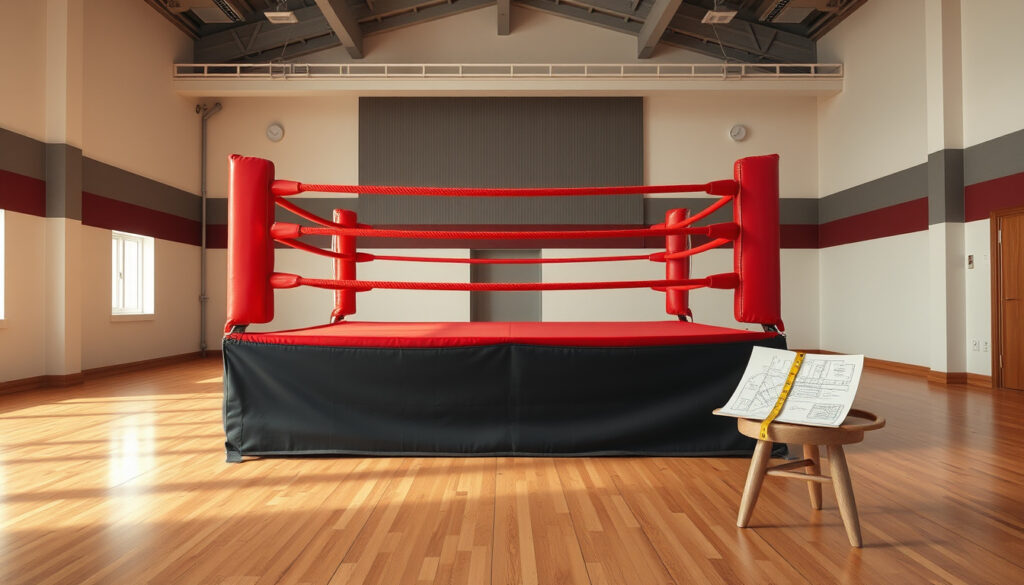
Boxing Ring: Dimensions, Costs, and DIY Construction 2025
Anyone who has searched for a boxing ring after watching a title fight has hit the same small absurdity: the ring is a square, and the rules explain why — the British Boxing Board of Control (UK sanctioning body) allows rings between 16 and 20 feet square, while American states and Ontario set wider limits. That spread decides the price of the steel, the floor space you need, and whether a home build makes sense.
Standard boxing ring size: 6.1 m (about 20 ft) square (Government of Western Australia CITS (sports-dimensions guide)) ·
Number of ropes: 4 (Maryland Code of Regulations (state combat-sports rules)) ·
Platform height: 3–4 ft (0.91–1.22 m) (Michigan Admin Code via Cornell Law School (state boxing regulation))
Quick snapshot
- A boxing ring is square, not round — the sport’s “squared circle” nickname says exactly that (Encyclopaedia Britannica).
- Regulated rings run from 16 to 24 ft per side, depending on the rulebook, as the size row in the table below lists each (British Boxing Board of Control).
- Competition rings use four ropes (Maryland Code of Regulations); Maryland specifies a 1-in minimum diameter.
- The platform always extends beyond the ropes — 18 in to 2 ft, depending on the jurisdiction (British Boxing Board of Control).
- Exact ring prices vary by brand, materials, and customization — treat the market ranges below as a budget, not a quote.
- Used-ring values depend heavily on the condition of the canvas, padding, and ropes.
- Whether a boxing gym turns a profit is set by location and management, not by the ring you buy.
- Before ordering, check the rulebook you’ll fight under: the UK allows 16–20 ft, US states and Ontario 16–24 ft (British Boxing Board of Control).
- Rope heights are measured in inches in Maryland and in centimetres in the AIBA spec (Maryland Code of Regulations).
- Rules vary by country and, inside the US, by state — so the “standard” ring depends on your address (Encyclopaedia Britannica).
- Measure the room, not just the ring: a full-size ring needs the apron and clear floor beyond it (Ask Me Boxing).
- Choose competition or training before pricing steel — the spec you need drives the cost (British Boxing Board of Control).
- For a gym startup, the ring is the cheap part; rent, insurance, and payroll decide the budget. (Ask Me Boxing)
Six rows, one pattern: the spread between rulebooks is wider than the word “regulation” suggests, and every row changes the budget.
| Specification | Value |
|---|---|
| Regulated ring size | 16–24 ft per side across US state rules and Ontario (Government of Ontario (provincial combative-sport rules)); the UK’s 16–20 ft range is cited in the intro |
| Floor margin beyond ropes | At least 18 in under UK rules (British Boxing Board of Control (UK sanctioning body)) and at least 2 ft under Maryland and Ontario rules (Government of Ontario (provincial combative-sport rules)) |
| Ropes | Four ropes, each at least 1 in thick; lower rope 18 in and top rope 54 in above the floor (Maryland Code of Regulations (state combat-sports rules)) |
| Rope heights (AIBA) | 40, 70, 100 and 130 cm from the canvas (Government of Western Australia CITS (sports-dimensions guide)) |
| Platform height | 3–4 ft typical; Michigan caps ring height at 4 ft (Michigan Admin Code via Cornell Law School (state boxing regulation)) |
| Market cost ranges | New competition ring $5,000–$15,000 · used $2,000–$8,000 · DIY $1,000–$3,000 · entry gear $200–$500 · UK gym startup £20,000–£80,000 (Ask Me Boxing (home-ring buyer’s guide)) |
Is it a boxing ring or rink?
A rink is for skaters and hockey players; a ring is for fighters. Boxing’s ring is a raised square platform — and the “squared circle” nickname exists because the contradiction is the point.
What is the origin of the term ‘boxing ring’?
- The word “ring” outlived the circle: fighters once faced off inside a chalk circle on the ground, and the name stayed after bouts moved to a raised square platform.
- That’s why the old nickname “squared circle” still makes sense — the ring is square, not round.
- The rink confusion is modern: “rink” belongs to ice surfaces, while a boxing ring is a platform measured in feet between the ropes.
The pattern: the name is a relic, but the square is the point. Ask “ring or rink?” and the answer decides which sport you are actually talking about.
What is a full-size boxing ring?
“Full-size” sounds like one number, but it is a bracket. A sanctioned competition ring runs from 16 to 24 ft per side, and the international AIBA spec lands at 6.10 m — just over 20 ft — so the “standard” ring depends entirely on the rulebook you fight under.
What are the standard dimensions of a professional boxing ring?
- Encyclopaedia Britannica puts the typical professional ring at 18–22 ft square with four ropes (context row in the spec table below).
- UK rules allow 16–20 ft; Michigan, Maryland, and Ontario allow 16–24 ft (regulated-size row in the table above).
- The AIBA competition spec is 6.10 m square inside the ropes, on a 7.80 m platform (standard-size entry in the stats line and the AIBA row below).
How many ropes does a regulation boxing ring have?
- Four ropes is the standard across the rulebooks cited here; Maryland’s rules set a minimum diameter of 1 in (rope row above).
- Maryland sets the bottom rope at 18 in and the top rope at 54 in above the ring floor (rope row above).
- The international AIBA spec tracks rope heights differently — 40, 70, 100, and 130 cm from the canvas (AIBA rope-height row above).
What this means: “full-size” is a range, not a fixed number. Buy to the rulebook you will compete under, not to a vague idea of standard.
How much does it cost to build a professional boxing ring?
The market cost row above puts a new competition ring at $5,000–$15,000, with solid used rings at $2,000–$8,000. The bill of materials is short: a steel or timber frame, foam padding, canvas cover, four ropes, and eight turnbuckles — and the price moves with the ring’s footprint, padding thickness, and canvas grade.
The gap between a $5,000 and a $15,000 ring is mostly durability and brand, not safety. The safety-critical items — the approved mat, the canvas, the padded turnbuckles — cost relatively little and matter far more.
What factors affect the price of a boxing ring?
- Frame material and gauge: tubular steel costs more than timber and lasts longer under daily use.
- Padding thickness and density — the single biggest safety variable in a sparring ring.
- Canvas quality, rope tension hardware, and corner turnbuckle padding.
- Brand and certification: a ring built to a specific commission’s spec carries a premium.
What is the cost range for a new competition ring?
- New competition ring: $5,000–$15,000 depending on size, frame, and accessories.
- Used ring: $2,000–$8,000, with canvas and padding condition driving most of the discount.
- Delivery, assembly, and a certified safety mat add to the total — often more than buyers budget.
The economics also explain why promoters treat a ring as long-term infrastructure — the same cost math behind Frank Warren: Net Worth, 1989 Shooting, and Eddie Hearn Rivalry is the math of every fight card.
The implication: cost follows the rulebook, and the rulebook follows the address — a single national spec would make the budget simpler, but the sport does not work that way.
Can I make a boxing ring at home?
Yes — a functional home ring can be built for a fraction of the commercial price. The market cost row above sets a realistic DIY budget at $1,000–$3,000 for materials, and the construction is straightforward if you respect the safety basics.
What materials do I need to build a DIY boxing ring?
- Structural timber or steel tube for the frame and corner posts.
- High-density foam for the floor padding, topped with a tear-resistant canvas cover.
- Four ropes and turnbuckles, with padding over every corner fitting.
- Fasteners, corner brackets, and a stable base that distributes weight evenly.
What safety considerations should I keep in mind when building a home boxing ring?
- The floor margin beyond the ropes is the legal part of the build: at least 18 in under UK and Michigan rules, 2 ft under Maryland and Ontario rules (floor-margin row above).
- The platform must sit low and rigid — Michigan caps ring height at 4 ft (platform-height entry in the stats line).
- Padding must cover the full fighting surface plus the apron; a slip near the ropes is the most common injury zone.
Every rulebook cited here demands floor beyond the ropes. A home ring without that apron turns a slip into a head-first meeting with the nearest wall — the 18–24 in margin is not a suggestion.
Why this matters: the difference between a home ring and a hazard is the apron and the padding, not the price of the steel.
The catch: home builders gain flexibility but lose the inspection-ready standard — a ring that passes your eye test might still fail a commission check.
How expensive is it to start boxing?
Cheaper than most people expect at the start, and far more expensive than most people expect once a gym is involved. The two questions — what one boxer needs, and what a gym needs — have very different answers.
What is the initial cost of boxing gear and training?
- Entry gear — gloves, hand wraps, mouthguard, boxing shoes — runs $200–$500 per person (market cost row above).
- Monthly gym membership or club fees are separate and vary widely by city and coach.
- Competition costs (licenses, travel, medicals) only kick in once you actually fight.
How much does it cost to open a boxing gym in the UK?
- Startup estimates land at £20,000–£80,000 once rent, equipment, and insurance are counted — market pricing reported by Ask Me Boxing (home-ring buyer’s guide).
- Location is the biggest variable — a high-street unit costs multiples of an industrial-estate space.
- Insurance and safeguarding compliance are recurring costs, not one-time setup items.
Location and management decide whether a gym turns a profit; the ring is a fixed cost that a packed gym and an empty gym pay identically. The lease is the real opponent.
What are the options for funding a new boxing gym?
- Small business loans and asset finance for the ring and equipment.
- Grants from local sports bodies and community foundations, especially for youth programmes.
- Crowdfunding and paid memberships sold before opening day.
- Partnership with an established club or promoter to share equipment costs.
The family model runs deep in the sport — John Fury: Jailed, Gypsy Heritage, and His Boxing Sons shows how boxing money, loyalty, and gym life mix in one household.
Boxing ring specifications at a glance
Specs vary more than the phrase “regulation ring” suggests: 16 ft to 24 ft per side, rope heights measured in inches in Maryland and centimetres in the AIBA spec. Buyers who order before checking their rulebook pay twice.
Six jurisdictions, one warning: the same word — “regulation” — produces different numbers depending on the address.
| Jurisdiction | Ring size (between ropes) | Platform / apron | Ropes & heights |
|---|---|---|---|
| British Boxing Board of Control (UK sanctioning body) | 16–20 ft square | At least 18-in floor margin; canvas over an approved safety mat | 4 ropes |
| Michigan Admin Code via Cornell Law School (state boxing regulation) | 16–24 ft per side | Ring height capped at 4 ft; floor extends at least 18 in beyond the ropes | — |
| Maryland Code of Regulations (state combat-sports rules) | 16–24 ft square | Platform extends at least 2 ft beyond the ropes | 4 ropes, min 1 in diameter; lower 18 in, top 54 in |
| Government of Ontario (provincial combative-sport rules) | 18–24 ft between the ropes | Platform extends at least 2 ft beyond the ropes | — |
| Government of Western Australia CITS (sports-dimensions guide) | 6.10 m (about 20 ft) square, AIBA spec | Platform 7.80 m square; 85 cm apron beyond the ropes | Ropes at 40, 70, 100, 130 cm |
| Encyclopaedia Britannica (boxing rules reference) | Professional rings generally 18–22 ft square | — | Four rope strands typical; rules differ by country and US state |
How to build a safe DIY boxing ring: 7 steps
- Budget first: $1,000–$3,000 for materials (market cost row above).
- Pick the size from the rulebook you’ll train under — 16 ft is the common floor across the sources above.
- Use the floor-margin row above to leave 18–24 in of deck beyond the ropes.
- Build the base frame from structural timber or steel tube, bolted and braced at every corner, and level the platform before anything else.
- Lay high-density foam across the full fighting surface and the apron, then stretch the canvas cover tight and secure it underneath.
- Fix the four corner posts with reinforced brackets and check the platform height against the 4-ft cap used in Michigan (stats line above).
- Install the four ropes at the heights your rulebook specifies — Maryland’s 18/54 in or the AIBA’s 40/70/100/130 cm are both workable references.
- Add padded turnbuckle covers and secure every rope end with proper tension hardware, not knots that slip.
- Test the whole ring with gloved partners before regular use: bounce off the ropes, check the apron for flex, and confirm the canvas has no ripples.
- Schedule a check by a coach or an experienced referee who knows what a sanctioning body will inspect.
The sequence matters more than any single purchase: frame, padding, canvas, posts, ropes, padding again, then people.
Confirmed facts
- A boxing ring is square, with four ropes — the old “squared circle” nickname is literal about the square part (Encyclopaedia Britannica).
- Regulated ring sizes span 16–24 ft per side depending on the sanctioning body (regulated-size row above).
- Regulators require floor beyond the ropes: 18 in in the UK and Michigan, 2 ft in Maryland and Ontario (floor-margin row above).
- Boxing rules differ by country and, in the US, by state — the context row in the spec table above makes that explicit.
What’s unclear
- Exact ring prices vary by brand, materials, and customization — the market range above is a planning number, not a quote.
- Used-ring pricing depends on canvas, padding, and rope condition more than on the frame.
- Gym profitability is set by location, rent, and management — no rulebook predicts it.
- A home ring’s true cost includes the surrounding room; a 20-ft ring needs roughly 24 by 24 ft of clear space (quote below, Ask Me Boxing).
- DIY build quality varies with timber grade, foam density, and workmanship — a ring can look right and still fail a real sparring session.
Two sources frame the extremes — the rulebook and the room.
“Professional boxing rings are generally 18 to 22 feet square, with four rope strands.”
— Encyclopaedia Britannica (Ring, rules and equipment)
“A 20-foot ring needs roughly 24 by 24 feet of clear space once the apron is included.”
— Ask Me Boxing (home-ring buyer’s guide)
The next time someone says “I’m thinking of getting a ring,” the honest reply is a question: which rulebook? A 16-foot ring passes in the UK, Michigan, and Maryland; an AIBA-spec competition ring needs 6.10 m between the ropes and a platform that stretches 7.80 m square. For a UK club or a home builder, the decision is clear: measure the floor against the regulator’s numbers before you price the steel — or the only thing that gets squared is your budget.
Frequently asked questions
Why is a boxing ring called a ring if it’s square?
The name outlived the shape. Fighters once faced each other inside a circle drawn on the ground, and the word “ring” stuck after bouts moved to a raised square platform — the layout Encyclopaedia Britannica (boxing rules reference) describes. The old nickname “squared circle” captures the contradiction perfectly.
What is a boxing ring made of?
A competition ring is a steel or timber frame with a foam-padded deck, a stretched canvas cover, four ropes, and padded turnbuckles. Under UK rules, the canvas sits over an approved safety mat — that requirement is in the British Boxing Board of Control row of the spec table above.
What is the smallest size boxing ring allowed for amateur matches?
In the rulebooks cited here, the floor is 16 ft per side: the UK allows 16–20 ft, and Michigan, Maryland, and Ontario allow 16–24 ft (regulated-size row in the key facts table above). Exact minimums depend on the sanctioning body running the event, so confirm the commission’s number before you build or buy.
Can a boxing ring be used for kickboxing or MMA?
Maryland’s regulations apply the same 16–24 ft ring specification to boxing and kickboxing, so a boxing ring works for kickboxing under that rulebook. MMA rules are set by different commissions — check the specific promotion’s requirements before assuming a boxing ring passes.
What safety margin is required around the ropes?
The floor must extend beyond the ropes: at least 18 in under UK and Michigan rules, and at least 2 ft under Maryland and Ontario rules (floor-margin row in the key facts table above). That apron is where fighters step out of trouble, so it is not optional.
How high is a professional boxing ring platform?
Typical platforms sit 3–4 ft (0.91–1.22 m) above the floor, and Michigan caps ring height at 4 ft (platform-height entry in the stats line above). The cap exists because a taller ring turns a fall into a serious injury.
How much does a full-size boxing ring cost?
Market pricing varies by brand and specification: roughly $5,000–$15,000 for a new competition ring, $2,000–$8,000 for a used ring, and $1,000–$3,000 for a DIY build (market cost row in the key facts table above). Delivery, assembly, and the approved safety mat add to the total.
More related posts
 Retail Jobs Near Me: Part Time, No Exp in Ireland
 Mr Ts Franchise: Owner, Menu, Locations & Halal Guide
 Patsy Kensit: Biography, Marriages, Financial Loss, and Life Now
 Maxi Dress With Sleeves – Essential Wardrobe Versatile Piece
 Elisabeth Fritzl: 24-Year Captivity Case Facts
 Priti Patel Biography: Politics, Net Worth, Career News
 Kae Tempest: Gender Identity, Voice Surgery, Biography
 Tonya Harding: 1994 Scandal, Punishment, and Life Now
