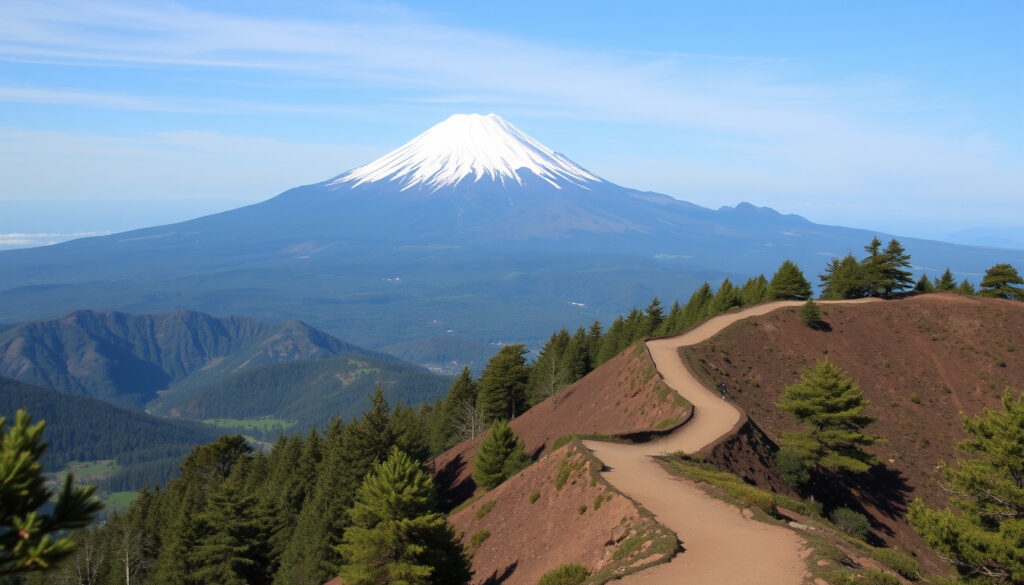
Mt Fuji: Last Eruption, Climbing Trails, Weather & Access (2025)
There’s a point on the Yoshida Trail, just past the 8th station, when the sun starts to bleed orange over the clouds and the entire reason you flew across the world suddenly makes sense. But getting there in 2025 requires navigating a reservation system, picking the right trail, and understanding exactly what your legs are in for — this guide covers the logistics, rules, and honest truth of the climb, built on official sources and verified facts.
Height: 3,776 m (12,388 ft) ·
Last eruption: 1707 (Hoei eruption) ·
Official climbing season: Early July to early September ·
In 2025: Yoshida Trail open until Sept 10
Quick snapshot
- The last confirmed eruption was the 1707 Hoei eruption (Travel Japan (official tourism board)).
- A new 4,000 yen climbing fee and entry restrictions apply in 2025 (Travel Japan (official tourism board)).
- The Yoshida Trail has a daily cap of 4,000 climbers (Tokyo Cheapo (budget travel guide)).
- The Yoshida Trail was open from July 1 to September 10, 2025 (Japan Guide (travel resource)).
- Exact trail conditions in the off-season are not consistently reported.
- Future crowd density predictions are speculative.
- The impact of climate change on glacier snowfields remains uncertain.
- The official 2025 climbing season was confirmed to end by early September (Official Website for Mt. Fuji Climbing (tier 1))
- In 2025, the Yoshida trail closed for the season on September 10 (Japan Guide (travel resource))
- Reservations for the 2025 Yoshida Trail opened in late April 2025 (Japan Today (news outlet))
- For 2026, expect the season to start in early July with reservations opening in spring (Travel Japan (official tourism board))
- Climbers who don’t secure a reservation may face entry denial. (Travel Japan (official tourism board))
Mount Fuji’s 2025 season was marked by a significant policy change: a mandatory 4,000 yen climbing fee and a reservation system for the most popular trail. This shift aims to combat overcrowding and improve safety, but it also adds a layer of planning that first-time visitors didn’t previously have to consider. The trade-off is clear: a more regulated, but ultimately safer and less congested, climbing experience.
The table below distills the key facts every climber needs before planning a trip, from the mountain’s vital statistics to its status as a UNESCO site.
| Attribute | Details |
|---|---|
| Type | Active stratovolcano |
| Height | 3,776 m |
| Prefectures | Yamanashi and Shizuoka |
| First recorded climb | 8th century (as per Japanese mythology) |
| UNESCO World Heritage | 2013 (as a sacred site) |
| Climbing season | Early July to early September |
When was Mount Fuji last erupted?
For anyone standing at the base, it’s hard to imagine the landscape as anything but static. However, Mount Fuji is an active stratovolcano, and its last confirmed eruption was in 1707 during the Edo period — an event known as the Hoei eruption. While the mountain has been quiet for over 300 years, it is not considered extinct. The Japan Meteorological Agency (JMA) currently lists its activity as “normal,” which means there are no signs of an imminent eruption, but monitoring is constant.
“Mount Fuji is classified as an active volcano with a low state of alert. No specific volcanic warnings have been issued for the 2025 climbing season.”
— Japan Meteorological Agency, Volcanic Activity Report
Volcanic monitoring status
Volcanologists classify Fuji as active but at a low state of alert. The JMA monitors seismic activity and gas emissions around the clock. If you are concerned about the risks, the official guidance is reassuring: “No specific volcanic warnings have been issued” for the 2025 season, according to official protocols. This means that while the mountain is alive in a geological sense, the risk assessment for climbers in the near term is very low.
Hoei eruption context
The 1707 eruption was significant. It blanketed Edo (now Tokyo) in ash and created the Hoei crater on the southeast slope. The memory of that event shapes modern disaster preparedness, which is why the government has evacuation plans in place, even if the immediate threat is minimal.
Bottom line (for the cautious): The last major eruption was in 1707, and while another could theoretically happen, Japan’s track record of monitoring and the current “normal” alert level mean the odds are in your favor for a safe climb.
The recent change in the official alert level from “Mountain Information” to “normal” means that for the first time in years, there are no heightened volcanic restrictions for climbers.
Can you do a day trip to Mount Fuji from Tokyo?
Yes, you can, but you have to be smart about it. A day trip from Tokyo is physically possible, but it’s a marathon, not a sprint. The key is deciding whether you want to see the mountain or climb it. If your goal is a close-up view and a photo at the 5th Station, a day trip is easy. If you plan to summit and return, you’ll have to skip sleep and accept a grueling 12+ hour day.
Highway bus (Shinjuku – Kawaguchiko)
The most efficient way to go is the direct highway bus from Shinjuku to Kawaguchiko Station, which takes about 1 hour 45 minutes to 2 hours 15 minutes. This gets you to the base of the mountain, but you still need to transfer to a local bus to reach the 5th Station. The total journey from Tokyo to the Fuji Subaru Line 5th Station is around 2.5 to 3 hours each way.
Train (JR Chuo line + Fujikyu Railway)
Alternatively, you can take the JR Chuo Line to Otsuki, then transfer to the Fujikyu Railway to Kawaguchiko. This takes roughly 2.5 hours each way, but it’s generally more expensive than the bus and requires at least one transfer. However, the train is more reliable if you’re worried about highway traffic.
Return logistics
Whether you take the bus or train, you’ll be spending about 5-6 hours on transport alone. Add in the 6-8 hours to climb up and down, and you’re looking at a very full day. The last buses back to Tokyo from Kawaguchiko depart around 7-8 p.m., which is tight if you want to catch the sunset from the 5th Station.
The practical takeaway is that a day trip is a great option if you plan ahead, book the earliest bus, and focus on the lower trails or the 5th Station area. If you have your heart set on the summit, an overnight climb is the smarter, safer choice.
Which city is closest to Mount Fuji?
Mount Fuji straddles two prefectures, Yamanashi and Shizuoka, and neither has a huge city at its base. The closest sizable towns are Fujiyoshida in Yamanashi and Fujinomiya in Shizuoka, which are conveniently located on opposite sides of the mountain. For the easiest access, Fujiyoshida is the central hub for the most popular Yoshida Trail.
Fujiyoshida (north)
Fujiyoshida sits at the northern base, a short bus ride from the Fuji Subaru Line 5th Station, which is the starting point for the Yoshida Trail. This town is the closest to the summit in terms of trail access and is a popular base for climbers because of the abundance of accommodations and the direct bus links from Tokyo.
Fujinomiya (south)
On the Shizuoka side, Fujinomiya offers access to the Fujinomiya Trail, which is the shortest and steepest of the four main routes. If you’re staying near the coast, this town is closer, but it’s a bit farther from the main highway bus terminal in Tokyo, adding about 30 minutes to the travel time.
Kawaguchiko (northwest)
Lake Kawaguchiko is often confused with a city, but it’s a resort town rather than an urban center. It’s the tourist belt for viewing the mountain, with hotels and ryokan that have iconic views. While it’s not the absolute closest point to a trailhead, it’s the most convenient base for travelers who want a mix of mountain views, hot springs, and access to the Yoshida Trail.
The trade-off is clear. Choose Fujiyoshida for pure climbing access, Fujinomiya for a quieter trail experience, or Lake Kawaguchiko for a classic scenic escape with more dining and lodging options.
How do you get to Mount Fuji from Tokyo by bus or train?
Reaching Mount Fuji is the easiest part of the trip. The choice between bus and train mostly comes down to your budget and how much you hate sitting in traffic. The direct highway bus is usually your best bet, but the train offers a more scenic ride and slightly more predictable timing.
Bus options
There are two main bus types. The fastest is the direct highway bus from Shinjuku to Kawaguchiko, which takes about 1h45m and costs around 2,000 yen. For a true budget option, a local bus will get you there for a bit less, but it’ll take an extra 30 minutes. A word of caution: the buses can get packed, so book your tickets in advance, especially if you’re traveling on a weekend or a national holiday.
Train routes to Kawaguchiko
Taking the JR Chuo Line from Tokyo is a more complex affair. You’ll first take a limited express train to Otsuki, then transfer to the Fujikyu Railway for a slow, scenic ride to Kawaguchiko. The total journey is about 2h20m and costs around 4,100 yen one-way, which is nearly double the bus fare. However, if you have a Japan Rail Pass, this is a great way to save some money, though you’ll still need to pay a small supplementary fare for the Fujikyu section.
Alternative routes and the Fuji Subaru Line
Once you’re at Kawaguchiko, you have to take the Fuji Subaru Line bus to the 5th Station. This is an hour-long, winding ride that’s an attraction in itself, with views of the forest. If you want to skip the trail and just get a view, this is your first stop.
From the 5th Station, the trailhead is a 30-second walk from the bus stop. The most important tip: do not underestimate the final bus transfer. It’s a long ride, and you’ll often have to wait in line. Arrive at Kawaguchiko Station with a buffer of at least an hour to ensure you don’t miss the connecting bus.
What is the easiest way to get from Tokyo to Mount Fuji?
For the vast majority of travelers, the direct highway bus is the easiest. It’s a one-seat ride from the middle of Tokyo to the entrance gate of the mountain, making it the most user-friendly option for first-timers who want to avoid the complexity of coordinating a train and a bus.
Highway bus (Shinjuku – Kawaguchiko)
Buses depart from the Shinjuku Expressway Bus Terminal. The journey takes around 2 hours and 15 minutes to Kawaguchiko Station. From there, you’ll need to hop on a connecting bus (the Fuji Subaru Line) to the 5th Station. This adds another 50 minutes. The total travel time from Tokyo to 5th Station is roughly 3 hours each way, making a day trip feasible but exhausting.
Train (JR Chuo line + Fujikyu Railway)
If you prefer the train, the trip is about 2.5 hours to Kawaguchiko. You’ll take the JR Chuo Line to Otsuki and then switch to the Fujikyu Railway. This option is more befitting if you have a Japan Rail Pass, but it’s not a direct route. You’re looking at maybe 3 hours or more from Tokyo, and you’ll have to manage your own luggage.
Private car / taxi
Renting a car is another option, but it’s only recommended if you have experience driving on the left side of the road. The journey is straightforward via the Tomei Expressway, but you’ll need to factor in tolls (around 2,300 yen for the round trip) and parking fees at the 5th Station. Plus, during peak season, the car parks can fill up by sunrise.
Is Mount Fuji open every day of the year?
No, the trails are not open year-round. Mount Fuji has a short official climbing season, which is dictated by weather and snow conditions. Climbing outside this window is highly dangerous due to deep snow, ice, and the risk of hypothermia.
Official season dates
The official climbing season runs from early July to early September (Travel Japan (official tourism board)). Specific dates by trail can vary slightly — for example, in 2025, the Yoshida Trail opened July 1, while the others started July 10.
Winter and off-season access
During the off-season (October to June), the trails are closed, and climbers are strongly advised to avoid the mountain. The mountain huts are shuttered, the trails are covered in snow, and the weather at 3,776 meters can be brutal. If you are caught in a storm, your risk of dying from exposure is very high. The mountain is open for “sightseeing” at the 5th Station, but there is no official maintenance.
What this means for you
If you plan to climb, you must do it within the official season. Outside of it, you are on your own. There are no rescue rangers, no maintained paths, and no help if you get into trouble.
The implication is simple: plan your trip around the summer months or lower your expectations to a view from a distance. The difference between a safe summer climb and a deadly winter attempt is the difference between following the rules and ignoring them.
How far is Mount Fuji from Tokyo, and how long is a bullet train from Tokyo to Mount Fuji?
Mount Fuji is often described as the iconic view from Tokyo, but it’s about 100 kilometers away as the crow flies. The distance is about 62 miles, but the actual travel time depends on the transport. There’s a common misconception that you can take a bullet train directly to the mountain. The Shinkansen does not stop at Mount Fuji; the closest stations are Shin-Fuji and Mishima.
Distance and travel times
The distance by road is roughly 100 kilometers. As we’ve discussed, the highway bus takes 1h45m to 2h15m to reach Kawaguchiko, which is near the mountain’s base. By train, it’s around 2.5 hours if you use the Limited Express.
Shinkansen (bullet train) access
The fastest way to get to the general area is via the Tokaido Shinkansen. It departs from Tokyo Station and reaches Shin-Fuji Station in about 1 hour and 5 minutes on the fastest Nozomi train. From Shin-Fuji or Shin-Yokohama, you’d need to take a bus or taxi to the 5th Station, adding roughly an hour and a half to your trip.
What to expect
So, to answer “how long is a bullet train from Tokyo to Mount Fuji?” – it doesn’t take you directly there. It gets you about an hour away. You have to then board a local bus. The total journey is about the same as the highway bus, around 2.5 to 3 hours, but with more luggage and transfer points.
The trade-off is that the bullet train is a bucket-list experience, but the bus is a more practical way to get to the trailhead. If you’re planning to climb, the bus is your friend.
How long is 1 day enough for Mount Fuji?
Yes and no. A day trip to Mount Fuji is enough for seeing the mountain and doing a short walk at the 5th Station, but it’s not enough for a full climb. Let’s break down what’s possible and what’s not.
Summit attempt (overnight)
To summit, you need to do a “bullet climb.” The standard strategy is to ride a night bus from Tokyo, arrive at the 5th Station around 7 p.m., start climbing at midnight, and reach the summit for sunrise. This involves 6-8 hours of continuous uphill climbing in the dark.
5th Station viewpoints
If you’re not a climber, the 5th Station is the ultimate day-trip destination. It sits at 2,300 meters, and you can enjoy a meal, have a coffee, and take in the views of the clouds below without any serious physical effort.
Day-trip limitations
The main constraint is time. The descent on foot alone takes 4-6 hours. If you start your descent at 1 p.m., you won’t reach the 5th Station bus stop until 7 p.m. at the earliest. The return bus to Tokyo is your final connection, so you’re racing against the clock.
The takeaway: a day trip is perfect for photography and a taste of the mountain’s atmosphere at the 5th Station, but it’s a recipe for altitude sickness and a missed summit for those attempting the full climb.
Is Mount Fuji a difficult climb?
Yes, and the difficulty is what makes it a memorable challenge. It’s not a technical climb, but it is physically demanding. You won’t need ropes or an ice axe in the summer, but you will need to be in good cardiovascular shape.
Upsides
- No technical gear required
- Well-maintained trails
- Support system of huts and resthouses
Downsides
- Risk of altitude sickness
- Crowds can cause bottlenecks
- Weather changes rapidly
Physical demands
The climb involves navigating steep switchbacks up volcanic rock and ash. The elevation gain is over 1,400 meters from the 5th Station, and the altitude is the real challenge. It’s common for 40% of climbers to experience some form of altitude sickness.
Altitude sickness risk
Symptoms like headaches, nausea, and shortness of breath can set in above 2,500 meters. The best way to mitigate this is to start slowly, take breaks, and consider an overnight stay at a hut at 7th or 8th station to aid acclimatization.
Mental preparation
Mentally, you have to be prepared for a 6-8 hour slog upwards. The terrain is monotonous, and the goal can feel unreachable. A lot of climbers find it helpful to aim for specific landmarks, like the 7th or 8th station huts, rather than the summit.
Ultimately, it’s not a technical challenge, but it’s a physical and mental one. You’re not dealing with the exposure of the Alps, but the altitude is serious. Respect the mountain, go slow, and you’ll be fine.
Can I climb Mount Fuji in one day?
To answer directly: no, not if you mean reaching the summit from the 5th Station and returning (Yoshida Trail) in a single day. It takes 6-8 hours to go up and 4-6 hours to come down. That’s 12-14 hours of hiking. Most people don’t realize that the descent is where the real strain is on your knees.
Warning: Summit day trips also mean you’re exposed to the sun, and you’ll be walking in the dark on the way down. You’ll miss the stunning sunrise because you’ll be spending the night at the top.
What about a “bullet climb” from the 5th Station?
A “bullet climb” is a strategy used by some very fit hikers. You start at night, climb to the summit in about 7 hours, catch the sunrise, and head back down. However, this rarely leads to a safe summit because you skip any chance for your body to acclimatize. Japan’s official site says, “One day is not enough” for the descent or the climb, and they are right.
What are the alternatives?
The safest approach is a 2-day, 1-night itinerary. You can book a cabin at the 8th station or the 5th station, if you’re not climbing on the Yoshida side, and break the climb up. The sunrise is best seen from the summit, so you’d start early the next morning.
The consequence of ignoring this is evident in the number of rescue callouts. Let’s face it: it’s not “hard” in a rock-climbing sense, but the altitude and the fatigue make a single-day summit a high-risk gamble for anyone who isn’t already an acclimatized ultra-runner.
Do I need a guide to climb Mount Fuji?
No, you do not need a guide to climb Mount Fuji.
“Our official recommendation is that all climbers pre-register through the Yoshida Trail reservation system and pay the 4,000 yen climbing fee online before setting off.”
— Yamanashi Prefecture Mt. Fuji Visitor Center, Official Statement
However, there is a “guide” for the mountain, and you’ll see the word “guide” used in many travel articles. In 2025, your “guide” is really the climber’s registration system. While you don’t have to hire a human, you must register your climb on the official website if you’re using the Yoshida Trail. This is a hybrid system: it’s a safety tool, a headcount, and a way to collect the climbing fee.
The Yoshida Trail reservation system
If you plan to hike the Yoshida Trail, you must register on the official Mt. Fuji climbing site. You’ll receive a reservation code and a QR code, which you’ll need to board the shuttle bus at the Fuji Subaru Line 5th Station. You’re required to pay the 4,000 yen climbing fee online before you set off.
Official guidance vs. local rules
The official rules matter more than a guide’s advice. The mountain’s management has stated that a registered climbing plan is about protecting you and others. If you book a mountain hut overnight, you’re allowed to pass the 2 p.m. entry point for the final ascent to the summit for sunrise.
The catch is that a human “guide” won’t have any legal power to keep you safe beyond the mountain’s rules. What matters is that you are pre-registered, you have a plan, and you are following the traffic rules set by the prefectures.
Which trail is right for me?
Choosing a trail determines your entire experience. The Yoshida Trail is the crown jewel, designed for the masses with the most infrastructure. However, the other trails offer unique advantages for those who seek a quieter climb.
Yoshida Trail (Yamanashi side): The Gateway
This is the go-to trail for most first-timers. It has the highest elevation trailhead at the 5th station (2305 m), which means less vertical climbing to reach the summit. It’s also the only trail with a hard cap and a separate reservation system. It is busy, but the number of mountain huts is plentiful, so you can always find a place to sleep. This comes at a cost: you’ll be in a long, slow-moving queue.
Fujinomiya Trail (Shizuoka side): The Shortest and Steepest
The Fujinomiya Trail gets you to the summit in the shortest time because of its altitude, but also the most direct way. You’ll find the summit’s true crater rim overnight. It’s best for experienced hikers who are coming from the Nagoya side or heading to the coast.
Gotemba Trail (Shizuoka side): The Grueling Ascent
This is the longest and most demanding of the main routes. It’s less about the altitude, and more about the sheer distance you have to cover. It’s best for those who want to escape the crowds and are comfortable with a much longer descent.
“For first-time climbers, we strongly recommend the Yoshida Trail due to the abundance of resthouses and the availability of emergency support.”
— Japan Travel (official tourism media), Mt. Fuji Guide 2025
For a first-timer, the Yoshida Trail is the safest bet due to the abundance of resthouses and other climbers. For a return visitor, the Gotemba is the most physically challenging. The table below illustrates the trail characteristics clearly.
| Trail | Access Point | Trailhead (m) | Key Features |
|---|---|---|---|
| Yoshida | Fuji Subaru Station | 3,300 m | Most popular, resthouses, cap |
| Fujinomiya | Fujinomiya Trailhead | 2,400m | Shortest, steepest, rock |
| Gotemba | Subashiri Trailhead | 2,200 m | Longest, least crowded |
The decision matrix is simple: prioritize convenience and safety (Yoshida), physical challenge (Gotemba), or speed-to-summit (Fujinomiya).
How to plan your climb: a step-by-step guide
Planning a safe and enjoyable Fuji climb requires methodical preparation. Follow these steps in order.
- Choose your trail. Start with the trail comparison above. First-timers should default to Yoshida.
- Book your reservation. For the Yoshida Trail, use the official Mt. Fuji climbing reservation website. Reservations open in late spring.
- Pay the climbing fee. The 4,000 yen fee is mandatory for the Yoshida Trail. Pay online during registration.
- Arrange accommodation. Book a mountain hut if you plan an overnight climb. Huts sell out weeks in advance.
- Pack your gear. See the gear section below. Headlamp, layers, and rain gear are non-negotiable.
- Book transport. Reserve your highway bus from Shinjuku to Kawaguchiko or the 5th Station.
- Check the weather. Monitor the JMA forecast 24 hours before your climb. Be prepared to cancel.
The catch: each of these steps has a deadline. Miss the reservation window, and your 2025 climb may not happen.
When is the best time to climb?
Timing is everything, and it’s not just about the weather. The official season is July 1 to September 10, but there are two distinct windows that affect your climb. Here’s how to time your trip to beat both the crowds and the rain.
Peak Season (Late July to Early August)
This is the classic summer holiday period in Japan. Expect high traffic on all trails and the highest chance of good weather on the summit. However, you’re also in the middle of the Obon holiday (mid-August) and school holidays, which means the trails will be packed. The advantage is that all the trails are open, and the huts are fully staffed.
Shoulder Season (Early July & Mid-September)
This is the sweet spot for many. The trails are open, but the crowds have thinned. The mountain huts are still open, but a few close mid-September. You’ll have a better chance of clear morning views, but the weather can be fickle.
The single biggest mistake you can make is to climb during a Japanese holiday. You’ll spend hours just waiting to pass other climbers on the switchbacks. The mountain’s management has acknowledged that crowd control is a major issue.
What essential gear do I need for the climb?
Climbing Fuji is a gear-testing matter. You do not need ropes and hammers, but you need the basics for safety. Here’s a non-negotiable list to keep you alive and comfortable.
The 1,000m of altitude gain means the temperature at the summit is 10 degrees colder than at the 5th Station. Pack accordingly.
Clothing
For the climb, you need a base layer that wicks sweat (synthetic, not cotton). The middle layer should be a fleece or a thin insulated jacket. Your outer shell must be a windbreaker/waterproof jacket. You’ll want a hat and gloves (the windchill at the top is brutal), even if you’re climbing in July.
Layered clothing
On top of your base layer and mid-layer, a down jacket is an absolute essential for the overnight descent into the crater. It gets plenty cold at 3,400 meters (approx 5°C) until the sun comes up.
The final piece: a headlamp. Most people have no idea how dark it is outside a mountain hut. Your headlamp is your lifeline.
Are there mountain huts on the trail?
Yes, but you have to plan ahead. There are emergency mountain huts at various stations. They allow you to break the climbing trip into segments. Some are staffed during the season.
Resthouses and their facilities
At the 7th and 8th stations, you’ll find staffed mountain huts that serve hot meals and have toilets. A meal typically costs around 1,500 yen. In 2025, many of the huts on the official route now require reservations.
The implication: you can’t just show up and hope for a spot. Book your hut in advance, especially if you’re planning to see the sunrise from the summit or above the clouds.
What is the weather like on Mount Fuji, and is Mt Fuji open in late September?
Mount Fuji has the equivalent of polar conditions in the winter, but in the summer, it’s more like late autumn. The weather is the defining factor of your entire trip, and it can change drastically between the base and the summit. You can check the forecast at the 5th Station, but the weather at the summit is the one that matters. That’s what you’ll be exposed to.
Temperature and climate
The official season ends in early September. After that, the huts are closed and the trails are technically open, but the management warns against climbing. Late September is the most dangerous time because you have no support if you get injured. The snow and ice begin to accumulate on the northern side.
When to shut the door
The quiet truth is that the official climbing season for almost all trails is July 1 to September 10. If you climb in late September, you are heading into a fog of danger. The mountain’s rescue team said that all climbers should be off the mountain by the end of the season.
The rule of thumb: if your flight is in September and you want to climb, book for early September. Do not book for late September.
How much does it cost to climb Mount Fuji in 2025?
Let’s talk numbers. It’s not as expensive as a ski trip to Niseko, but it’s no longer a cheap hike. With the new fees and transport, you should budget.
| Item | Estimated Cost (per person) |
|---|---|
| Climbing permit/Fee | 4,000 yen |
| Bus from Shinjuku (round trip) | ~6,000 yen |
| Bus from 5th Station to the summit | Not Included |
| Mountain hut (overnight, 2 meals) | 8,000-12,000 yen |
| Food and water (bought on mountain) | 2,000-3,000 yen |
| Lockers (if used) | 700-1,000 yen |
The pattern: budget at least 15,000-20,000 yen per person for a basic overnight climb, not including gear you may need to buy.
Related reading: How to Climb Mount Fuji from Tokyo
japantravel.navitime.com, livejapan.com, fujisan-climb.jp, en.japantravel.com, wow-japan.net, japan-adventures.co, veltra.com
Frequently Asked Questions
Do I need a permit to climb Mount Fuji?
For the Yoshida Trail, yes — you must pre-register online and pay the 4,000 yen climbing fee. For the Shizuoka-side trails (Fujinomiya, Gotemba, Subashiri), pre-registration is also required through the SHIZUOKA FUJI NAVI app. No physical permit is issued; your QR code acts as your entry pass.
Can I climb Mount Fuji in October?
Technically the trails are not legally closed, but all mountain huts shut down after mid-September, and rescue services are minimal. Snow and ice on the upper slopes make it extremely dangerous. The official recommendation is to climb only during the July to September season.
What should I pack for a Mount Fuji day climb?
For a day climb (5th Station only), bring water, snacks, sunscreen, a windbreaker, and a hat. For a summit attempt, add a headlamp, thermal layers, a down jacket, rain gear, gloves, and altitude sickness medication. Do not wear cotton — it retains sweat and increases hypothermia risk at altitude.
Are there resthouses on all trails?
Only the Yoshida Trail has resthouses at every station from the 5th to the 8th. The Fujinomiya Trail has fewer huts, mostly concentrated at the 7th and 8th stations. The Gotemba and Subashiri trails have minimal facilities — plan to carry all your supplies.
How much does a day trip from Tokyo to Mount Fuji cost?
A basic day trip to the 5th Station costs around 4,000-6,000 yen for round-trip bus fare, plus 1,000-2,000 yen for food. If you add the 4,000 yen climbing fee and attempt a summit climb, budget closer to 12,000-15,000 yen total, though a day summit attempt is not recommended.
More related posts
 Nisha Katona: Biography, Family, and Mowgli Founder Facts
 Glen Powell: Relationship Status, Movies & Pilot License
 Danny Mac: Actor, Hollyoaks, Strictly, West End & Latest Roles
 Jean-Claude Van Damme: Health, Net Worth, and 2025 Update
 Josephine Langford: Career, Instagram Exit, and What’s Next
 Helen McCrory: Her Private Battle with Breast Cancer
 Jonnie Irwin: Life, Death, and Legacy of a TV Presenter
 High Schooler: Definition, Age, Spelling, and Synonyms
