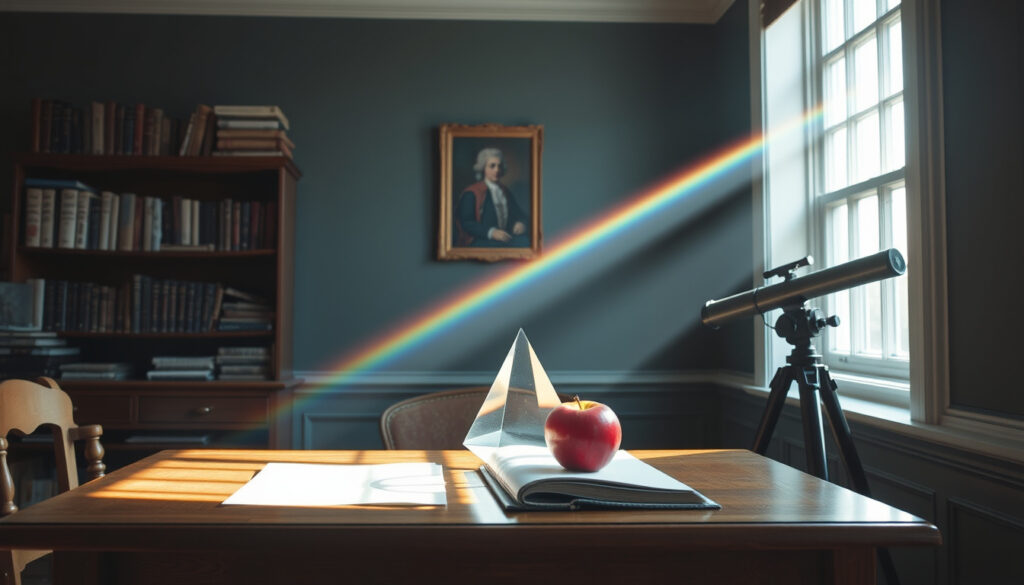
Isaac Newton: Discoveries, Personal Life, and Fascinating Facts
We all think we know Isaac Newton — the apple, the gravity, the genius. But the real man was far stranger: a brooding recluse who decoded the cosmos, dabbled in alchemy, and predicted the end of the world. This article separates fact from folklore, exploring his scientific triumphs, personal struggles, and the questions that still linger about his life.
Birth date: 4 January 1643 (OS 25 December 1642) ·
Death date: 31 March 1727 (OS 20 March 1726) ·
Key contributions: Universal gravitation, laws of motion, calculus ·
Occupation: Mathematician, physicist, astronomer, alchemist, theologian ·
Notable work: Philosophiæ Naturalis Principia Mathematica (1687)
Quick snapshot
1Confirmed facts
- Newton formulated the laws of motion and universal gravitation (Encyclopaedia Britannica)
- He published Principia Mathematica in 1687 (Encyclopaedia Britannica)
- He built the first reflecting telescope in 1668 (Encyclopaedia Britannica summary)
- Newton died on 31 March 1727 and is buried in Westminster Abbey (Encyclopaedia Britannica)
2What’s unclear
- Who invented calculus first? The Newton–Leibniz debate continues (Encyclopaedia Britannica summary)
- Newton’s actual IQ remains speculative (posthumous estimates have no reliable basis) (Stanford Encyclopedia of Philosophy)
3Timeline signal
- 1661 – Enters Trinity College, Cambridge (Cambridge University Library Archive)
- 1687 – Principia Mathematica published (Encyclopaedia Britannica)
4What’s next
More related posts
 Elisabeth Fritzl: 24-Year Captivity Case Facts
 Glen Powell: Relationship Status, Movies & Pilot License
 Mandy Moore Movies and TV Shows – Full Filmography and Career Guide
 Cheyanne King: Age, Occupation, Ethnicity, and Wedding Details
 Billy Joel: Health, Marriages, and Career Challenges
 Ipswich Town vs Brentford – Final Score, Stats and Analysis
 Iliman Ndiaye – Age, Height, Career Stats, and Personal Life
 Fuzz Townshend: Car SOS Presenter and Drummer
