Hatsune Miku: Complete Guide – What It Is, Anime, Age, AI, and More
Walk through any anime convention and you’re bound to see a turquoise-haired digital singer performing to thousands — yet Hatsune Miku isn’t a person in the usual sense. She’s a voice synthesis software, a character, and a global cultural phenomenon that began with a 2007 release. This guide separates fact from fiction, answering the most common questions about her gender, her technology, and why she matters far beyond the screen.
Release Year: 2007 ·
Voice Provider: Saki Fujita ·
Engine: VOCALOID2 ·
Songs Created: Over 100,000 ·
First Live Concert: 2009 ·
Global Tour Started: 2014 (Miku Expo)
Quick snapshot
- Released August 31, 2007 (WIPO (UN Agency))
- Voice provided by Saki Fujita (Wikipedia)
- Developed by Crypton Future Media (Crypton Future Media (official licensor))
- Not artificial intelligence (VOCALOID.com (software platform))
- Gender (software has no gender, character is female-presenting) (Piapro (official character page))
- Whether Miku “supports” any political cause (Crypton, brand steward) (Piapro (official character page))
- Exact number of songs (estimates vary wildly) (WIPO) (Piapro (official character page))
- Height (often cited as 158 cm but not officially confirmed) (Wikipedia)
- 2007 – First release (WIPO) (Wikipedia)
- 2009 – First live concert (Wikipedia)
- 2014 – Miku Expo global tour begins (YouTube Official Channel (concert footage archive))
- Continued engine updates (VOCALOID6 voicebank now available) (VOCALOID.com (product page))
- Expanding global tour and merchandise (Crypton) (VOCALOID.com (product page))
- Growing creator community using Miku for original music (YouTube Official Channel) (VOCALOID.com (product page))
The following table summarizes the core statistics about Hatsune Miku as a product.
| Label | Value |
|---|---|
| Release Date | August 31, 2007 |
| Developer | Crypton Future Media |
| Voice Provider | Saki Fujita |
| Engine Versions | VOCALOID2, VOCALOID3, VOCALOID4 |
| Number of Songs | Over 100,000 |
| First Concert | 2009 (Sega’s Project DIVA) |
| Global Tour | Miku Expo since 2014 |
What Is Hatsune Miku?
Origins and Development
- Hatsune Miku is a virtual singer software voicebank developed by Crypton Future Media, based in Sapporo, Japan (Crypton Future Media (official licensor)).
- Her voice is derived from Japanese voice actress Saki Fujita (Wikipedia).
- The software was first released in August 2007 under the VOCALOID2 engine (WIPO).
Voice and Technology
Miku uses pre-recorded vocal samples from Fujita, stitched together by the VOCALOID engine to produce singing. She does not learn or adapt — she is a synthesis tool, not an AI (VOCALOID.com). The latest version, VOCALOID6 Voicebank HATSUNE MIKU V6, is optimized for the current generation of the software (VOCALOID.com (product page)).
Cultural Impact
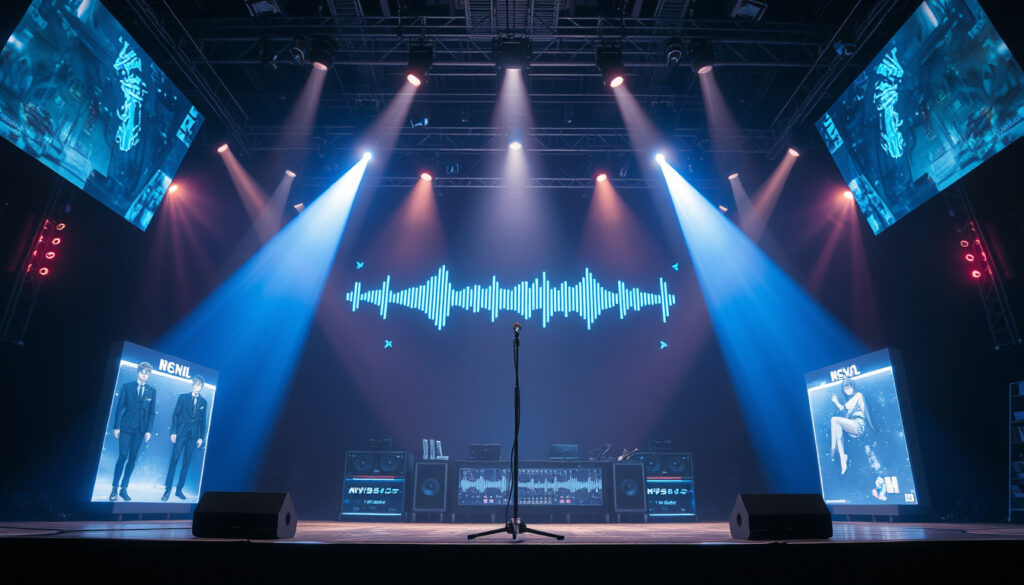
With over 100,000 songs created by users worldwide, Miku has headlined sold-out concerts using holographic projection and has become a symbol of collaborative creativity. The WIPO profile describes her name as meaning “the first sound from the future” (WIPO).
The implication: Hatsune Miku exists at the intersection of software and fandom — a product that becomes more valuable the more people use it to make their own art.
In What Anime Does Hatsune Miku Appear?
Cameo Appearances
- Miku has appeared as a cameo in “The iDOLM@STER” series (Wikipedia).
- She shows up in various music video compilations and crossover games.
Dedicated Anime and OVAs
No full-length anime series features Miku as the main character. She is the star of short OVAs like “Hatsune Miku: Project DIVA” animated cutscenes and the “Miku no Sato” series.
Music Videos as Anime
Thousands of fan-made and official music videos use anime-style animation featuring Miku, many of which are uploaded to her official YouTube channel.
The pattern: Miku’s anime presence is scattered and collaborative — she is a canvas for creators, not a fixed character in a fixed story.
Is Hatsune Miku Non-Binary?
Character Design and Gender Identity
- Crypton Future Media has not assigned a gender to the software (Piapro).
- The character design is female-coded — long turquoise hair, schoolgirl outfit — but the software itself is ungendered.
Official Statements
Crypton’s official English page describes Miku as a “virtual singer software” without pronouns or gender markers (Crypton).
Community Interpretation
Many fans interpret Miku as non-binary because the software lacks an official gender, and the character’s identity is fluid across thousands of user creations.
Crypton’s intentional ambiguity allows Miku to be anything to anyone — but it also means there is no definitive answer, only community-driven interpretations.
The catch: The official line is “no gender assigned,” but the visual design and marketing overwhelmingly present a female character.
Is Hatsune Miku Safe for Children?
Content Appropriateness
- The software itself has no age restrictions and is safe to install and use (VOCALOID.com).
- User-generated songs can contain mature themes — parents should preview content.
Parental Controls
VOCALOID software does not include built-in parental controls; monitoring is left to the parent. Official Miku Expo events are advertised as family-friendly (Crypton).
Community Guidelines
Crypton’s licensing terms prohibit using the character for explicit or harmful content, but enforcement depends on reporting (Piapro).
What this means: The software is a tool — safe in itself, but the output depends entirely on the creator.
Is Hatsune Miku Technically an AI?
How Vocaloid Works
- VOCALOID uses concatenative synthesis: pre-recorded phonemes from a human voice are pieced together (VOCALOID.com).
- It does not use machine learning or neural networks.
Difference Between AI and Voice Synthesis
True AI can generate new sounds from learned patterns. Miku cannot — she only plays back and combines existing samples. Calling her “AI” is a common media mischaracterization (Wikipedia).
Misconceptions
Because Miku can “sing” any lyrics the user types, casual observers often assume she is artificially intelligent. In reality, she is a sophisticated instrument, not a thinking entity.
Miku is no more an AI than a digital piano. The misconception matters because it confuses what the software can and cannot do — and raises unrealistic expectations about what users can produce.
The trade-off: The “AI” label may boost interest, but it misrepresents the technology.
Does Hatsune Miku Support LGBTQ+?
Official Stance from Crypton
- Crypton Future Media has no official position on LGBTQ+ issues (Crypton).
- The brand does not partner with political or advocacy organizations.
Fan Culture and LGBTQ+ Representation
Miku is extremely popular in LGBTQ+ fan communities. Fan art, fan fiction, and cosplay frequently re-imagine her with various gender expressions and relationships (Wikipedia).
Miku as a Symbol
Because she has no fixed identity, Miku becomes a blank slate. For many fans, that neutrality is precisely what makes her a supportive symbol — even if Crypton never intended it.
The pattern: Miku’s power is in her emptiness. She absorbs whatever meaning the community projects onto her, which is why she resonates across so many identities.
Specifications: Hatsune Miku Software Versions
Three major voicebank generations, each with incremental improvements in sound quality and expression control.
| Version | Release Year | Key Features |
|---|---|---|
| VOCALOID1 | N/A | Not compatible |
| VOCALOID2 | 2007 | Original release, samples from Saki Fujita |
| VOCALOID3 | 2013 | Improved sample editing, cross-synthesis |
| VOCALOID4 | 2016 | Multi-language support, Attack/Release control |
| VOCALOID5 | N/A | No Miku voicebank released |
| VOCALOID6 | 2022 | Native VOCALOID6 integration, optimized workflow |
Confirmed facts
- Release date: August 31, 2007 (WIPO)
- Voice provider: Saki Fujita (Wikipedia)
- Developer: Crypton Future Media (Crypton)
- Not artificial intelligence (VOCALOID.com)
What’s unclear
- Gender (software ungendered, character female-coded) (Piapro)
- Political stance (none official) (Crypton)
- Exact number of songs (estimates exceed 100,000) (WIPO)
- Height (often cited as 158 cm but not officially confirmed) (Wikipedia)
The takeaway: The distinction between fact and interpretation is central to understanding Miku’s role in culture.
Voices from the Community
Hatsune Miku is a virtual singer software that we license as a music technology property. – Crypton Future Media (official licensor)
Her voice is derived from Saki Fujita and the software was released in 2007. – Wikipedia
VOCALOID6 Editor Lite is included free when a VOCALOID6 voicebank is purchased. – VOCALOID.com (software platform)
For anyone considering using Hatsune Miku in their music production, the choice is clear: treat her as a powerful creative tool rather than a personality. The software delivers precisely what you program — nothing more, nothing less. For parents, the software is safe, but the content marketplace requires vigilance. And for the millions of fans who see themselves in her, Miku remains a mirror: whatever you need her to be, she can be.
crypton.co.jp, reddit.com, vocaloid.fandom.com, en.wikipedia.org, music.tutsplus.com, vocaloid.fandom.com, underhallningidag.se
For those new to the phenomenon, a detailed guide to Hatsune Miku explains her origins, age, and AI-related questions.
Frequently asked questions
How do I use Hatsune Miku in music production?
You need VOCALOID6 Editor (or a compatible DAW) and the Hatsune Miku voicebank. Install the voicebank, then input lyrics and melody in the editor. Official learning resources are available at VOCALOID.com.
Is Hatsune Miku free to download?
No, the voicebank is a commercial product. Prices vary by version and retailer. VOCALOID6 Editor Lite is free with a voicebank purchase (VOCALOID.com).
What software is needed to use Hatsune Miku?
You need a VOCALOID editor (version 6 recommended) and the corresponding voicebank. The editor acts as the host application for the voicebank (VOCALOID product page).
Can I see Hatsune Miku in real life?
Yes — Crypton produces holographic concert tours (Miku Expo) that travel globally. Check official tour dates on Crypton’s site.
What languages does Hatsune Miku sing in?
Primarily Japanese, but VOCALOID4 and later versions include English voicebanks (e.g., “Hatsune Miku V4 English”). VOCALOID6 supports multiple languages via cross-synthesis.
Has Hatsune Miku influenced real musicians?
Yes. Artists like Anamanaguchi, and producers in the J-pop scene have used Miku in their work. The software has also inspired mainstream pop productions globally.
Are there any Hatsune Miku official apps?
Yes, including mobile rhythm games like “Hatsune Miku: Project DIVA” and the “Miku Flick” series. Official apps are available on iOS and Android.
- Krusty the Clown: Real Name, Catchphrase, and Jewish Roots – Another fictional performer with a curated public identity.
- Artist Banksy: Identity, Net Worth, and Most Famous Artworks – How anonymous creators build iconic brands.
More related posts
 Francisco Goya’s Saturn Devouring His Son: Meaning & History
 Dirk Bogarde: The Actor’s Life, Career, and Lasting Legacy
 Photo Frame Guide: Sizes, Materials & Where to Buy in Ireland
 Derrick Lewis: career update, retirement talk, and wife comments
 Geraldine Chaplin: Biography, Age, Children, Eye Dots
 How Old is Les Dennis? Age, Wife, Kids & Bio 2025
 Stand Up Paddle Board – Best Picks for UK Waters 2025
 Katherine LaNasa: Biography, Cancer Battle, Career & Family
